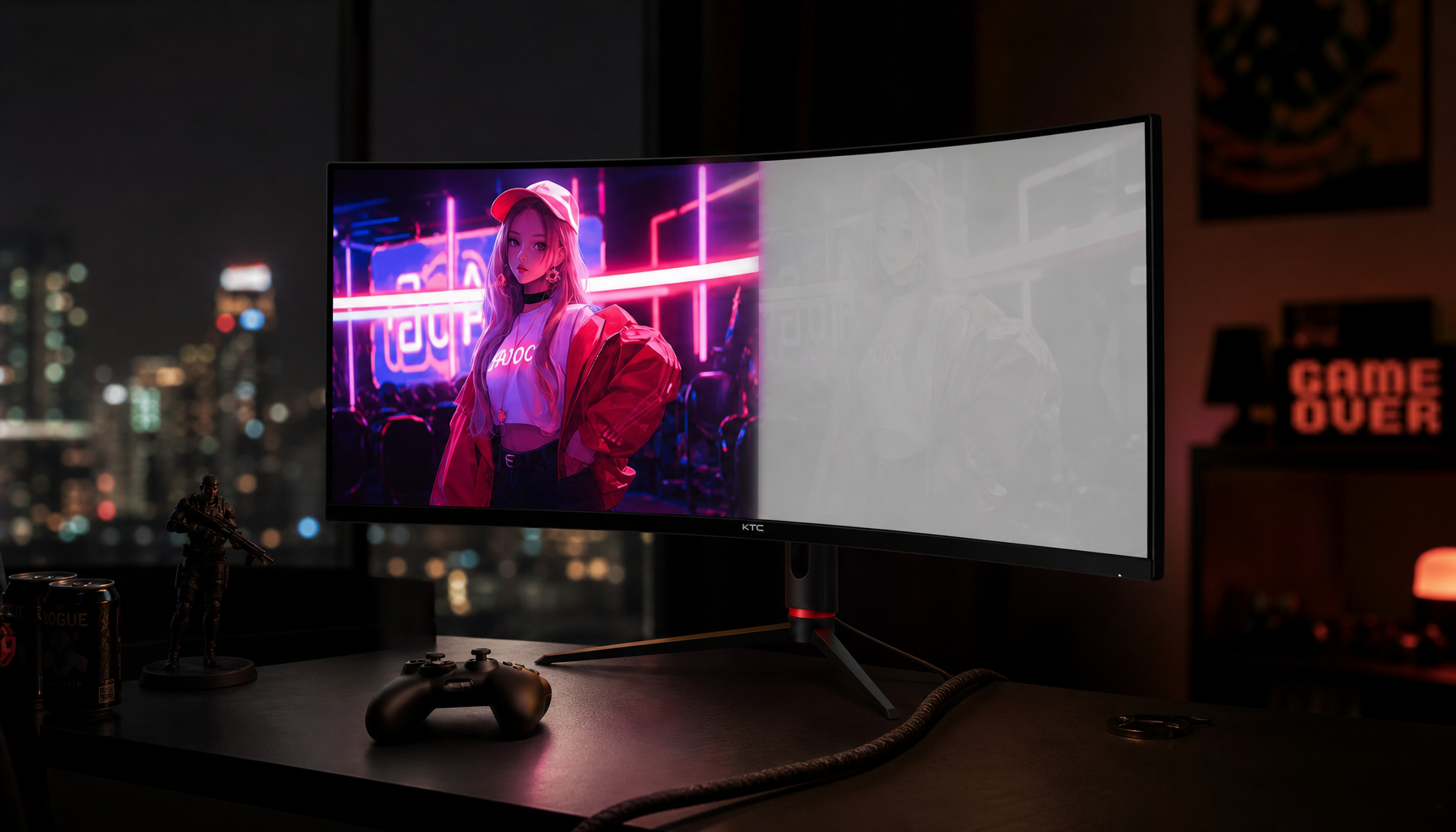
RGB OLED and WOLED differ most at the subpixel level: RGB OLED uses three color subpixels, while WOLED adds a white subpixel. For monitor buyers, that mainly changes desktop text clarity, HDR color behavior, and how the screen looks in bright rooms.
If you have ever looked at an OLED monitor and wondered why games looked incredible but tiny a platform text still felt a little off, this is usually the reason. On today’s gaming monitors, the practical gap shows up most clearly on 27-inch 1440p panels, ultrawides used for mixed work, and any setup where you read code, chat, or spreadsheets for hours before switching to high-refresh gaming. The goal here is simple: help you tell when the subpixel layout actually matters and when it does not.
Why Monitor Buyers Should Care About Subpixel Layout
A non-standard subpixel layout changes how a platform renders text because a product was built around the usual vertical RGB or BGR stripe found on most IPS, VA, and TN monitors. When an OLED panel uses a white subpixel or a triangular arrangement instead, edge smoothing can produce color fringing instead of the clean letter edges many desktop users expect.
That matters more on monitors than on TVs because monitor use is harsher on text rendering. A 27-inch or 32-inch display used at arm’s length shows menus, browser tabs, IDEs, and small fonts all day, and a text-clarity test set shows WOLED layouts still behave differently from standard RGB even when a product helps. In practice, the issue is easiest to notice on small text, thin UI lines, and white backgrounds.

For gaming-first buyers, the tradeoff is less dramatic. A discussion of OLED monitor fringing noted that the artifact tends to stand out most on very small 9 to 10 pixel text, especially when viewed closely, while motion, contrast, and HDR impact dominate during actual gameplay. That is why some buyers happily use OLED for gaming but still prefer LCD for office-heavy work.
What “RGB OLED” and “WOLED” Actually Mean
A WOLED monitor layout uses four subpixels, typically RGWB on newer panels, with the white subpixel helping produce white and boost brightness efficiency. That white element is the main reason WOLED text behavior differs from standard RGB desktop monitors.
An RGB-style OLED layout uses three color subpixels without a white subpixel. In current monitor shopping, that usually means QD-OLED with a triangular RGB arrangement, while newer monitor-roadmap designs are moving toward a vertical RGB stripe that should behave more like conventional desktop displays.
Marketing names can make this confusing. A forum comparison of a product and WOLED behavior points out that “a brand” does not automatically mean a true RGB subpixel layout; many current panels still use the usual WOLED white-subpixel structure. For buyers, the safe rule is this: if the panel still has a white subpixel, expect WOLED-like text behavior even if the branding sounds more RGB-friendly.
Text Clarity: The Biggest Real-World Difference
A monitor text-clarity roundup shows the clearest pattern: most standard RGB monitors render text more naturally, older WOLED RWBG layouts fringe the most, and newer RGWB WOLED layouts improve things but do not fully erase the issue. Higher pixel density helps, but layout still matters.
That is why desktop use varies so much by model. On a 27-inch 1440p OLED used for work by day and gaming at night, small fonts, code editors, and spreadsheet grids are where the difference usually shows up first. A QD-OLED fringing discussion notes that newer panel generations and higher pixel density reduce visibility, and 4K OLED options are generally more forgiving than 1440p models.

A product also has limits here. A a product issue on OLED text rendering argues that a platform cannot fully correct WRGB stripe or triangular RGB layouts because its tuning model assumes a conventional stripe. For mixed-use monitor buyers, that means software tweaks can reduce annoyance, but they usually cannot turn a non-standard OLED layout into a truly LCD-like text experience.
Which Users Notice It Most
Buyers who notice fringing first are usually the ones doing text-heavy work on gaming monitors: coders, writers, analysts, and anyone using compact UI scaling. The effect is much less important if your monitor is mainly for controller gaming, video, or full-screen content.
A recent OLED monitor buying list also highlights that newer high-refresh WOLED generations have improved subpixel structures. That matters because the category is getting better, but it still does not change the broader rule that true RGB-style layouts are the cleaner fit for desktop text.
Brightness, Color Volume, and HDR: Where WOLED and RGB OLED Split
A WOLED versus QD-OLED comparison shows why these panels look different in HDR. QD-OLED’s three-color structure generally delivers stronger color volume and wider gamut, while WOLED relies on its white subpixel to help with white output and brightness behavior.
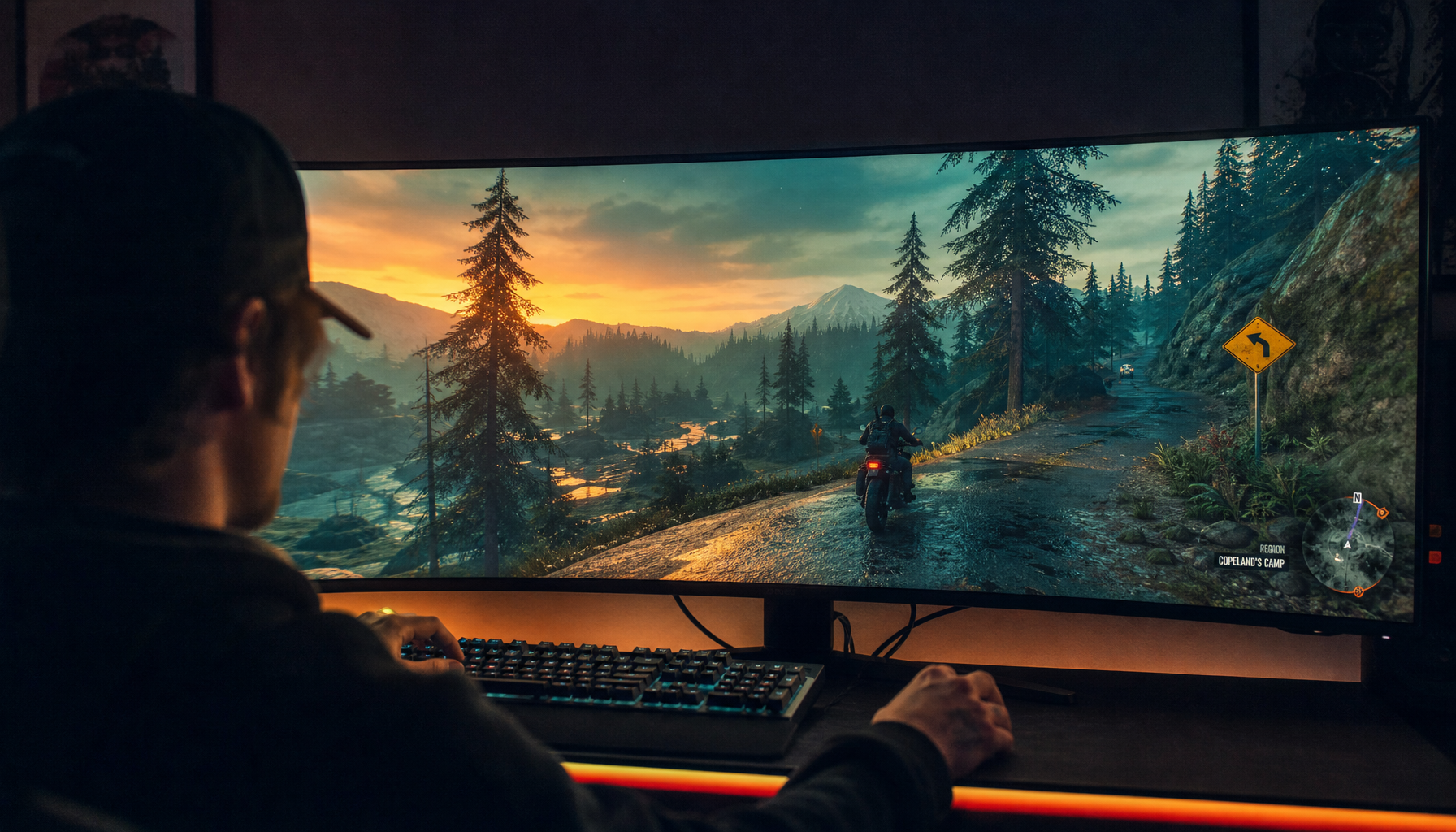
That difference becomes visible in games with bright saturated effects. Neon signs, spell effects, HUD accents, and sunlit highlights usually look richer on RGB-style OLED panels because bright colors stay more saturated instead of leaning more heavily on a white subpixel. A 2026 OLED gaming monitor roundup similarly describes QD-OLED as stronger for color gamut, while WOLED is stronger at producing pure white.
WOLED still has real strengths. A current best-OLED monitor list notes that WOLED tends to preserve black levels better in bright rooms, while QD-OLED can show raised blacks or a purple tint because it lacks a polarizer. If your gaming monitor sits near a window or bright lamp, that can matter more than the color-volume advantage.

Practical HDR Buying Guidance
If you care most about bright, punchy color in HDR games, RGB-style OLED is usually the more convincing choice. If you care more about bright-room use, cleaner blacks under ambient light, or you simply prefer the look of WOLED’s white-heavy output, WOLED remains competitive.
A a product brightness comparison adds one more twist: newer tandem designs can push HDR brightness far higher than older WOLED generations, but many current tandem monitor panels still use the same RGWB subpixel layout. In other words, better brightness does not automatically mean better text clarity.
Does Subpixel Layout Affect Gaming Performance?
A broad OLED monitor overview makes the key point: OLED’s real gaming advantage comes from self-emissive pixels, near-instant response, high contrast, and high refresh capability, not from the subpixel layout alone. Layout affects sharpness and fringing more than motion clarity.
That is why both WOLED and RGB-style OLED can be excellent for esports and fast single-player titles. A a platform monitor list includes OLED gaming displays at 240 Hz, 480 Hz, 500 Hz, and dual-mode options that switch between 4K 240 Hz and 1080p 480 Hz. Once a game is in motion, the response-time and contrast benefits usually overwhelm the text-rendering disadvantage.
The layout matters indirectly when a gaming monitor also serves as your desktop monitor. A monitor buying guide focused on gaming use frames this well: text issues matter less during gaming, where motion and contrast dominate, but they matter much more when the same panel is used for documents, browsing, or coding.
Best Fit by Use Case
Different ultrawide OLED workloads put different pressure on the panel. Gaming and media use reward OLED contrast and response time first, while productivity and multitasking expose text and UI weaknesses much faster.
For a pure gaming monitor, either layout can work well. For a mixed-use 27-inch or 34-inch ultrawide that spends eight hours on chat, browser tabs, dashboards, and code before jumping into high-refresh games, RGB-style OLED is usually the safer buy. For a 32-inch 4K monitor, the higher pixel density narrows the gap enough that other factors, like room lighting and HDR preference, often matter more.
Portable monitors are a special case. Smaller screens and shorter viewing distances can make text issues more obvious, but higher pixel density can also hide them. The practical advice is simple: if the portable OLED will be used mostly for documents and UI, prioritize true RGB-style layouts or very high PPI; if it is mainly a travel gaming or media screen, WOLED tradeoffs are easier to accept.
Quick Comparison Table
Factor |
RGB OLED |
WOLED |
Subpixel structure |
3 subpixels, no white subpixel |
4 subpixels with white subpixel |
Typical monitor example |
QD-OLED today, RGB-stripe OLED in newer designs |
a company WOLED families |
Text clarity on desktop |
Usually better, especially at lower PPI |
Improved on newer RGWB panels, but still more prone to fringing |
Color volume in HDR |
Usually stronger for bright saturated colors |
Usually weaker in bright saturated colors |
White output behavior |
No dedicated white subpixel |
Dedicated white subpixel helps white output |
Bright-room blacks |
Can look raised or slightly purple on some models |
Usually holds black levels better in bright rooms |
Gaming motion clarity |
Excellent |
Excellent |
Best fit |
Mixed-use desktop, text-sensitive buyers, HDR color enthusiasts |
Gaming-first buyers, bright-room users, buyers who value WOLED’s room-light behavior |
FAQ
Q: Is RGB OLED always better than WOLED for monitors?
A: No. A current OLED monitor comparison shows RGB-style OLED usually wins on text behavior and color volume, while WOLED often handles bright-room blacks better. The better choice depends on whether your monitor is mostly for desktop work or mostly for gaming and media.
Q: Can a product fix WOLED text fringing?
A: Not fully. A a platform subpixel-rendering discussion explains that a product assumes standard RGB or BGR stripes, so non-standard OLED layouts still show artifacts that tuning cannot completely remove.
Q: Does higher resolution make the difference less visible?
A: Yes, often. A text-fringing discussion for OLED monitors notes that higher pixel density reduces visibility, which is why 4K OLED monitors generally bother fewer people than 1440p OLEDs when used for desktop text.
Final Takeaway
The real difference is not that one panel is “for gaming” and the other is “for work.” It is that RGB OLED behaves more like a normal monitor for text and UI, while WOLED makes a bigger compromise there because of the white subpixel.
If you are buying a high-refresh gaming monitor that also has to handle web work, office apps, a platform, or code every day, RGB-style OLED is the safer long-term choice. If your priority is immersive gaming, strong bright-room performance, and OLED contrast more than pixel-perfect text, WOLED is still a very valid monitor buy, especially on newer panels and higher-resolution screens.
References
- Improved subpixel text rendering for OLED issue
- OLED text fringing discussion on a platform
- Best OLED gaming monitors
- How to choose an ultrawide OLED gaming monitor
- Monitor panel types explained
- OLED monitor experience and text fringing
- Pixel structure comparison thread
- a platform text clarity tests
- a platform forum text-fringing discussion
- a platform forum WOLED vs QD-OLED discussion
- a platform tandem OLED vs WOLED