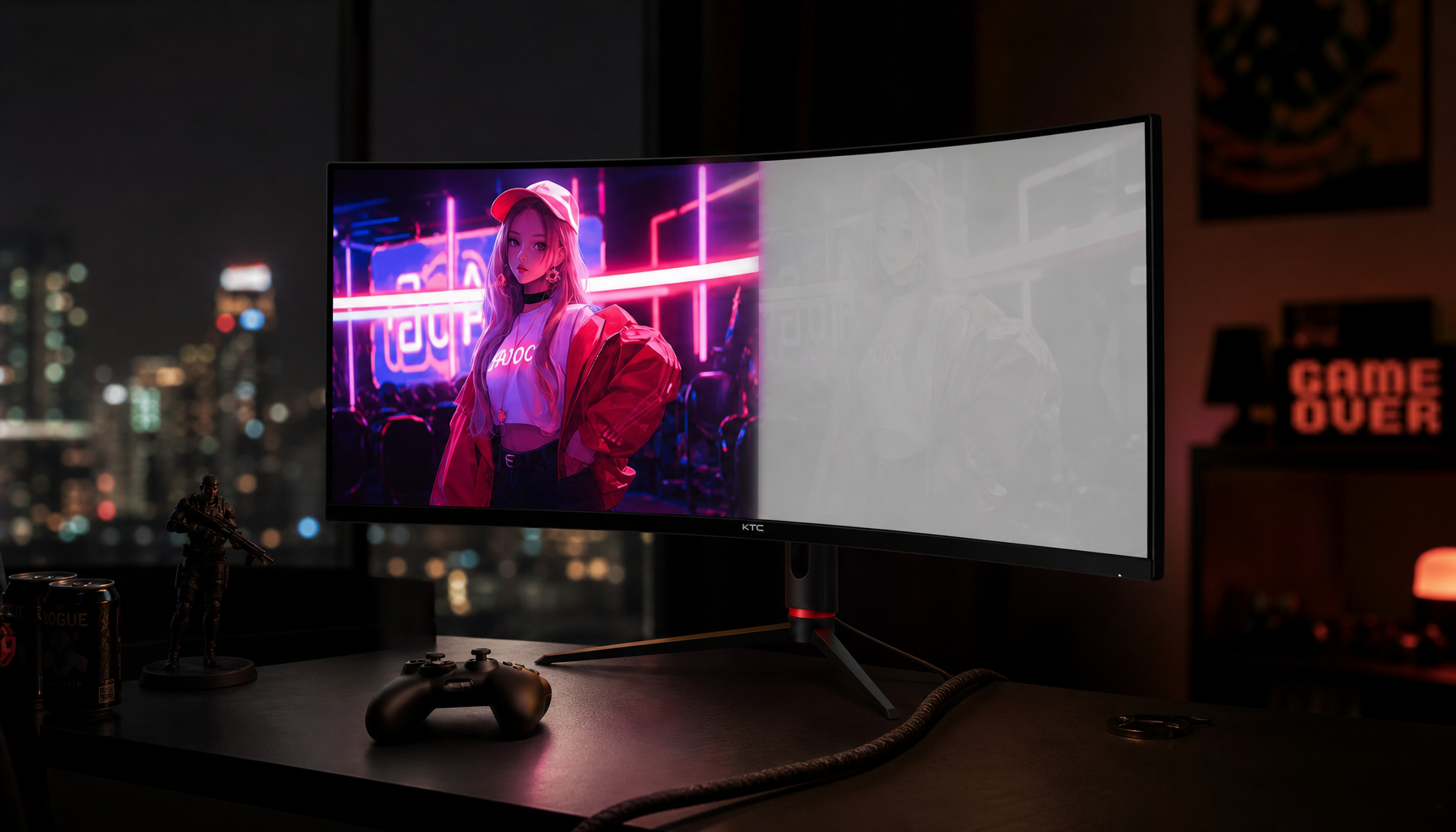
Smart blue-light reduction works best when a monitor changes output selectively instead of putting an amber veil over the entire screen.
If your gaming monitor feels easier on your eyes at night but white menus suddenly look beige, you are seeing the usual trade-off of old low-blue-light modes. Better eye-care displays already combine comfort features with near-full sRGB coverage and refresh rates of 120 Hz or higher, which proves eye comfort and image quality do not have to fight each other. The useful part is knowing which monitor features actually preserve color and which ones simply warm the picture.

Why Traditional Blue Light Modes Usually Shift Color
Whole-screen warming is a blunt tool
A blue light filter usually works by warming the image or adding a yellow-orange cast, which lowers blue output but also changes how whites, grays, skin tones, and shadow detail look. On a gaming monitor, that can flatten the contrast between UI elements and the background; on a portable monitor, it can make spreadsheets and web pages feel dull instead of neutral.
A low blue light mode on the monitor itself often reduces the blue channel relative to red and green, which tends to preserve contrast better than a software overlay from the operating system. The problem is that it still pushes the display away from a neutral image target, so a mode that feels comfortable for late-night browsing may look wrong for photo edits, game art, or any task where accurate white balance matters.
Blue light is a comfort and sleep issue, not a reason to abandon calibration
A monitor calibration workflow still revolves around a stable white point, often D65, with gamma around 2.2 for normal screen work. If a reading mode pulls the screen far warmer than that, the display may become easier to view in a dark room, but it is no longer showing a trustworthy reference for content creation or even for judging whether a game’s art direction looks as intended.
A practical eye-care view of blue light treats it more as a sleep-timing and comfort issue than a dangerous radiation hazard from modern monitors. That matters for buyers because the goal is not to remove blue from the picture at all costs; it is to reduce excess short-wavelength output when it actually helps, especially in the evening, while keeping daytime color believable.
What Machine Learning Can Do Better
Adaptive control beats one fixed filter
Adaptive eye-protection software already shows the basic pattern that machine learning can improve: it can match brightness to ambient light, change output gradually across the day, and switch presets for reading, programming, or movie watching. That is a better fit for real monitor use because a 240 Hz gaming display at 2:00 PM in a bright room should not be treated the same way as a portable monitor in a dim hotel room at 11:00 PM.

The sources here do not describe one specific monitor-side model by name, so the machine-learning part should be understood as an inference from these adaptive controls rather than a universal feature in every display. In practice, that means the value of ML is not “magic color correction”; it is better decision-making about when to lower brightness, when to warm the image slightly, and when to leave a calibrated mode alone.
Hardware still does the heavy lifting
Low-blue-light displays that maintain color performance work best when the panel or backlight is already designed to reduce higher-energy blue output without relying only on a temporary yellow-tinted viewing mode. That matters more than marketing language because if the hardware starts closer to the target, the monitor does not need such an aggressive white-point shift to feel comfortable.
Machine learning helps most when it sits on top of that hardware base. On a good ultrawide or high-refresh display, it can decide how much correction is needed for the room, the time of day, and the task on screen, instead of forcing one permanent eye-care look onto everything from spreadsheets to HDR-style game scenes.
How to Judge Color Accuracy on an Eye-Care Monitor
Start with image targets, not branding
Eye-friendly monitor guidance puts blue-light filtering alongside accurate color reproduction, IPS viewing angles, high resolution, and customizable settings rather than treating comfort as a separate feature. For most buyers, that means checking for near-full sRGB coverage, a usable sRGB or custom picture mode, and enough on-screen controls to change brightness and color temperature independently.

A neutral display setup should still be able to return to D65 and gamma 2.2 when you need dependable color. If an eye-care mode locks out normal color controls or leaves no easy way back to a neutral preset, the monitor is better suited to casual night use than to mixed gaming, office, and creative work.
Compare the method, not just the promise
Option |
How it reduces blue light |
Typical color impact |
Best use |
What to look for |
OS night mode or software overlay |
Warms the whole image in software |
Highest visible yellow shift |
Late-night reading or basic browsing |
Useful scheduling, but weak for color fidelity |
Monitor reading or eye-saver preset |
Reduces blue in the monitor OSD |
Moderate shift, often better than GPU overlay |
General evening use |
Separate brightness and color controls |
Hardware low-blue-light design |
Reduces higher-energy blue at the panel or backlight level |
Lower visible shift when well implemented |
Mixed use, gaming, long sessions |
Color-performance claims and recognizable certification |
Adjusts intensity by room light, time, and task |
Depends on implementation |
Day-to-night workflows |
Only valuable if neutral color modes are still strong |
Monitor-side low blue light adjustments generally preserve contrast and shade variety better than GPU-level color changes, while hardware-certified low blue light is the clearest sign that a display is trying to cut blue output without simply turning the whole screen amber. For buyers, that is the real dividing line between a feature that helps comfort and a feature that just hides blue by distorting the picture.
What to Buy for Gaming, Ultrawide, and Portable Use
Gaming and high-refresh monitors
Fast-refresh eye-care displays increasingly pair low-blue-light features with 120 Hz or higher refresh rates, which is useful because comfort is not only about spectral output. Long sessions feel better when motion is clearer, text is stable, and the panel gives you both a neutral daytime preset and a softer night preset instead of one permanently warm mode.
A discussion of refresh rate and eye strain shows why buyers should not expect 144 Hz, 170 Hz, or 240 Hz alone to fix fatigue. People also react to flicker behavior, sample-and-hold blur, and panel-specific quirks such as polarity inversion, so the better buying order is: hardware low blue light or credible eye-care certification first, a good sRGB mode second, then refresh rate and response-time features.
Ultrawide and portable monitors
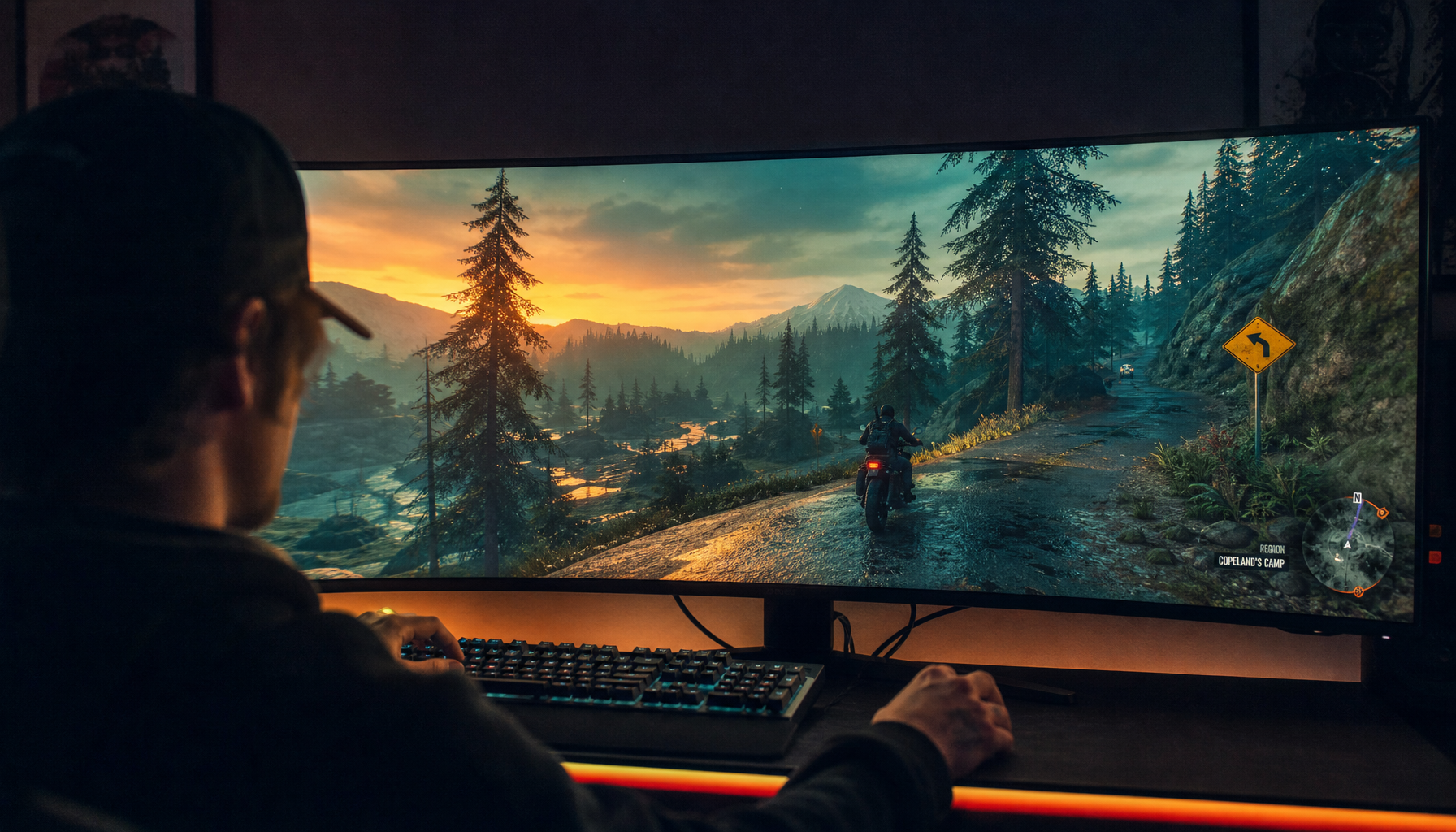
A curved display can reduce distortion and widen the field of view, which can make long ultrawide sessions feel more comfortable. For a 34-inch productivity-and-gaming setup, the best feature is often a fast toggle between a calibrated work mode and a mild evening eye-care mode, not an aggressively warm preset that stays on all day.

A sensible color temperature range depends on the room, with cooler settings fitting bright daylight and warmer settings fitting dim spaces, while many office-style setups land between 5000K and 6500K. That is especially relevant for portable monitors because they are often used in uneven lighting, so a low minimum brightness, easy OSD access, and an IPS panel with strong sRGB coverage matter more than a dramatic “reading” tint.
FAQ
Q: Can a gaming monitor reduce blue light without making whites look yellow?
A: Yes, but usually not with the oldest style of night mode. Hardware-focused low-blue-light displays are built to reduce higher-energy blue output while maintaining color performance, so they need less visible warming than a basic software filter.
Q: Should I leave low blue light on all day?
A: Usually no for mixed-use or color-sensitive work. A blue light filter is most useful in the evening or in dim rooms, while daytime use often benefits more from correct brightness, a neutral preset, and regular breaks.
Q: Is high refresh rate enough to reduce eye strain?
A: No. Eye-friendly display advice also points to brightness, color temperature, flicker control, picture quality, and ergonomics, so refresh rate should be treated as one part of comfort rather than the whole answer.
Practical Next Steps
A blue light filter is only one part of monitor comfort, so even a strong gaming or portable display still needs sane brightness, a reasonable viewing distance, and breaks such as the 20-20-20 rule. If you edit, work, and game on the same monitor, keep one neutral preset for daytime accuracy and one milder eye-care preset for evening use.
- Check for near-full sRGB coverage and a usable sRGB or custom color mode.
- Prefer hardware low-blue-light design or credible certification over a heavy yellow overlay.
- For long sessions, treat 120 Hz or higher as a comfort bonus, not a substitute for good panel behavior.
- Make sure the monitor lets you adjust brightness and color temperature separately.
- If color matters, verify that you can return to a D65-like white point and gamma around 2.2.
For most buyers, the best answer is not “more filtering.” It is a monitor that starts with accurate color, gives you real control over brightness and white balance, and uses adaptive logic to make smaller corrections instead of large visible ones. That is how machine learning can help reduce blue light without sacrificing the color accuracy that makes a good monitor worth owning.