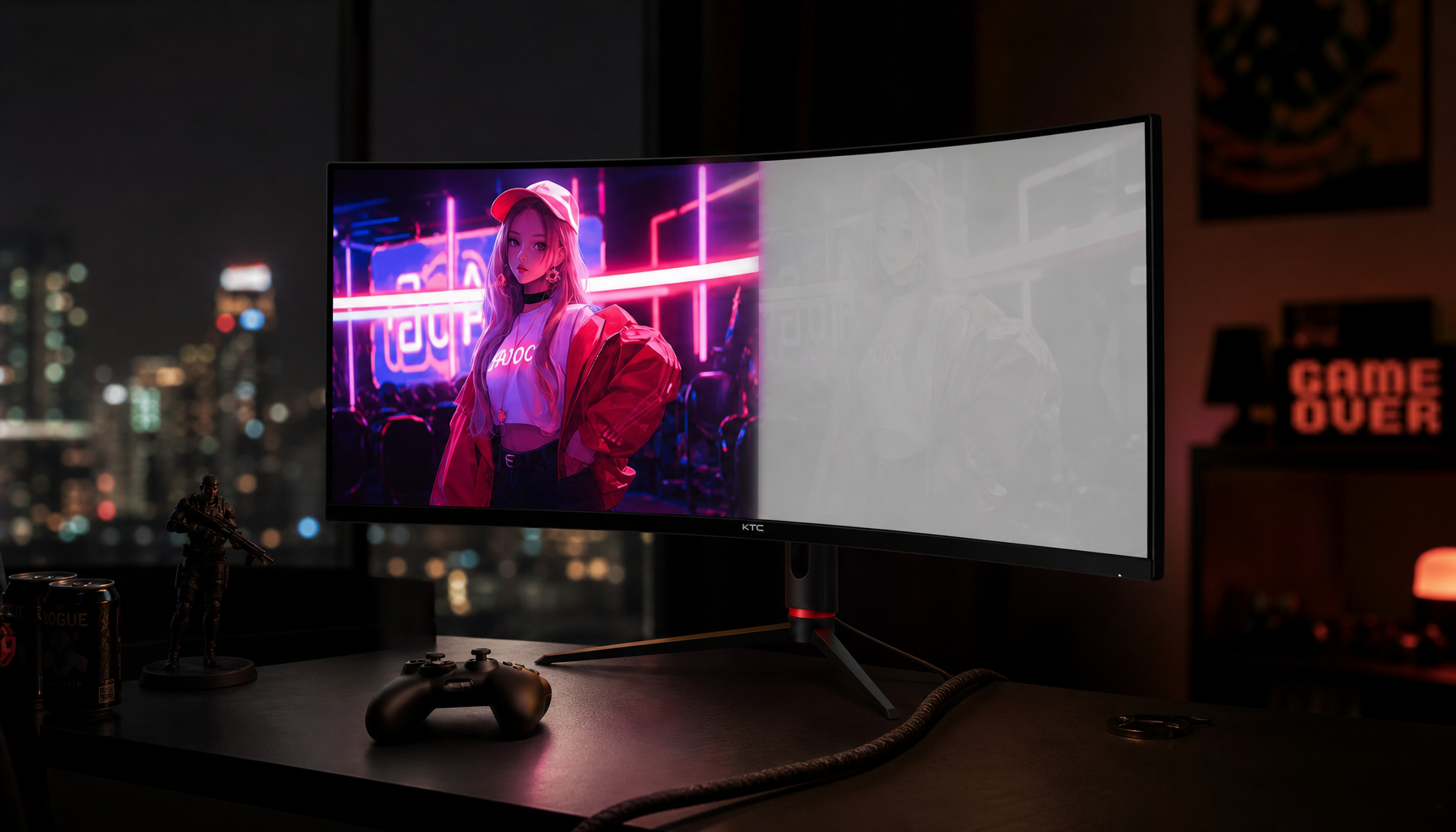
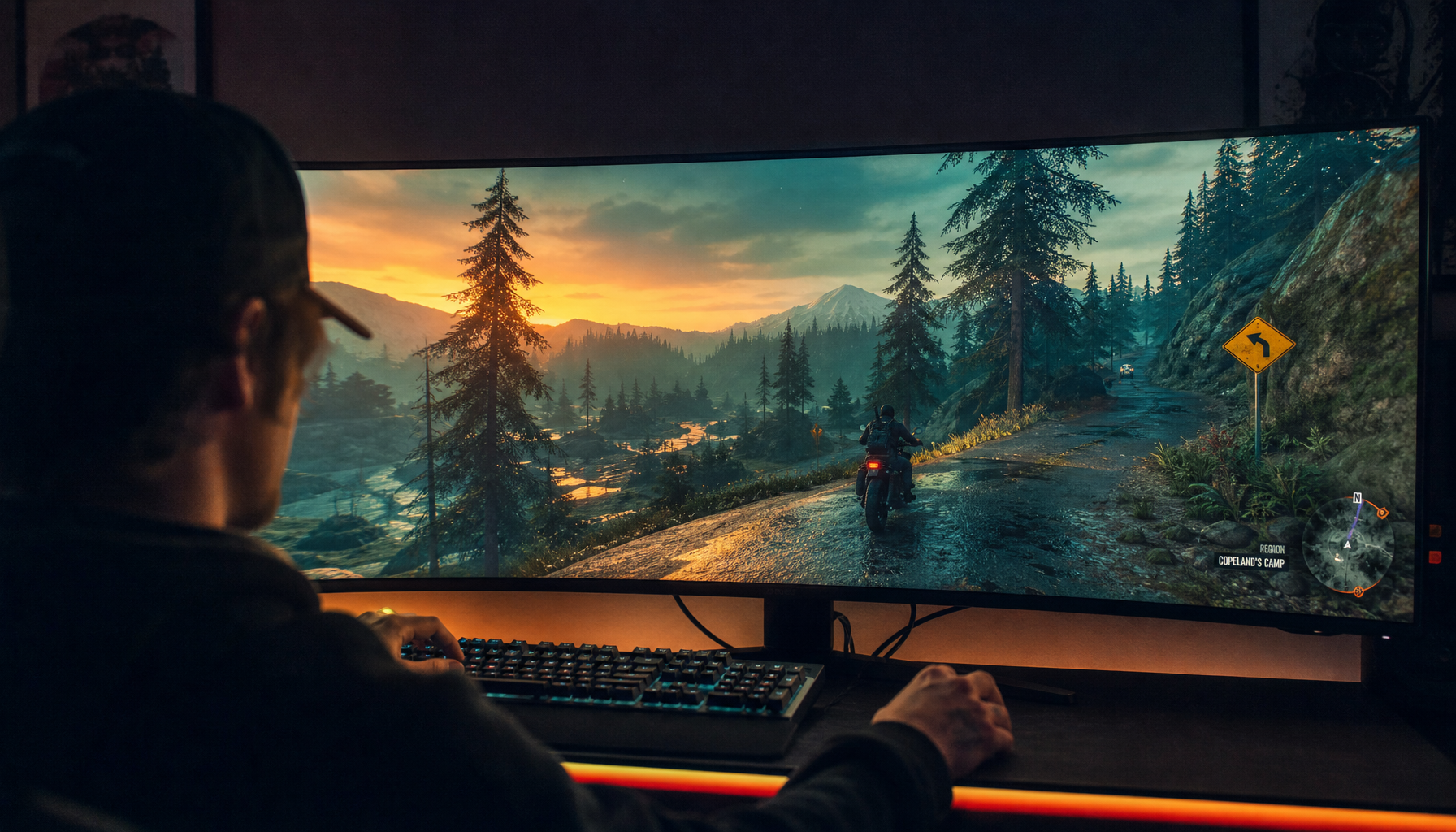
Peak brightness can make highlights easier to see, but contrast perception depends just as much on black level, ambient light, gamma behavior, and how the human eye adapts. A brighter monitor is not automatically a higher-contrast monitor in real use.
Ever boost a monitor to maximum brightness and still feel like dark game corners look washed out, spreadsheets feel harsh, or HDR highlights pop while shadows lose detail? With the right brightness target and contrast expectations, you can make a screen easier to read, more immersive, and less fatiguing without chasing the biggest nit number. Here is how peak brightness and perceived contrast actually work when you are choosing or tuning a gaming monitor, office display, or portable smart screen.
Peak Brightness and Contrast Are Related, But Not the Same
Peak brightness describes the highest luminance a display can produce, usually expressed in nits. Contrast describes the difference between bright and dark areas. The relationship is simple on paper: if a screen can get much brighter while keeping blacks equally dark, contrast improves. In practice, many displays get brighter by raising the backlight, which can also lift black levels and make dark scenes look gray.
That is why a bright office monitor can look crisp under overhead lights but disappointing in a dark room. The extra brightness fights ambient glare, yet the panel may still lack deep blacks. A self-emissive screen, such as OLED, can turn individual pixels off, creating very deep blacks and high perceived contrast; the tradeoff is that many OLED displays are less ideal in very bright rooms and can carry burn-in concerns for static desktop layouts. A display-technology overview notes that self-emissive technologies are known for deep blacks, high contrast, wide viewing angles, and fast response, while LCD-style displays remain popular because they are cost-effective, scalable, and bright enough for many environments.
For a real-world comparison, imagine two monitors showing a star field. A 600-nit LCD with mediocre black levels may make stars bright but the sky charcoal-gray. A 300-nit OLED may make the stars less intense in absolute light output, yet the black space around them looks deeper, so the scene can feel more dimensional.

Why Your Eyes Do Not Read Brightness Linearly
The eye does not treat brightness like a ruler. It is more sensitive to relative differences than raw light output, which is why a small luminance change in a dark shadow can be easier to notice than the same physical change inside a bright white window. Human brightness response spans an enormous range, and brightness perception is non-linear, with classic Weber-Fechner-style models showing that perceived brightness often grows more slowly than physical intensity.
This matters when reading monitor specs. A jump from 250 nits to 500 nits is a major physical increase, but it will not look twice as bright to your eyes. It may feel like a useful step in a sunny room, a modest improvement in a normal office, or an uncomfortable blast in a dark bedroom.
It also explains why midtones can surprise people. In photography and display calibration, perceived middle gray is much closer to about 18% luminance than 50% physical luminance. On a 170-nit display, 18% lands around 31 nits, which is why a pixel value near the middle of an 8-bit scale can look visually reasonable after gamma correction even though the emitted light is not physically halfway to peak white.
The Contrast You Perceive Depends on the Room
Ambient light is the silent contrast killer. In a bright room, reflections and glare raise the apparent black floor of your screen. Even a strong panel can look flat if light from a window or ceiling fixture washes across it. In a dark room, the opposite problem appears: high brightness can make whites and UI panels feel piercing while dark areas remain hard to judge because your eyes keep adapting.
For general indoor productivity, a practical brightness range is often around 200 to 300 nits, with lower settings preferred at night. In a dark-environment study using screen brightness levels of 52.4, 287.6, and 422.6 nits, participants reported less fatigue at the low brightness setting, and the study’s anti-fatigue index also favored lower brightness in nighttime viewing conditions. That does not mean every user should work at 52 nits all day. It means the right brightness is contextual: dim room, dimmer display; bright room, brighter display.
For a gaming setup, this is especially important. If your HDR monitor has a strong peak highlight mode, use it for HDR games and movies, but do not leave the desktop at eye-searing brightness for email, chat, or long spreadsheet sessions. For office work, the screen should look comfortably integrated into the room, not like a light panel floating in darkness.

Display Type Changes the Brightness-Contrast Tradeoff
LCD, Mini LED, OLED, and emerging Micro LED each handle brightness and contrast differently. LCDs use a backlight, so they can be very bright and durable for static work, but their blacks depend on how well the panel blocks that backlight. IPS LCDs are often excellent for color-accurate work, yet they can show IPS glow or backlight bleed in dim rooms. VA LCDs can deliver stronger native contrast than many IPS panels, but may trade off viewing angle or motion clarity depending on implementation.
Mini LED improves LCD contrast by dividing the backlight into many dimming zones. This can make HDR highlights look more dramatic, but blooming can appear around bright objects on dark backgrounds. For a gamer, that may be an acceptable tradeoff for explosive HDR scenes. For a photo editor working on low-key portraits, blooming can make shadow evaluation less trustworthy.

OLED handles contrast differently because each pixel emits its own light. That gives it exceptionally deep blacks and strong perceived depth, especially for games, movies, and screen-first creative work. A creative-display primer describes OLED as capable of extremely deep blacks and very high perceived contrast, while also noting that IPS LCD remains a strong choice for print-focused work because of brightness stability, burn-in resistance, and predictable calibration.
Display Type |
Brightness Strength |
Contrast Strength |
Practical Watchout |
IPS LCD |
Strong for offices and creative work |
Moderate |
Glow and backlight bleed in dark rooms |
VA LCD |
Often solid |
Better native contrast than many IPS panels |
Motion and viewing-angle behavior vary |
Mini LED LCD |
High HDR brightness |
Strong with local dimming |
Blooming around bright objects |
OLED |
Moderate to strong depending on model |
Excellent perceived contrast |
Burn-in risk and bright-room limits |
Micro LED |
Promising |
Potentially excellent |
Limited mainstream availability |
Peak Brightness Helps Most When the Scene Has Room to Use It
Peak brightness is most valuable when a display can reserve it for small highlights: sunlight glinting off armor, a muzzle flash in a dark corridor, a specular reflection on a product render, or a bright chart element on a portable monitor outdoors. In HDR, this is the point. The display does not need the whole screen at peak brightness; it needs enough headroom to separate highlights from midtones without crushing shadow detail.
For SDR office work, peak brightness is less glamorous. A 1,000-nit monitor does not make documents, spreadsheets, or a browser automatically better. What matters more is stable brightness, anti-glare coating, text clarity, uniformity, and a setting that matches your room. For a portable smart screen used near a window, a higher brightness rating can be useful because it preserves readability against ambient light. For a desk monitor in a controlled room, excessive brightness can reduce comfort faster than it improves clarity.

A simple tuning method works better than spec chasing. Set your monitor brightness so a white document looks like white paper in the room, not like a lamp. Then open a dark test image or a game scene with shadow detail. If blacks look gray, reduce room reflections first, then adjust brightness and contrast controls. If shadows disappear, raise black equalizer or gamma carefully rather than just raising peak brightness.
Gamma and Calibration Decide Whether Contrast Feels Natural
Monitor pixel values are not emitted as linear light. Most consumer displays use gamma behavior around 2.2 so that digital values map more naturally to human brightness perception. This is why a gray value in the middle of a scale does not emit half the display’s maximum physical luminance, yet it can still look visually centered.
For practical users, that means contrast complaints are often calibration complaints. If a gaming monitor’s gamma is too low, shadows look lifted and the image loses punch. If gamma is too high, dark detail gets crushed and enemies disappear into black areas. For office productivity, poor gamma can make light gray gridlines vanish or make dark-mode interfaces feel muddy.
A colorimeter is the best way to measure and calibrate luminance, but you can still improve results without one. Use the monitor’s sRGB or creator mode for standard work, avoid vivid showroom presets for productivity, and tune brightness separately for day and night. On gaming displays, save different profiles for competitive play, cinematic HDR, and desktop work. Competitive modes often lift shadows for visibility, while immersive modes should preserve deeper blacks and highlight separation.
Pros and Cons of Chasing Higher Peak Brightness
Higher peak brightness has clear advantages. It improves visibility in bright rooms, makes HDR highlights more convincing, helps portable screens remain usable near windows, and gives local-dimming displays more headroom for high-impact scenes. For esports, it can also make visual targets easier to track when paired with good motion performance and a sensible black-level setting.
The downsides are just as practical. Higher brightness can increase eye fatigue in dim rooms, expose backlight bleed, make blacks appear weaker on LCDs, increase power use, and produce glare if the panel coating or room lighting is poor. On OLED, sustained full-screen brightness is often more limited than small-window peak brightness, so the quoted number may not reflect how bright a spreadsheet, web page, or coding environment will look.
The best value choice is not the highest nits possible. It is enough brightness for your environment, enough contrast for your content, and enough control to switch modes cleanly.
Practical Buying and Setup Guidance
For office productivity, prioritize brightness stability, text clarity, ergonomics, anti-glare handling, and comfortable SDR brightness. A strong 300- to 400-nit monitor can be excellent if the panel is uniform and easy on the eyes. For long workdays, avoid running maximum brightness in a dim room; the visual fatigue evidence is stronger for matching brightness to the environment than for simply going brighter.
For competitive gaming, brightness helps only if motion handling, refresh rate, response time, and shadow visibility are also well tuned. A monitor that reaches high peak brightness but smears dark transitions may feel worse than a slightly dimmer panel with cleaner motion.
For immersive single-player gaming and movies, prioritize contrast system behavior. OLED and well-implemented Mini LED are the most compelling choices, but they solve the problem differently. OLED gives pixel-level black control. Mini LED gives stronger HDR punch and higher full-screen brightness, with some risk of blooming.
For portable smart screens, brightness matters more because the environment changes constantly. Choose higher peak brightness if you use the screen in cafes, airports, or near windows, but still check whether it offers quick brightness controls and a matte or reflection-resistant finish.
FAQ
Is 1,000 nits always better than 400 nits?
No. A 1,000-nit display can be better for HDR highlights and bright rooms, but a 400-nit display with deeper blacks, better gamma, and fewer reflections may look more contrast-rich in a normal desk setup.
Does OLED need high peak brightness to look high contrast?
Not always. OLED’s perceived contrast comes heavily from its ability to produce extremely dark blacks. High peak brightness still helps HDR highlights, but OLED can look immersive even when its full-screen brightness is lower than a bright LCD.
Why does my monitor look worse at maximum brightness?
Maximum brightness can raise black levels on LCDs, reveal backlight flaws, worsen glare, and fatigue your eyes in dim rooms. If the room is not bright enough to require maximum output, lower brightness usually improves comfort and perceived balance.
A performance display should not just win the spec sheet; it should make targets readable, edits trustworthy, movies dimensional, and work sessions comfortable. Treat peak brightness as headroom, contrast as the depth engine, and calibration as the control system that makes both useful.