Operating systems shape HDR signaling, brightness behavior, color handling, and driver output, while the monitor’s firmware decides how local dimming zones respond. Knowing that split helps you tune a display for games, office work, media, and portable setups.
Does your Mini-LED monitor look cinematic in one app, washed out on the desktop, then suddenly too dark in a game menu? The practical win is simple: with the right OS, HDR, and monitor-side settings, you can separate a real panel limitation from a software handoff problem. You will learn what the operating system actually controls, what the monitor controls, and how to tune the stack for gaming, office work, and portable displays.
The Key Definition: Local Dimming Is Not an OS Feature
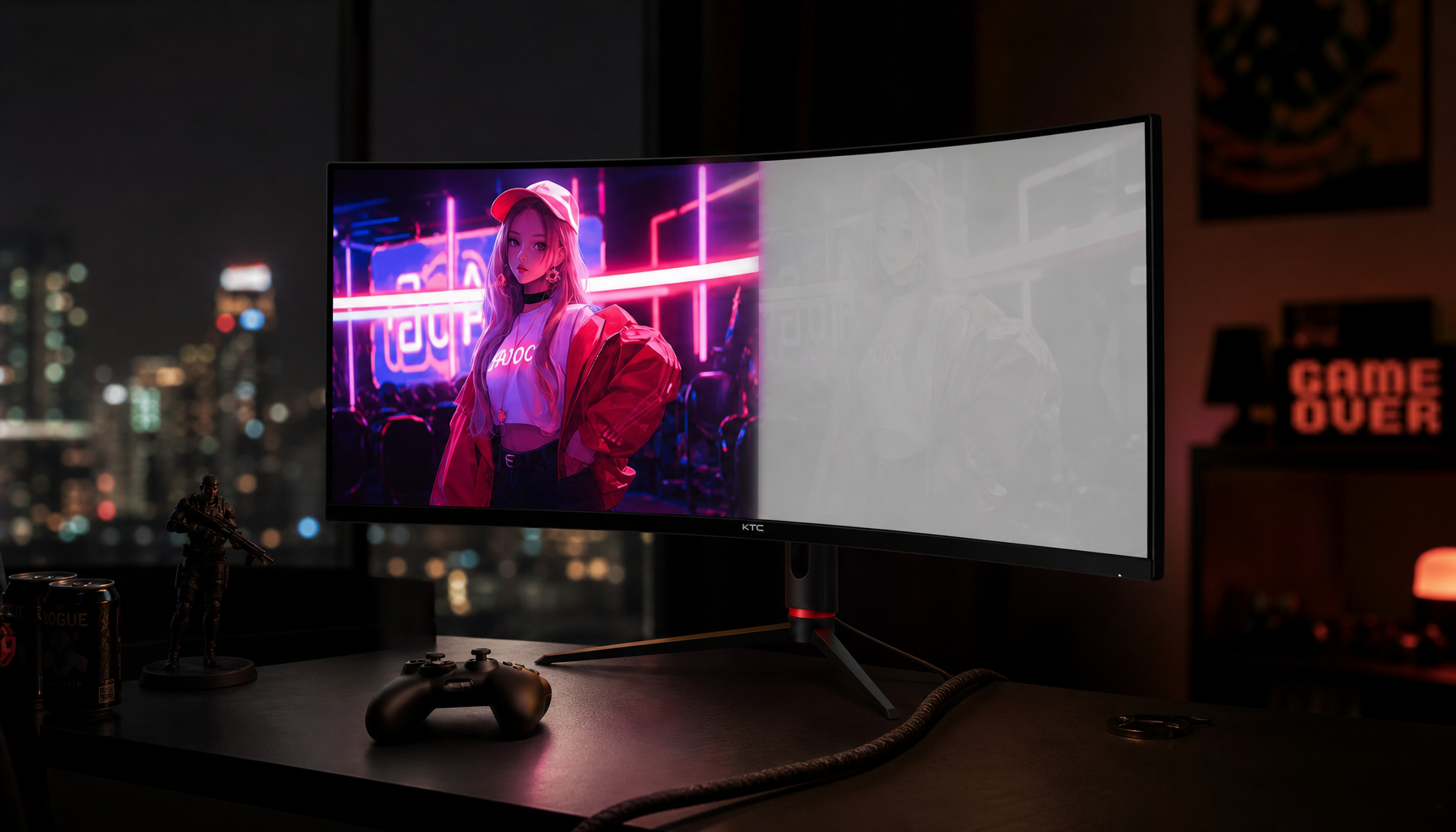
Local dimming is a display-side backlight system. On an LCD monitor, the pixels modulate light, but the light itself comes from LEDs behind or around the panel. A local dimming display divides that backlight into zones, then brightens or darkens those zones based on the image. A strong implementation can make black areas look deeper while keeping bright HUD elements, headlights, explosions, or HDR highlights vivid. A weak implementation can create blooming, black crush, or uneven brightness.
That distinction matters because local dimming is primarily monitor firmware behavior, not something an operating system micromanages zone by zone. The OS sends frames, color information, brightness intent, and HDR signaling. The monitor’s scaler, processor, backlight controller, and firmware decide how zones react.
VESA’s DisplayHDR explanation is useful here because it separates basic HDR signaling from active backlight behavior. Active dimming means the display responds to real-time image changes, not merely the presence of HDR metadata. In practical terms, a game frame with a bright crosshair over a dark tunnel challenges the monitor’s dimming algorithm far more than the OS itself.
What the Operating System Actually Handles
An operating system manages hardware resources, applications, memory, input, output, and user interaction. That broad role is why hardware resources sit between the GPU driver, the app, the display connection, and the user’s brightness or HDR settings. It can determine whether HDR is enabled globally, whether SDR content is tone-mapped into an HDR desktop, how brightness controls behave, and how display drivers expose capabilities.
The OS can pass or influence HDR metadata, such as luminance intent and color format, but it generally does not say, “turn zone 143 down to 12%.” For most external monitors, that lower-level decision happens inside the monitor. For built-in laptop panels, the OS and device utility may have more influence because power management, presence sensing, adaptive brightness, and panel firmware are bundled into one device experience.
A simple example shows the difference. If you open a white spreadsheet beside a dark video player, the OS is compositing windows and sending the final image. A Mini-LED monitor then sees a mixed-brightness frame and decides how its zones should behave. If the spreadsheet causes nearby dimming zones to rise, that is not the spreadsheet controlling local dimming; it is the monitor reacting to the final frame.

How OS Differences Show Up in Real Use
Gaming-Focused Desktops: More HDR Control, More Variables
Gaming-focused desktop systems are often the most visible example because gaming monitors, HDR toggles, GPU control panels, vendor utilities, and built-in display power features frequently overlap. The strength is flexibility. You can run HDR games, SDR desktop apps, VRR, high refresh rates, and monitor OSD presets from one ecosystem. The drawback is that one wrong layer can make local dimming look broken when the panel is only reacting to an inconsistent signal.
For example, SDR office work on a Mini-LED monitor can look distracting if local dimming is left aggressive. White documents, dark sidebars, and moving cursors can make zones pump subtly. Monitor guidance often recommends turning local dimming off for SDR office, web, and desktop use because consistent screen brightness is usually more comfortable than maximum contrast in productivity work. For HDR, the same guidance recommends enabling local dimming and tuning halo controls to balance black depth against highlight brightness.
The practical approach is to treat the desktop and HDR games as separate modes. Use stable SDR brightness for office sessions, then switch to HDR with local dimming enabled for games and movies that actually benefit from expanded contrast. If the image looks too dim in shadow-heavy games, reduce the most aggressive dimming level before blaming the OS.
Color-Managed Desktops: Cleaner Behavior, Less Gaming-Monitor Tuning
The research notes do not provide platform-specific engineering documentation for local dimming metadata, so the safest conclusion is conservative: a color-managed desktop OS should be understood as a display pipeline and color-management environment, while the monitor still owns zone control. On external Mini-LED or FALD monitors, the OS may deliver a polished desktop experience, but the monitor firmware still decides blooming, dimming speed, and black crush.
The benefit for productivity users is predictability. If your daily work is writing, coding, design review, or video conferencing, a stable SDR setup often matters more than chasing peak HDR. The limitation is that many gaming-focused controls live in the monitor OSD or GPU driver ecosystem rather than inside the OS itself. That makes monitor-side presets especially important.
A real-world setup would be a USB-C portable smart screen or desk monitor used with a laptop during the day and a console or gaming PC at night. The best workflow is not to force one universal setting. Keep a restrained SDR preset for desktop clarity, then use the monitor’s HDR and local dimming preset for media or gaming input sources.
Open and Web-First Systems: Driver Path and App Support Matter More Than Zone Count
For open desktop systems and web-first systems, the notes support a broader OS-level point rather than a vendor-specific HDR claim: operating systems manage devices through drivers, resources, security, and user interfaces. That means local dimming quality depends heavily on whether the app, compositor, GPU driver, display protocol, and monitor agree on the signal being sent.
Users often buy high-performance displays for development, simulation, content review, or gaming through compatibility layers. In that environment, the monitor’s OSD becomes the dependable control surface. If HDR behavior varies by desktop environment or app, you can still evaluate the display by testing known mixed-contrast scenes: a dark game menu with small white text, a starfield, a film subtitle scene, and a bright window moving across a dark desktop.

Web-first systems and portable smart screens follow a similar value logic. The OS is optimized for simplicity, battery life, and browser-based work, so local dimming should be judged by comfort and consistency first. If the screen is used for email, documents, dashboards, and streaming, aggressive local dimming may create more distraction than benefit.
Metadata Versus Real-Time Dimming
HDR metadata tells the display something about the content’s brightness and color intent. Local dimming uses the actual image to control light zones. Those two things are related, but they are not identical.
A monitor can receive an HDR signal and still have poor local dimming. Conversely, a well-tuned FALD or Mini-LED monitor can improve perceived contrast because it analyzes the frame in real time. DisplayHDR’s description of global, edge-lit, and full-array dimming makes the hierarchy clear: global dimming adjusts the whole backlight, edge-lit systems control broad bands, and full-array systems place LEDs behind the panel for more precise control. Full-array local dimming is therefore the stronger foundation for HDR than basic signal support.
This is why “HDR10 supported” on a spec sheet is not enough. The monitor may understand the metadata, yet lack enough zones, brightness, processing speed, or firmware tuning to make highlights and shadows convincing at the same time.
Layer |
What It Controls |
What It Does Not Guarantee |
Operating system |
HDR mode, desktop composition, brightness policy, driver path, app handoff |
Clean blooming control or perfect black levels |
GPU driver |
Output format, refresh behavior, VRR path, color settings |
Good dimming algorithms inside the monitor |
Monitor firmware |
Zone response, halo control, black preservation, brightness transitions |
Accurate OS-level color management |
Panel and backlight hardware |
Zone count, LED capability, heat behavior, native contrast |
Good tuning or low latency by itself |
Gaming: Latency and Dimming Can Pull Against Each Other
For competitive gaming, local dimming is valuable only if it does not compromise motion feel, visibility, or latency. A dark tactical shooter may look richer with dimming on, but if shadow detail disappears or bright UI elements bloom around enemies, the setting is working against performance.
Latency analysis is relevant because modern gaming displays often use near-real-time scanout and transport techniques to reduce delay. Near-real-time scanout depends on the display receiving usable picture information quickly enough for top-to-bottom refresh behavior. Local dimming adds a separate processing challenge: the monitor must analyze image regions and drive zones fast enough that bright objects do not leave visible trails or delayed halos.
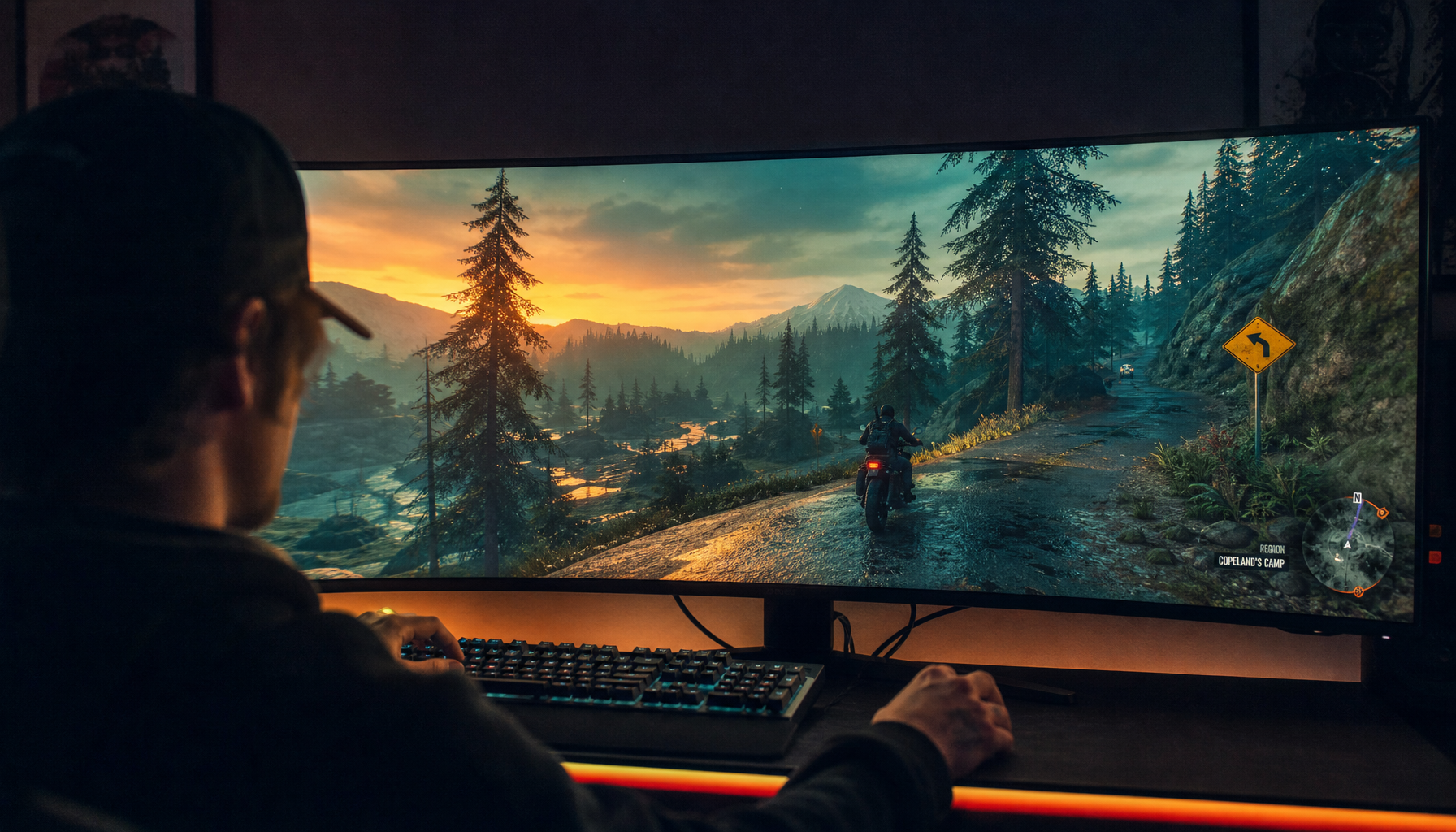
The practical gaming rule is sharp. For esports, prioritize refresh rate, response time, VRR stability, and visibility. Use local dimming cautiously, often at a lower level or off if it hides detail. For immersive single-player games, enable HDR and local dimming, then test a dark cave, a bright sky, subtitles, and a moving flashlight before settling on the preset.

Office Productivity: Brightness Stability Beats Maximum Contrast
Office work exposes the weak side of aggressive dimming. Spreadsheets, documents, code editors, browser tabs, and video calls contain large flat areas and high-contrast text. If a monitor keeps adapting its zones while you scroll, the display can feel unstable even when the hardware is technically doing what it was designed to do.

That is why the best office setting is often boring in the right way. Turn local dimming off or choose the gentlest mode for SDR productivity. Enable brightness uniformity if your monitor offers it. Keep HDR off unless your workflow specifically requires HDR preview. On a portable smart screen, this also helps battery life and reduces distracting brightness shifts in changing room light.
For a creator editing HDR video, the answer changes. You still need controlled ambient lighting, correct HDR mode, and monitor-side dimming enabled. But for writing emails or analyzing a dashboard, local dimming is usually a comfort tax rather than a productivity upgrade.
Pros and Cons by Display Type
Edge-lit local dimming is cheaper and thinner, but it controls broad regions and can create obvious glow in dark scenes. Full-array local dimming places LEDs behind the screen, giving the monitor better control over mixed bright and dark content. Mini-LED improves that concept with smaller LEDs and often many more zones. OLED and QD-OLED avoid the local dimming problem entirely because each pixel controls its own light, although buyers then weigh different risks such as burn-in behavior, brightness limits, and long-term panel care.
A TV-focused explanation maps well to monitor buying because the physics are the same: Mini LED can use hundreds or thousands of dimming zones, but zone count alone is not the whole story. Processing, brightness capability, panel quality, and tuning decide whether those zones feel invisible or distracting.
For a desk buyer, that means a 1,000-zone monitor with poor firmware can look worse than a lower-zone model with smarter tuning. The best evidence is still hands-on testing with the content you actually use.
Practical Setup Advice
For HDR Gaming Monitors
Use the OS HDR toggle only when playing HDR games or watching HDR video. Then enable the monitor’s local dimming mode and start from a balanced preset rather than the most aggressive one. Monitor guidance often separates maximum black depth from shadow-detail preservation; a very high dimming setting can deepen blacks, but it may also hide texture in dark scenes.
After changing settings, test the same scene every time. A good test is a dark game area with a bright HUD, a flashlight sweep, or white subtitles over black bars. If the halo is distracting, reduce halo aggressiveness or dimming strength. If the scene loses detail, back off the deepest-black preset.
For Office Displays
Keep SDR stable. Local dimming off, brightness uniformity on, and moderate brightness will usually feel better across eight hours of documents, code, spreadsheets, and browser work. If your OS or laptop has adaptive brightness, presence-based dimming, or display utilities, check those before assuming your monitor is defective.
For Portable Smart Screens
Portable displays often live between productivity, travel, and media. Because they may depend on USB-C power and compact thermal design, consistency matters. Treat HDR and local dimming as content modes, not permanent desktop modes. Use normal brightness for work, then switch to contrast-focused settings for video or gaming.
The Bottom Line
Different operating systems handle the display pipeline differently, but local dimming metadata is only part of the story. The OS influences HDR mode, app handoff, brightness behavior, and driver output; the monitor’s firmware turns the final image into zone-by-zone backlight behavior.
For the best result, tune by use case. Stable SDR for productivity, balanced HDR local dimming for immersive games and movies, and monitor-side presets for anything the OS cannot reliably control. A great display does not just get bright; it gives you control over when brightness serves the image and when stability serves your work.