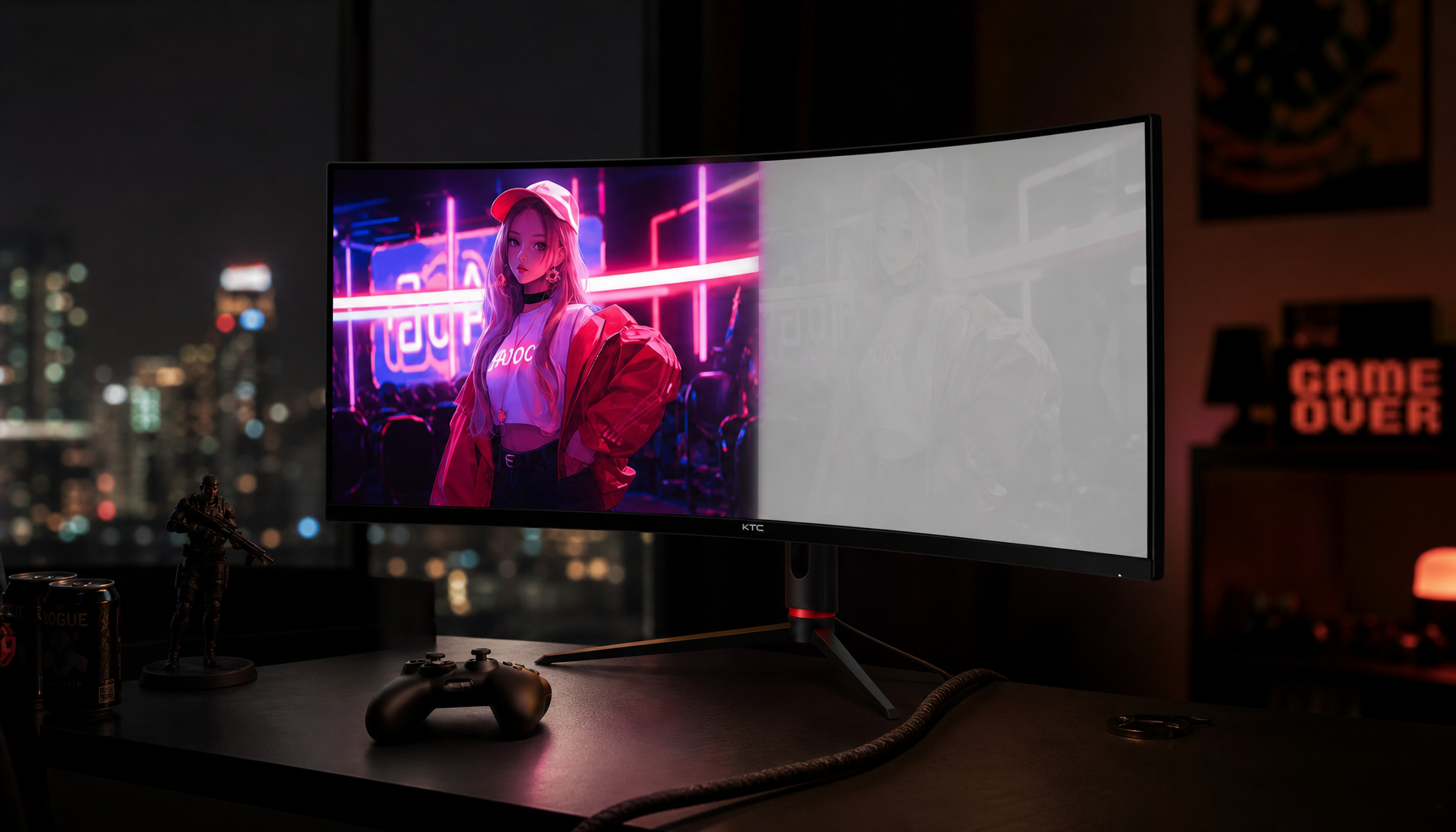
Yes. Monitor-side motion blur reduction can clash with in-game motion blur because the monitor tries to sharpen motion while the game deliberately blends it for cinematic softness.
Does your 240 Hz or 360 Hz screen look sharp during desktop scrolling but strangely smeared when you sprint, pan, or flick in a game? A simple A/B test using a fast scene, monitor strobing, and the game’s motion blur toggle can reveal whether the blur comes from the display or the game engine. You can separate monitor blur, ghosting, strobing artifacts, and post-processing blur so your screen feels faster and clearer.
Why These Two Blur Systems Can Fight Each Other
Motion blur reduction on a monitor is usually a hardware-driven clarity feature. It may use backlight strobing, black frame insertion, or similar timing methods. The goal is to reduce perceived blur caused by sample-and-hold behavior, where a modern display keeps each frame visible while your eyes track a moving target.
In-game motion blur is different. It is a post-processing effect added by the game engine after the scene is rendered. It simulates camera blur, object blur, or per-pixel velocity blur to make movement look more cinematic, smoother, or less harsh at lower frame rates. That can look good in a single-player story game, but it often works against the sharpness gains of a high-refresh gaming monitor.
The technical conflict is straightforward: LCD motion blur is partly caused by sample-and-hold persistence, not just slow pixel response. Strobe-style blur reduction tries to show each frame for a shorter visible window. If the game has already blurred the frame before it reaches the monitor, the monitor can flash a cleaner timing window, but it cannot undo blur baked into the rendered image.
Motion Blur Reduction, Defined Clearly
Monitor motion blur reduction is a display-side feature designed to improve motion clarity. On LCD monitors, it usually works by turning the backlight off while pixels transition and then flashing it briefly when the frame is ready. That gives the eye less time to smear the image during tracking.
This is why a strobed 120 Hz or 240 Hz mode can sometimes look clearer in motion than a non-strobed mode at the same refresh rate. Research on motion blur shows that higher refresh rates reduce persistence blur because each frame is held for less time, while strobing goes further by reducing the visible portion of each refresh cycle.
However, blur reduction is not free. It can reduce brightness, add flicker, limit refresh-rate options, disable variable refresh rate, and expose frame pacing problems. A competitive player in a bright room may notice the brightness loss immediately. A user sensitive to flicker may prefer non-strobed 240 Hz over strobed 144 Hz, even if the test pattern looks cleaner.
In-Game Motion Blur, Defined Clearly
In-game motion blur is an artistic rendering choice. The game engine intentionally blends pixels across time or direction so fast movement looks softer. Some games apply it to camera movement, some apply it to individual moving objects, and some combine both.
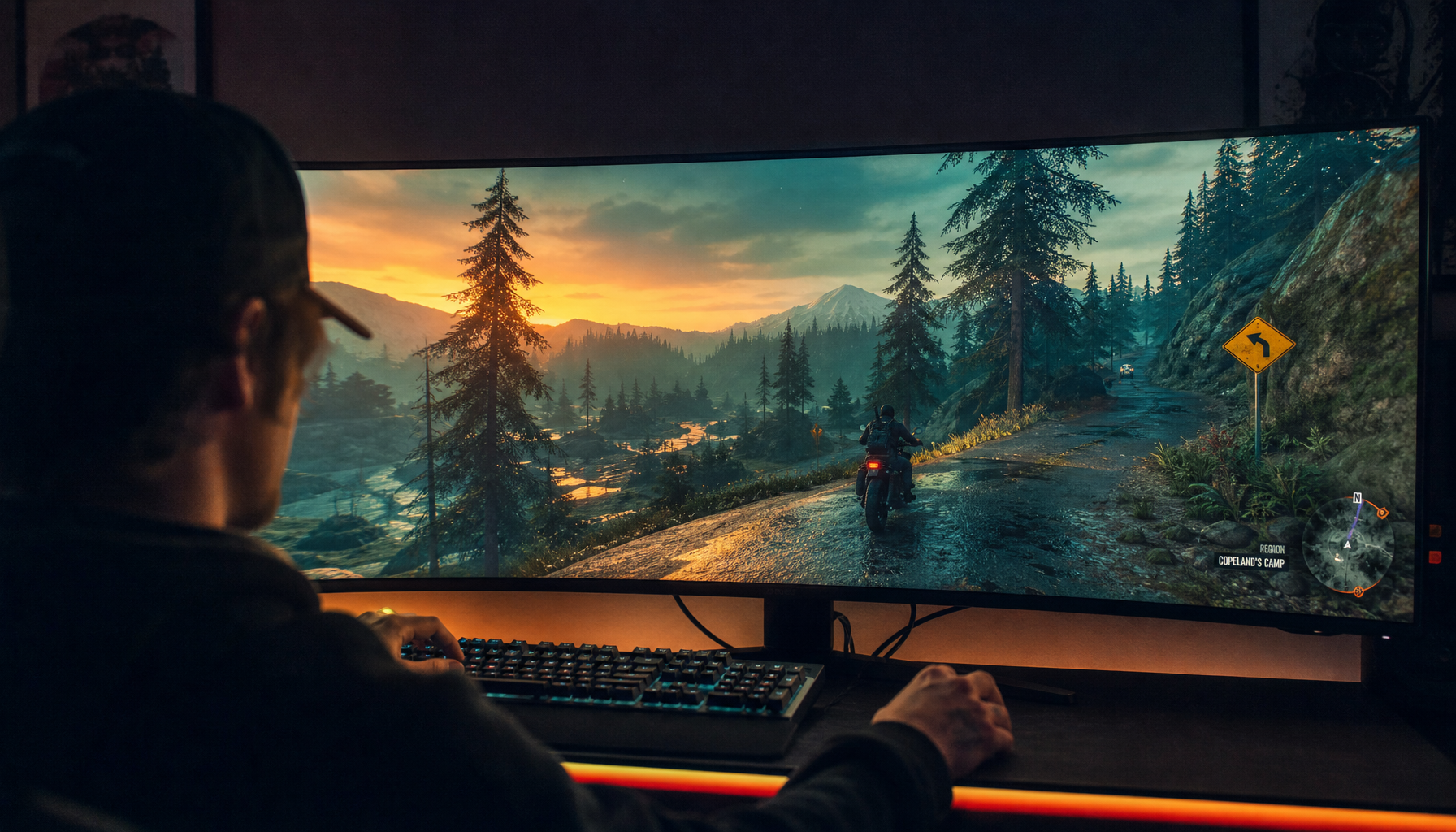
That effect can hide low frame rate judder, make racing games feel more cinematic, and smooth out animation in story-driven titles. But for esports, aim tracking, rhythm timing, fast scrolling maps, and dense UI reading, it often reduces practical visibility. A blurred enemy silhouette is still blurred even if your monitor uses an excellent strobe backlight.
The most reliable rule is simple: when you want motion clarity, disable in-game motion blur before judging your monitor. If the game’s own blur is on, you are no longer evaluating the panel, overdrive, refresh rate, or strobe mode cleanly.
Where the Interaction Goes Wrong
The most common failure is double blur. The game engine smears the image first, then the display adds whatever blur remains from pixel response, persistence, imperfect strobe timing, or overdrive. The result can look oddly soft even on a premium panel.

A second failure is sharpened smear. Strobing can make the edges of a post-processed blur trail more visible because the monitor is presenting each rendered frame more distinctly. Instead of a smooth cinematic smear, you may see a ghosted-looking band around weapons, tree lines, nameplates, or enemy outlines during fast pans.
A third issue is frame pacing sensitivity. Backlight strobing works best when frame rate and refresh rate are tightly matched. If you run a 240 Hz strobe mode but the game swings between 190 and 240 FPS, the eye may perceive uneven clarity, double images, or stutter. Forum troubleshooting around blur-reduction availability also highlights a real-world complication: blur-reduction modes are often restricted by refresh rate, connection type, adaptive sync state, and sometimes HDR.
Practical Example: Why 240 Hz Still Looks Blurry
Imagine a shooter running at 240 FPS on a 240 Hz monitor. Each refresh lasts about 4.2 milliseconds. That is already much better than 60 Hz, where each refresh lasts about 16.7 milliseconds. But if the game’s motion blur is enabled, the rendered frame may already contain a smeared weapon model, blurred floor texture, or softened target edge before the monitor displays it.

Now turn on a strobe mode. The display may reduce persistence blur, but it flashes the same motion-blurred frame. The result is cleaner timing with a blurred input image. In practice, a player may say strobing barely helped when the real issue is that the game’s post-processing is masking the benefit.
That is why monitor tuning should start with the cleanest possible rendered frame. Turn off in-game motion blur, disable unnecessary cinematic filters, use native resolution, confirm the correct refresh rate in your operating system or graphics settings, and then test overdrive and blur reduction.
Pros and Cons of Combining Both

Setup |
Strength |
Weakness |
Best Use |
Motion blur reduction on, in-game blur off |
Highest motion clarity when frame rate is stable |
Lower brightness, possible flicker, VRR often unavailable |
Competitive FPS, aim trainers, racing precision |
Motion blur reduction off, in-game blur off |
Balanced clarity and comfort |
More sample-and-hold blur than strobed modes |
General gaming, office plus gaming displays |
Motion blur reduction off, in-game blur on |
Cinematic smoothness |
Lower target clarity and softer camera pans |
Story games, casual racing, controller play |
Motion blur reduction on, in-game blur on |
Can feel stylized in some games |
Often creates double blur or visible smeared edges |
Rarely ideal; test case by case |
The VRR, HDR, and Strobing Tradeoff
One of the biggest practical traps is assuming every premium monitor feature can run at once. In reality, many monitors make you choose. Variable refresh rate smooths uneven frame delivery and reduces tearing, while strobing usually wants fixed, predictable timing. HDR may also change backlight behavior, brightness limits, or processing paths.
The forum case around a 360 Hz-class monitor is a useful reminder because the user could not access a strobe blur-reduction mode under their setup. The discussion pointed toward restrictions such as cable type, fixed supported refresh rates, adaptive sync state, graphics hardware, and HDR state. That does not mean every monitor behaves the same way, but it does mean an on-screen display option being grayed out is often a compatibility state, not a defective panel.
For high-FPS competitive play, fixed refresh plus strobing can make sense if your frame rate is locked and stable. For graphically heavy games where FPS fluctuates, VRR may feel better even if raw motion clarity is not as sharp. The smarter value choice is not always strobing or always VRR, but matching the mode to the game.
Ghosting Is Not the Same Problem
Ghosting is a pixel response artifact, not the same as in-game motion blur. It appears as trails, shadows, or delayed replicas following moving objects. Overdrive can reduce it by pushing pixels to transition faster, but aggressive overdrive can create inverse ghosting, where bright or dark halos appear around motion.
A practical monitor setup should separate these issues. If a UFO test or fast side-scrolling scene shows colored trails with in-game blur off, you are probably dealing with pixel response or overdrive. If the image only becomes smeared when a specific game setting is enabled, the game’s motion blur is the likely cause. Guidance on monitor ghosting also makes the same distinction between ghosting, tearing, and general motion blur, which matters when deciding whether to adjust overdrive, refresh rate, VRR, or game settings.
For most gaming monitors, the safest overdrive starting point is the middle setting. Extreme modes often look impressive in marketing but can create overshoot artifacts, especially on VA panels or at lower refresh rates. If your display has variable overdrive tied to VRR, test it both at high FPS and in the lower FPS range where transitions may behave differently.
Panel Type Changes the Result
Panel behavior matters. Fast IPS and OLED gaming monitors usually handle motion better than slower VA panels, while TN can still be strong for pure speed with weaker color and viewing angles. OLED has a major advantage because pixels switch extremely quickly, but sample-and-hold blur can still exist unless refresh rate is very high or black frame insertion is used.
Modern buying advice should weigh the full display chain. OLED and IPS differences matter because OLED’s self-emissive pixels bring deep blacks and very fast transitions, while IPS remains a reliable choice for bright rooms, long office sessions, and static productivity layouts. If your screen doubles as a work display for spreadsheets, dashboards, or coding, an IPS panel with strong overdrive and 144 Hz to 240 Hz may be a better value than an OLED you worry about leaving static windows on all day.
For immersion-first players, OLED or QD-OLED can make HDR games feel more immediate and dimensional. For esports-first players, a flat 24- to 27-inch high-refresh display with predictable overdrive may still beat a large curved ultrawide if the wider field makes edge blur more noticeable during fast turns.
A Clean Testing Method That Works

Start with one game that has a repeatable motion scene, such as a training range, replay camera, racing lap, or fixed pan across a high-contrast wall. Set the monitor to its intended refresh rate in the operating system, then confirm the same value in the game. Use the required high-bandwidth cable when your monitor’s highest refresh or strobe modes depend on it.
Next, disable in-game motion blur and test normal non-strobed mode. Adjust overdrive until trails are minimized without bright halos. Then enable the monitor’s blur reduction mode and retest the same motion. If clarity improves but brightness drops, decide whether the tradeoff is acceptable for that room. If clarity gets worse or double images appear, check whether your frame rate is matching the strobe refresh rate consistently.
Only after that should you turn in-game motion blur back on for comparison. If the image becomes soft again, the interaction is confirmed. The fix is not a new cable or a new panel; it is simply leaving game motion blur off for clarity-focused play.
Recommended Settings by Use Case
Use Case |
Monitor Mode |
In-Game Motion Blur |
Extra Tuning |
Fixed high refresh or strobing if FPS is locked |
Off |
Medium overdrive, low processing, stable frame cap |
|
VRR or strobing depending on FPS stability |
Low or off |
Test cockpit readability during fast turns |
|
Cinematic single-player |
VRR, HDR if the monitor handles it well |
Optional |
Favor image quality and comfort |
Office plus gaming |
Non-strobed high refresh |
Off for games, irrelevant for work |
Comfortable brightness, sharp text, no aggressive overdrive |
Portable smart screen gaming |
Native refresh with VRR if available |
Off |
Prioritize stable FPS and readable brightness |
So, Should You Use Both?
Usually, no. If your goal is performance-driven clarity, disable in-game motion blur when using monitor-side motion blur reduction. Let the monitor sharpen motion from the cleanest possible frame instead of asking it to rescue an intentionally blurred image.
There are exceptions. A cinematic game at 60 to 90 FPS may look more pleasant with subtle in-game motion blur and no strobing. A racing game may benefit from light per-object blur while keeping camera blur off. But for competitive visibility, the best setup is simple: clean rendered frames, high refresh rate, well-tuned overdrive, stable FPS, and blur reduction only when its brightness, flicker, and compatibility tradeoffs are worth it.
A high-performance display should make motion easier to read, not just impressive on a spec sheet. Treat motion blur reduction and in-game motion blur as separate tools with opposite priorities, then choose the one that serves the game you are actually playing.