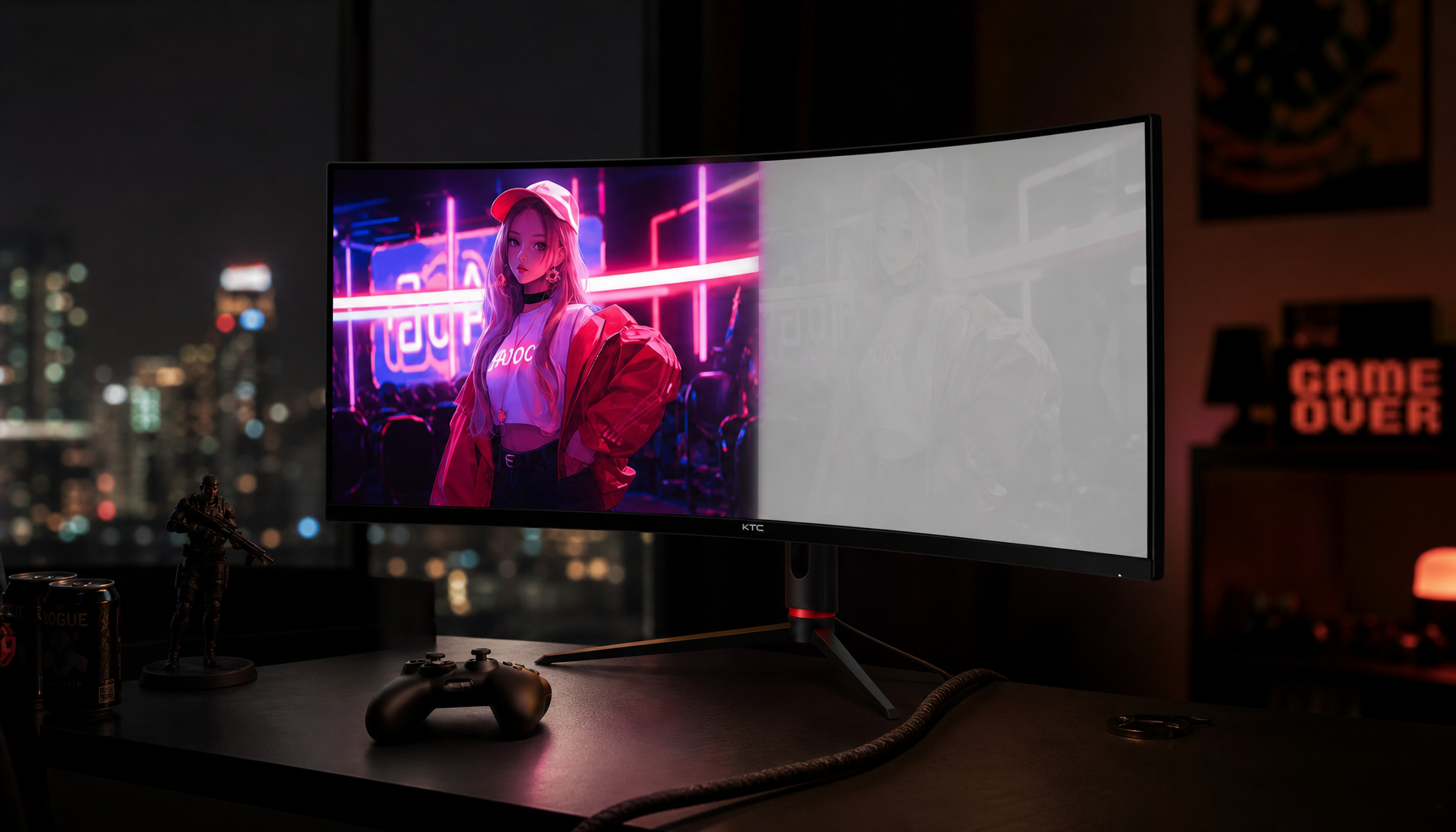
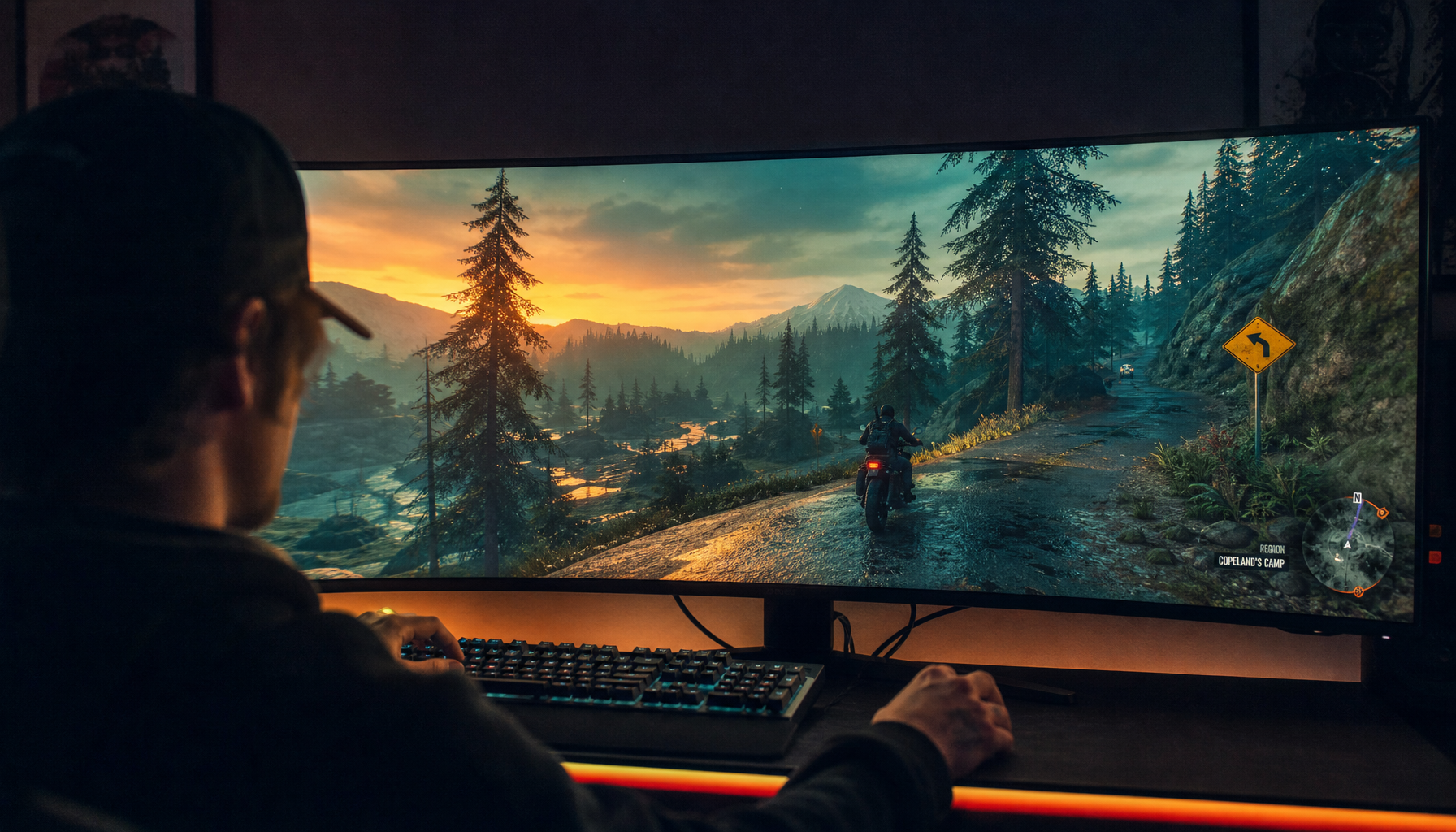
Motion Blur Reduction can expose ghosting in dark scenes because the backlight strobe makes slow pixel transitions more visible, and dark-to-dark LCD changes are often the slowest. Bright scenes hide more of that lag because pixels settle faster and higher luminance masks faint trails.
Ever enable blur reduction for sharper aim, then load into a shadowy corridor and see enemies drag a gray-black echo behind them? A practical fix is testable in minutes: switch between dark and bright motion scenes, lower overdrive one step, and compare whether trails turn from sharp halos into softer, less distracting blur. You will leave with a clear way to tune your monitor instead of guessing between “Fast,” “Extreme,” and “MBR.”
Key Takeaway: Blur Reduction Cuts Persistence, Not Pixel Lag
Motion Blur Reduction, often called MBR, ULMB, ELMB, backlight strobing, or Black Frame Insertion, reduces sample-and-hold blur. On a normal LCD, each frame remains visible until the next refresh, and your eyes smear that held image while tracking motion. Motion-clarity guidance describes moving-image sharpness as a combination of sample-and-hold blur and pixel response time.
The catch is that MBR does not make LCD pixels finish their color transitions sooner. It flashes the backlight for a shorter window, which can make the image look cleaner when the pixels are already near the correct shade. If the pixels are still halfway through a dark transition when the strobe fires, the display briefly shows the wrong shade with high clarity. That wrong shade is the ghost, smear, double image, or inverse trail you notice in dark game scenes.
Why Dark Scenes Reveal the Artifact First

Dark game scenes stress the slowest part of many LCD panels. VA panels are the clearest example: they often produce rich blacks and high contrast, but their dark-to-dark transitions can lag behind bright or midtone transitions. A panel overview notes the familiar tradeoff: VA delivers deep blacks and strong contrast, while IPS leans toward color accuracy and viewing angles, and TN historically favors speed.
That matters because ghosting is not only about how many hertz your monitor has. A 240Hz display refreshes every 4.17 milliseconds, while a 144Hz display refreshes every 6.94 milliseconds. If a dark pixel transition takes longer than that frame window, the next strobe can catch the pixel before it has settled. On screen, a black wall, gray cave, night map, or shadowed doorway becomes a perfect test pattern for trailing.
Bright scenes are more forgiving. Bright-to-bright and midtone transitions are often faster, and the extra luminance can visually bury weak afterimages. In a snowy map, bright skybox, or sunlit racing scene, the same monitor setting may look crisp because the pixel transition error is smaller, less contrasty, or simply harder for your eyes to separate from the background.
MBR Can Make Ghosting Look Sharper, Not Softer

Regular motion blur is broad and smeary. MBR tries to reduce that by showing each frame for a shorter slice of time. When it works, moving crosshairs, lane markers, and enemy silhouettes appear more readable. When it misfires, the artifact becomes more defined because the strobe reveals a partially completed transition instead of letting it blend across the full refresh cycle.
This is why a monitor can look better with MBR in bright desktop scrolling, then worse in a dark shooter. You did not create a new slow pixel response problem. You exposed the timing problem. KTC’s motion blur notes make the same distinction: ghosting comes from slow pixel transitions, while sample-and-hold blur comes from frames staying visible as your eyes track movement.
A simple real-world example is a dark character model crossing a dim hallway at 144Hz. With MBR off, the outline may look soft because your eyes smear the held frame. With MBR on, the outline can look sharper, but a second dim silhouette may appear behind it if the black-to-gray transition has not finished before the strobe.
Overdrive Is the Second Half of the Problem

Overdrive pushes LCD pixels harder so they transition faster. It is useful, but the highest mode is not automatically the best mode. Too little overdrive causes normal ghosting, where trails lag behind moving objects. Too much overdrive causes overshoot, also called inverse ghosting, where pixels go past the target shade and snap back, producing bright halos, dark outlines, or colored edges.
This is why “Extreme” response time can look impressive in a spec and ugly in a real match. Motion-clarity coverage emphasizes that refresh rate alone does not determine clarity; response behavior and implementation quality matter heavily. In dark scenes, aggressive overdrive can be especially obvious because high-contrast edges make the overshoot stand out.
The best overdrive setting is usually the one that looks clean at your actual frame rate. If your game runs at 240 FPS locked on a 240Hz monitor, a stronger mode may behave well. If the same game drops to 120 FPS during explosions or open-world traversal, that overdrive tuning may become too aggressive for the longer frame interval, and trails can become more visible.
Setting Choice |
What It Tries To Fix |
Common Dark-Scene Risk |
MBR off |
Avoids strobe timing artifacts |
More sample-and-hold blur |
MBR on |
Reduces perceived blur |
Double images if pixel transitions miss the strobe |
Low overdrive |
Reduces overshoot |
More normal ghosting |
Speeds transitions |
Bright halos, dark outlines, inverse ghosting |
|
Faster transitions |
Higher cost, OLED burn-in considerations |
Why It Is Less Obvious in Bright Game Scenes
Bright scenes hide MBR ghosting for three practical reasons. First, LCD transitions involving brighter tones may complete closer to the strobe window, so there is less wrong-state image to reveal. Second, a faint trail against a bright background has lower perceptual weight than a gray smear across black. Third, your attention in bright environments often locks onto high-luminance targets, HUD elements, and sharp geometry rather than low-level shadow detail.
Game rendering can also complicate diagnosis. In-game motion blur deliberately smears movement for cinematic speed, especially in racing, sports, and single-player action games. Motion blur is commonly described as streaking or smearing caused by fast change over time and space, and competitive players generally disable it for clearer visibility. If game motion blur, temporal antialiasing, upscaling, monitor overdrive, and MBR are all active, the result can look like one problem even when multiple systems are stacking trails.
The reliable test is to remove variables. Disable in-game motion blur first. Then test with MBR off and on. Then change overdrive one level at a time. Use the same map, same camera pan, and same dark object crossing the same background. If the artifact only appears with MBR enabled, you are likely seeing strobe timing interacting with slow pixel response.
Practical Tuning: How to Reduce Dark-Scene Ghosting

Start with your monitor at its native resolution and intended refresh rate. Operating system and graphics control panels sometimes default a high-refresh monitor to a lower mode, so confirm the refresh rate before judging motion clarity. A 165Hz or 240Hz panel running at 60Hz will hold each frame far longer, making blur and trails easier to notice.
Next, set overdrive to Normal or Medium, not the maximum setting. Turn MBR on only after the basic response setting looks balanced. If dark trails are soft and lag behind objects, try one stronger overdrive step. If trails become bright, sharply outlined, or colored, back down one step. This is the fastest way to separate normal ghosting from inverse ghosting.
Frame pacing matters too. Strobing works best when frame rate and refresh rate are tightly matched. If your 165Hz monitor is using MBR but your game swings between 95 and 160 FPS, the strobe timing will not feel consistent. For competitive play, either lower graphics settings to hold a stable frame rate or disable MBR and use adaptive sync if consistency matters more than maximum motion sharpness. Some blur-reduction systems cannot be used with adaptive sync, while newer approaches aim to combine strobing, variable refresh behavior, and black frames.
Brightness is another tradeoff. MBR often reduces perceived brightness because the backlight is off for part of each refresh cycle. In dark scenes, raising brightness slightly can help visibility, but raising black levels too far can wash out contrast and make gray trails easier to see. Adjust brightness after overdrive, not before, because overdrive is usually the root of the artifact shape.
When the Monitor Itself Is the Limit

If you mainly play dark shooters, horror games, extraction shooters, or racing sims at night, panel behavior matters more than the marketing response-time number. VA can look excellent in static contrast, but it is the panel type most associated with dark smearing. Fast IPS is usually a safer LCD choice when you want strong motion clarity without giving up color and viewing angles. OLED is the cleanest motion option because pixels transition extremely quickly, though it brings its own cost and burn-in considerations. OLED response times can be as low as 0.02 milliseconds, far beyond typical LCD behavior.
For value-focused buyers, the decision should match the games you actually play. A 24- to 27-inch high-refresh IPS monitor is often the practical esports pick. A 32-inch 4K Mini-LED or OLED display can be more satisfying for cinematic AAA gaming. A curved ultrawide can be immersive for racing and flight, but curvature does not fix pixel response; it can make blur feel more obvious because more motion fills your peripheral vision. Genre-based recommendations reflect that split, with competitive FPS favoring high refresh and low latency, while AAA and simulation setups prioritize HDR, contrast, and immersion.
Pros and Cons of Using MBR in Dark Games
MBR is worth using when your frame rate is stable, your monitor has clean strobe tuning, and your overdrive setting does not create halos. It can make strafing targets, scrolling textures, and fast camera pans easier to read. For aim training, arena shooters, and racing apexes, that extra edge definition can feel like a genuine upgrade.
The downside is reduced brightness, possible flicker discomfort, loss of adaptive sync on many models, and more visible strobe crosstalk or double images when pixel transitions are too slow. In dark scenes, those weaknesses are amplified. The setting that wins a bright UFO motion test may not win a shadow-heavy game map.
FAQ
Should I Turn Off Motion Blur Reduction for Dark Shooters?
If dark trails or double images distract you, yes, at least for testing. Then try MBR again with overdrive lowered one step and frame rate capped near a stable refresh target. If the artifact remains, standard adaptive sync with MBR off may give better real-world readability.
Is Ghosting the Same as Motion Blur?
No. Motion blur is perceived smearing from motion, game effects, or sample-and-hold behavior. Ghosting is a trailing image caused by pixels not reaching the next shade quickly enough. MBR reduces one kind of blur but can reveal ghosting if the panel response is not fast enough.
Is VA Bad for Gaming?
No, but it is risky for players who are sensitive to dark smearing. VA is strong for contrast and atmospheric visuals, while fast IPS and OLED are usually better choices for clean motion in dark competitive scenes.
The performance move is simple: treat MBR as a precision tool, not a universal upgrade. Tune overdrive at the frame rate you actually play, test in the darkest map you care about, and choose the cleanest moving image rather than the most aggressive spec on the box.