Yes. Motion blur reduction can introduce strobe crosstalk on LCD panels when pixel transitions and backlight timing do not line up cleanly, while image retention is a separate risk that matters most on OLED when static content stays on screen for long periods.
Does your fast 240Hz monitor look sharper with blur reduction on, but suddenly show duplicate edges, pale halos, or faint trails around moving targets? A practical test is simple: if a UFO-style motion test or a fast horizontal game pan gets clearer in the center but messier near the top or bottom, the mode is reducing persistence blur while exposing timing artifacts. You’ll learn when to use motion blur reduction, when to disable it, and which panel types need extra care.
What Motion Blur Reduction Actually Changes
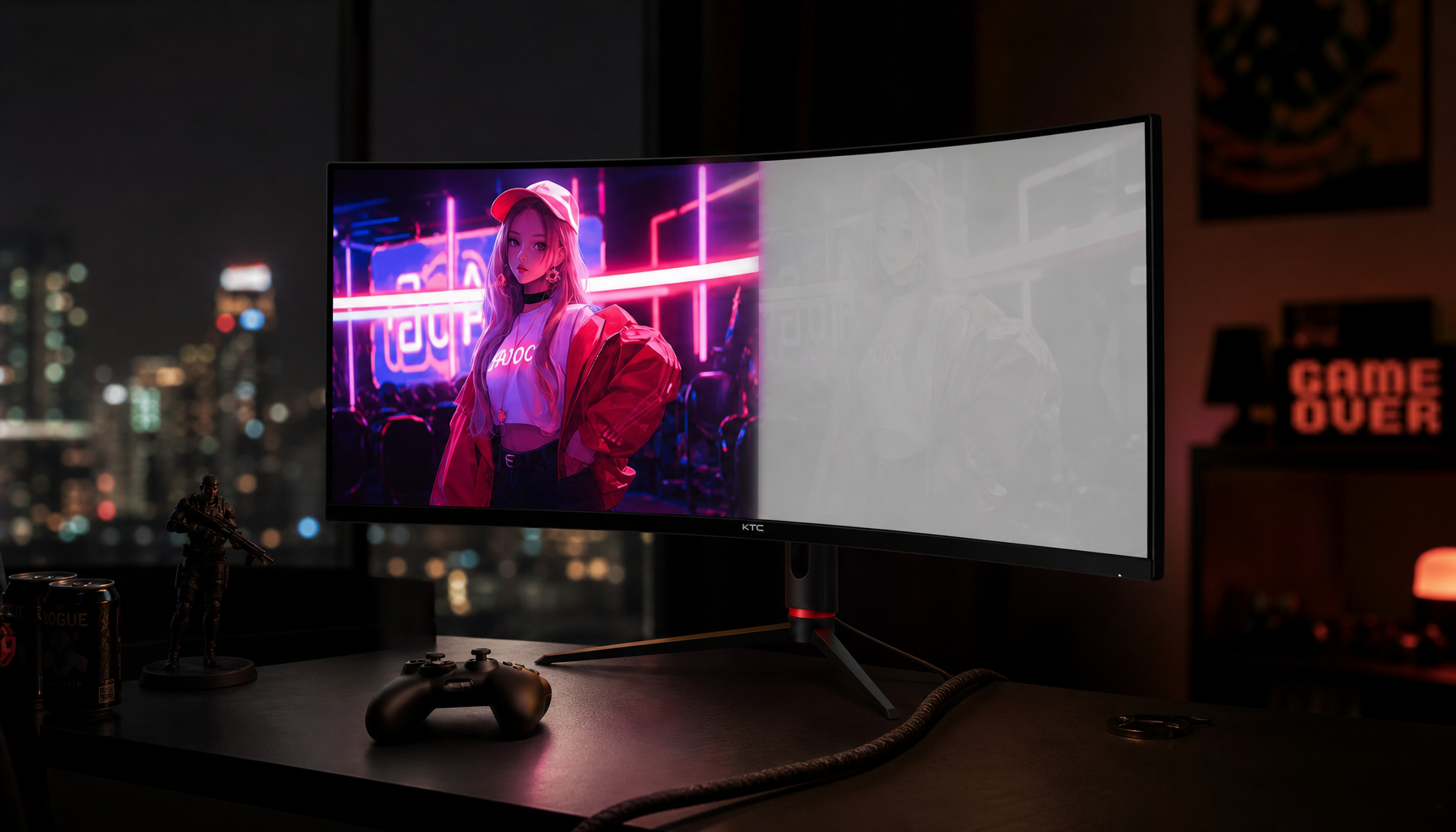
Motion blur reduction, often marketed through low-persistence or backlight-strobing modes, usually works by reducing how long each frame remains visible. On LCD monitors, that often means the backlight turns off while pixels transition and flashes only when the frame is closer to settled; motion blur reduction is most effective when the frame rate, refresh rate, and strobe timing are tightly matched.
The important split is GtG versus MPRT. GtG describes how fast pixels change between shades, while MPRT describes how long motion remains visible to your eyes. A display can advertise fast GtG and still look blurry because LCD and OLED screens are usually sample-and-hold displays, where each frame remains visible until the next refresh; sample-and-hold blur is created when your eyes track motion across those held frames.

A simple example makes the tradeoff clear. At 60Hz, each frame persists for about 16.7 ms. At 120Hz, that drops to about 8.3 ms. A well-tuned strobe mode can make the visible portion even shorter, which is why moving crosshairs, scrolling maps, and racing lines can look dramatically cleaner. The cost is that the monitor now has less time to hide pixel transitions, so artifacts that were previously smeared into general blur can become visible as distinct double images.
Why Crosstalk Appears
Strobe crosstalk is the main artifact to watch for. It looks like a duplicated edge, shadow image, or offset copy of a moving object. The cause is usually incomplete LCD pixel transition at the moment the backlight flashes; strobe crosstalk becomes visible when the panel is still partway between the old frame and the new frame.

This is why crosstalk often varies by screen position. LCD panels refresh progressively from one part of the screen to another, so the top, center, and bottom are not always equally settled when the strobe fires. In hands-on monitor tuning, the center of the screen is often the cleanest zone, while the top or bottom may show stronger duplicate images. For competitive FPS play, that means a setting can feel excellent for tracking a centered target but look distracting during large vertical camera movement.
The issue is not always true crosstalk. Low frame rates can create duplicate-image effects even without strobe timing failure: 60 fps on a 120Hz strobed display can look doubled because each rendered frame is effectively shown across two refresh opportunities. That distinction matters because tuning the strobe will not fix a frame-pacing problem. If your game fluctuates between 80 and 120 fps on a 120Hz strobe mode, the fix is often a stable frame cap, lower graphics settings, or a lower refresh and strobe rate that your GPU can actually sustain.
Panel Type Matters
Different panel technologies respond differently to blur reduction because their transition speed, contrast behavior, and retention risks are not the same.
Blur reduction behavior |
Main artifact risk |
Best use case |
|
Usually the easiest LCD type to strobe cleanly because transitions are fast |
Lower contrast and weaker viewing angles remain visible |
Competitive gaming where speed matters more than image richness |
|
Fast IPS LCD |
Often a strong balance of clarity, color, and usable strobing |
Crosstalk or overshoot if overdrive is pushed too hard |
Esports plus mixed gaming and productivity |
VA LCD |
High contrast, but slower dark transitions can fight strobing |
Dark smearing, crosstalk, and duplicate-looking trails |
Immersive play where contrast matters more than perfect motion |
OLED |
Near-instant pixel response, but still sample-and-hold unless using low-persistence methods |
Image retention or burn-in from static content, not LCD-style strobe crosstalk |
Premium gaming and media with good static-image management |

TN’s advantage is speed. Many TN gaming monitors have historically delivered the cleanest motion with fewer transition-related trails, which is why they stayed relevant in esports long after IPS became the better-looking daily display. The tradeoff is use-specific: if you edit photos, work in spreadsheets all day, or want rich single-player visuals, a TN panel’s viewing angle and contrast limitations may cost more than a small motion advantage is worth.
IPS is the practical sweet spot for many buyers. Modern Fast IPS panels have narrowed the response-time gap while keeping strong color consistency and wide viewing angles. Motion blur reduction can work well here, but the fastest overdrive mode is not automatically the best one. If you see bright halos or colored outlines around moving text, you are likely seeing overshoot, not improved clarity.
VA is the most sensitive LCD category for this question. VA panels deliver the deeper blacks that make curved ultrawide gaming and dark-room media feel immersive, but their slower dark-to-light transitions can collide with strobing. In real use, that can mean a night map in a shooter looks rich when blur reduction is off, then shows bold shadow trails or duplicate contours when it is on. For VA, motion blur reduction should be treated as a game-specific mode, not a default desktop setting.
Image Retention Is a Different Problem
Image retention is not the same as strobe crosstalk. Crosstalk is a motion artifact caused by timing and transitions. Image retention is a persistence or aging issue where previous static content remains faintly visible after it should disappear.
OLED deserves special attention here. OLED pixels emit their own light, so they can switch extremely quickly, but they can still show perceived motion blur because the frame may be held onscreen like other modern displays. OLED motion blur is often persistence-based rather than response-time-based. Low-persistence OLED driving, black-frame insertion, or rolling-scan methods can improve clarity, but they require brightness headroom and may add flicker or comfort tradeoffs.
For productivity, OLED image retention risk comes mainly from static UI elements: taskbars, browser bars, white document backgrounds, fixed app panels, and window borders. OLED productivity guidance points to brightness, temperature, and static images as key burn-in factors, with practical mitigations such as pixel shift, panel protection cycles, taskbar hiding, and static-screen detection; OLED monitors can be viable for work, but they need disciplined settings.

A real-world office example is a 34-inch OLED used for eight hours of spreadsheets, email, and dashboards. Motion blur reduction is not the concern there. The smarter move is keeping brightness moderate, enabling pixel maintenance features, hiding static taskbars, and using darker or varied layouts when possible. For a two-hour gaming session afterward, low-persistence or BFI can be useful, but it should not distract from static-image care during the workday.
Pros and Cons of Enabling Blur Reduction
The upside is direct and measurable by eye. Fast panning becomes easier to track, small moving targets look less smeared, and side-scrolling text or map detail can remain readable at higher speeds. Research on strobe backlights describes major reductions in perceived blur when the backlight hides pixel transitions and flashes during the cleaner part of the refresh cycle; strobe backlights are valuable because they attack persistence blur, not just pixel response.
The downsides are just as real. Brightness drops because the screen is dark for part of each refresh. Flicker can bother sensitive users. Adaptive sync is often disabled, although some newer implementations combine the two with mixed results. Poor tuning can create crosstalk, inverse ghosting, microstutter, or color shifts. In other words, blur reduction is a performance mode, not a universal image-quality upgrade.
The most reliable rule is to enable it only when your frame rate is stable. A 144Hz strobe mode wants a consistent 144 fps. If your system hovers between 90 and 130 fps, variable refresh rate will usually feel better than strobing because it reduces tearing and uneven pacing. If you can lock a game at 120 fps more reliably than 144 fps, a 120Hz strobe mode may look cleaner than an inconsistent 144Hz mode.
How to Test and Tune It
Start with the monitor at native resolution and a refresh rate your PC can sustain. Then compare motion blur reduction off versus on in a repeatable scene: a training range, a racing replay, a side-scrolling test, or a browser-based motion test. Look at the center first, then the top and bottom. If the center is sharp but the edges duplicate, you are seeing strobe crosstalk rather than normal blur.
Next, adjust overdrive. Use the fastest setting that does not create obvious halos or coronas. On many monitors, that is the middle setting, not the “Extreme” setting. Overdrive and strobing interact because the panel may be pushed harder to finish transitions before the flash. If the image gets brighter-edged or outlined, reduce overdrive before blaming the panel.
If your monitor offers strobe phase, pulse width, duty cycle, or similar controls, tune for the area of the screen where your eyes spend the most time. Competitive players may prioritize the center. Productivity users should usually leave strobing off because scrolling clarity is rarely worth lower brightness, flicker risk, and possible text artifacts over a full workday.
Buying Advice for Gaming, Office, and Portable Displays
For esports, prioritize a monitor with proven low-crosstalk blur reduction, strong overdrive tuning, and enough brightness in strobe mode. Do not buy from the MPRT number alone. A “1ms MPRT” claim tells you the monitor has a low-persistence mode, not that the mode is clean, bright, or comfortable.

For office productivity, a clean 120Hz or higher refresh rate without strobing is often the better value. Cursor movement, scrolling, and window dragging feel smoother, while brightness and adaptive sync behavior stay consistent. If you use OLED for productivity, panel-care features and static-image habits matter more than motion blur reduction.
For portable smart screens, blur reduction is rarely the top priority unless the device is built for gaming. Brightness, power draw, text clarity, color accuracy, USB-C behavior, and eye comfort usually matter more. A portable screen that strobes aggressively but looks dim in a bright room is not a performance win.
Final Verdict
Motion blur reduction can absolutely introduce crosstalk on LCD panels, especially VA and poorly tuned IPS implementations, while OLED’s bigger long-term concern is image retention from static content. Use blur reduction as a targeted gaming tool: lock the frame rate, tune overdrive conservatively, check the whole screen for duplicate images, and turn it off when brightness, comfort, adaptive sync, or desktop consistency matters more.