Competitive players usually want maximum visual clarity, while single-player players often prefer a more cinematic sense of motion. The best setting depends on the game, your frame rate, and how your monitor handles motion.
Motion Blur Is Not Bad by Default
motion blur softens or streaks moving imagery. Developers use it to mimic camera behavior, emphasize speed, and make lower frame rates feel less harsh during quick pans. In story-driven games, racing games, and cinematic action games, that can be the right tradeoff because the goal is not pure target clarity. It is mood, continuity, and impact.
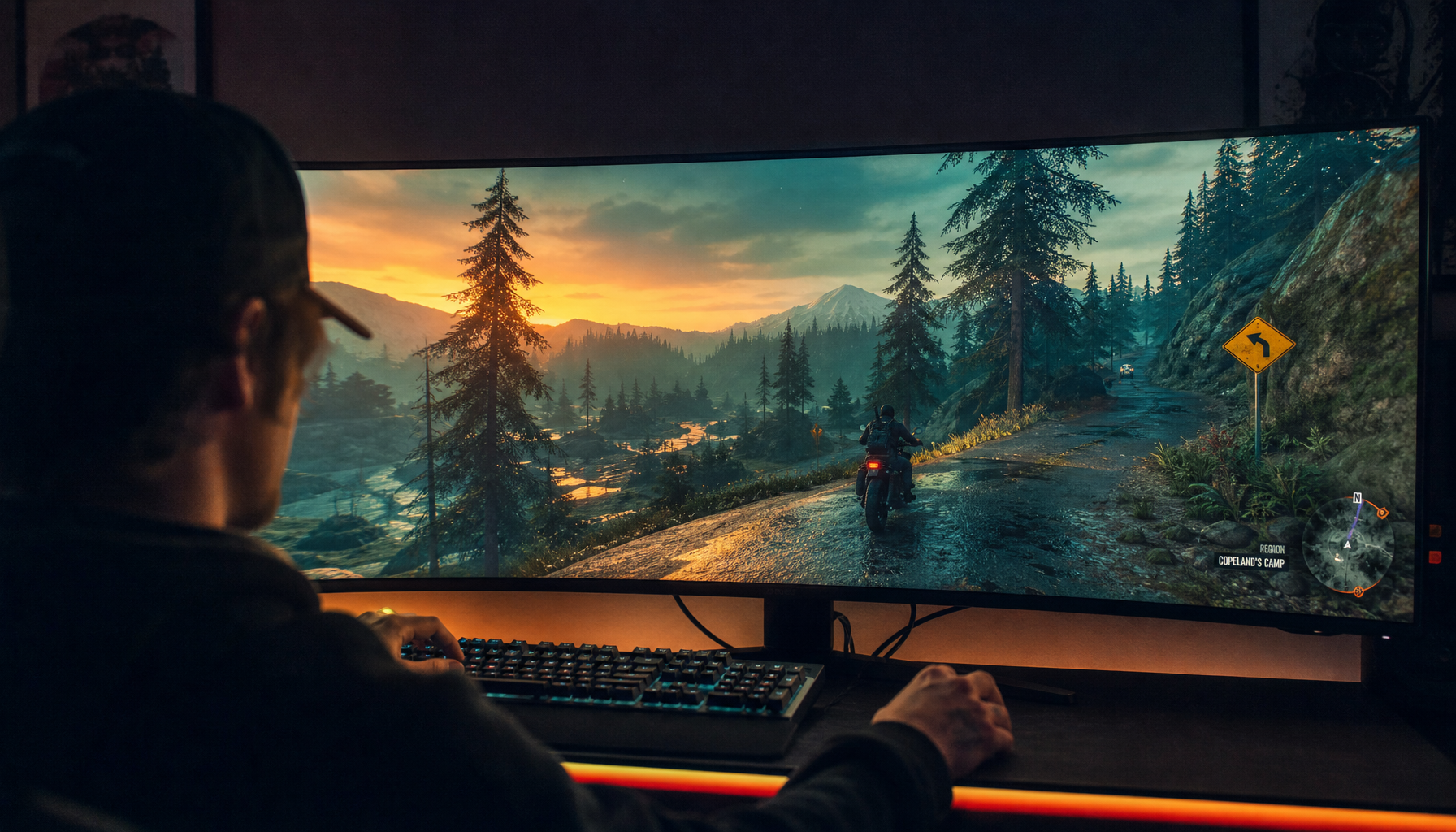
motion blur helps create speed, realism, and smoother transitions. That is why many players who spend their time in open-world adventures or single-player action games keep at least some blur enabled. When you are riding through a city, drifting through a corner, or sweeping across a large environment, a controlled amount of blur can make motion feel intentional instead of choppy.

In practice, camera blur and object blur also behave differently. Whole-screen blur during every mouse flick is usually what irritates competitive players first, while subtle per-object blur can be much less distracting in slower games. That distinction matters because “motion blur on” can mean very different things from one game to another.
Why Competitive FPS Players Usually Turn It Off
In games like Counter-Strike 2, Valorant, Apex Legends, and Fortnite, players constantly read fine detail during motion: a shoulder at a doorway, recoil recovery, a head peek through smoke, or a strafe change at mid-range. If the image smears while you flick, your eye has to work harder to separate the target from the background.
higher refresh rates such as 144Hz and 240Hz improve motion clarity, which is exactly why blur feels so counterproductive on esports setups. Once you invest in a 240Hz panel, fast pixel response, and a stable frame rate, adding a post-processing effect that softens motion works against the reason you bought the display. On a tuned 240Hz setup, the screen is already giving you a cleaner motion path, and blur partly hides that advantage.
240Hz displays show a new frame every 4.17 ms, versus 6.94 ms at 144Hz. That 2.77 ms gap does not sound large on paper, but in play it tightens visual updates during tracking and flicks. If you then layer motion blur on top, you reduce the visible benefit of the faster update cycle. That is why competitive players often describe blur as making aim feel muddy, even when input latency itself has not changed much.

Motion blur can also lower performance rather than improve it. That makes it an easy setting to cut during performance tuning, especially because other settings, such as texture quality, may preserve image quality better for the same GPU budget.
Why Single-Player Gamers Often Keep It On
Motion blur can improve the sense of speed in racing and sports games. The same effect that annoys an esports player can enhance a cinematic single-player experience, because the player is not usually tracking a tiny head hitbox during a 180-degree snap. Instead, they are absorbing atmosphere, momentum, and spectacle. In those moments, slight blur can make movement feel more natural and less digitally abrupt.
Fast camera turns in first-person games can also look unnaturally crisp at lower frame rates. That is why single-player fans often tolerate, or even prefer, moderate blur in games built around immersion. If your priority is dramatic traversal, weather, explosions, and camera weight, blur can help tie those elements together. It is not about winning the duel; it is about feeling the scene.
Frame rate also changes the answer. At 30 FPS or 60 FPS, motion can look harsher during pans, especially on large screens, and blur may hide some of that roughness. At 120 FPS and above, many players find the same blur unnecessary because the underlying motion is already much smoother. The right setting depends not just on genre, but on genre, frame rate, and screen behavior together.
Your Monitor Changes the Outcome More Than Most Players Realize
Modern flat panels use a sample-and-hold method, so some blur does not come from the game setting at all. It comes from how the display presents motion. That is why two players can use the same game preset and come away with completely different opinions. A fast 240Hz IPS or TN esports monitor will present motion very differently from a slower VA panel with dark smearing.
Slow pixel response time is also a major cause of ghosting. If your display leaves trails behind moving objects, disabling in-game blur may help, but it will not fix the panel itself. That is where response-time tuning, sensible overdrive, and refresh-rate choice matter. Practical monitor guidance generally points to the same middle ground: use a faster response mode, but do not force the most aggressive overdrive setting if it creates bright inverse ghost trails.

motion blur reduction can improve clarity but often. This is one of the few cases that can change the advice. A competitive player may prefer backlight strobing for extra clarity, but those modes can dim the image, feel uncomfortable to sensitive users, or conflict with variable refresh rate behavior on many monitors. If your frame rate is unstable, variable refresh rate usually helps more overall than blur-reduction strobing.
brightness should be adjusted for room conditions, while. That matters because an over-sharpened, overly bright panel can send you chasing the wrong fix. Many people blame motion blur when the bigger issue is poor overdrive, an incorrect refresh-rate setting in Windows, or a monitor running below its advertised maximum refresh.
How to Decide Setting by Setting
Set the monitor to its native resolution and advertised maximum refresh rate in Windows first. Only then should you judge whether motion blur is helping or hurting, because testing blur at the wrong refresh rate leads to bad conclusions. A player on 60Hz, 144Hz, and 240Hz is not really evaluating the same effect.
Use case |
Better default |
Why |
Ranked FPS, tactical shooters, battle royale |
Off |
Preserves target clarity, tracking, and visual separation during flicks |
Racing, sports, cinematic action |
Low or medium |
Enhances speed and smoothness if it does not obscure UI or road detail |
Story-heavy single-player at 30–60 FPS |
Low |
Can hide harsh camera pans and add polish |
High-FPS single-player on a fast monitor |
Off or low |
Native motion is already smooth, so extra blur often adds little value |
A reliable test is simple. Load a scene with a fence, doorway, or small text detail, then strafe or pan the camera quickly. If the detail becomes harder to read or the target outline dissolves, turn blur off or lower it. If the motion feels harsh and disconnected at modest frame rates, bring it back at the lowest useful level. That approach is more dependable than copying someone else’s settings because implementation quality varies widely from game to game.
For most mixed-use players, a well-tuned 144Hz display is still the strongest value choice. If your library leans toward ranked shooters, favor clarity and speed. If your library leans toward cinematic exploration, allow some visual softness where it genuinely improves the experience.
Motion blur is not a universal mistake; it is a tool. In competitive FPS games, it usually takes away more than it gives. In single-player games, it can still earn its place when your display, frame rate, and the game’s implementation all point toward immersion rather than precision.