Dry eye symptoms often get worse during monitor use because focused screen viewing reduces full blinking, destabilizes the tear film, and increases tear evaporation. The right monitor setup can reduce the strain, but display specs alone will not solve a medical dry eye problem.
Ever finish a workday, gaming session, or long spreadsheet review with gritty eyes, blurry text, or the urge to blink hard just to reset your vision? In one long-term computer-use study, users averaging about 7.7 hours per day had tear-film stability drop significantly from morning to evening, while low-use controls did not show the same pattern. This guide explains why displays trigger symptoms, which monitor factors matter, and how to choose and set up a screen if your eyes are prone to dryness.
Why Monitor Use Triggers Dry Eye Symptoms
Your blink rate drops when you concentrate
During normal activity, many people blink roughly 15 times per minute, but screen use can reduce that rate to about five to seven times per minute, and sometimes even lower. That matters because blinking spreads a fresh tear film across the eye surface; when you stare at a monitor, fewer full blinks mean the tear layer breaks up faster and the eye surface dries out.

This is why dry eye can feel worse during tasks that demand precision: editing video on a 32-inch 4K monitor, tracking enemies in a fast shooter, reading small text on a portable display, or comparing columns across an ultrawide screen. The problem is not simply “screen time” in the abstract. It is sustained visual attention, reduced blinking, and long periods without letting the tear film recover.
Tear evaporation is the key monitor-use mechanism
Dry eye is not only about whether your eyes make enough tears. A medical organization describes dry eyes as a problem of tears that are insufficient, unstable, or poor quality, and notes that blinking less often can increase tear evaporation during focused activities such as working at a computer. For monitor users, that points to a practical distinction: your eyes may feel fine outdoors or while walking around, but dry and scratchy after several hours at a desk because your tear film is evaporating faster than it is being refreshed.

A controlled study of long-term computer users supports that pattern. Participants who used computers for about 7.7 hours per day showed a significant evening decline in tear break-up time, from 9.15 seconds to 6.80 seconds, while tear production did not significantly change; that suggests display-related dryness may often be evaporative rather than purely a tear-production problem.
Display Habits That Make Dryness Worse
Session length matters more than one perfect spec
Two hours of continuous digital screen use per day is enough to increase the risk of computer vision syndrome symptoms, and an eye care organization notes that discomfort tends to rise as screen time increases. For monitor buyers, this means a “comfortable” display is not only the one with the best panel. A monitor used for eight uninterrupted hours can still cause symptoms even if it has high resolution, a matte coating, and a fast refresh rate.
A practical example: a 27-inch monitor at a desk may feel comfortable for a 30-minute email session, but the same display can become irritating after a full day of coding, design work, or gaming because your blink behavior changes over time. If symptoms appear predictably late in the day, the issue is probably the combination of duration, concentration, airflow, lighting, and monitor position rather than a single defective feature.
Small text and poor contrast keep your eyes locked in
Digital screen viewing can make the eyes work harder when text is less sharp, contrast is low, or glare and reflections make the image harder to see. On a monitor, that often happens when a user buys a large high-resolution display but keeps interface text too small, or when a glossy screen faces a bright window and forces the eyes to constantly refocus through reflections.
For office work, productivity, and research-heavy browsing, comfort usually improves when text size is large enough to read without leaning forward. On a 27-inch 4K monitor such as the a brand’s 27” 4K IPS 60Hz low blue light home and office monitor, many users still need display scaling rather than native-size text so reading stays comfortable during long sessions. On an ultrawide, comfort often improves when the main document or browser window stays near the center instead of forcing constant side-to-side eye movement across the full panel.

Monitor Features: What Helps, What Is Overstated, and What to Prioritize
Refresh rate can help motion comfort, but it does not fix dry eye by itself
High-refresh-rate displays can make motion look smoother, especially in games, fast scrolling, and cursor-heavy creative work. A 144 Hz, 165 Hz, or 240 Hz gaming monitor may reduce perceived motion harshness compared with a basic 60 Hz panel, but dry eye symptoms are still mainly tied to blinking, tear-film stability, screen height, glare, and session duration.
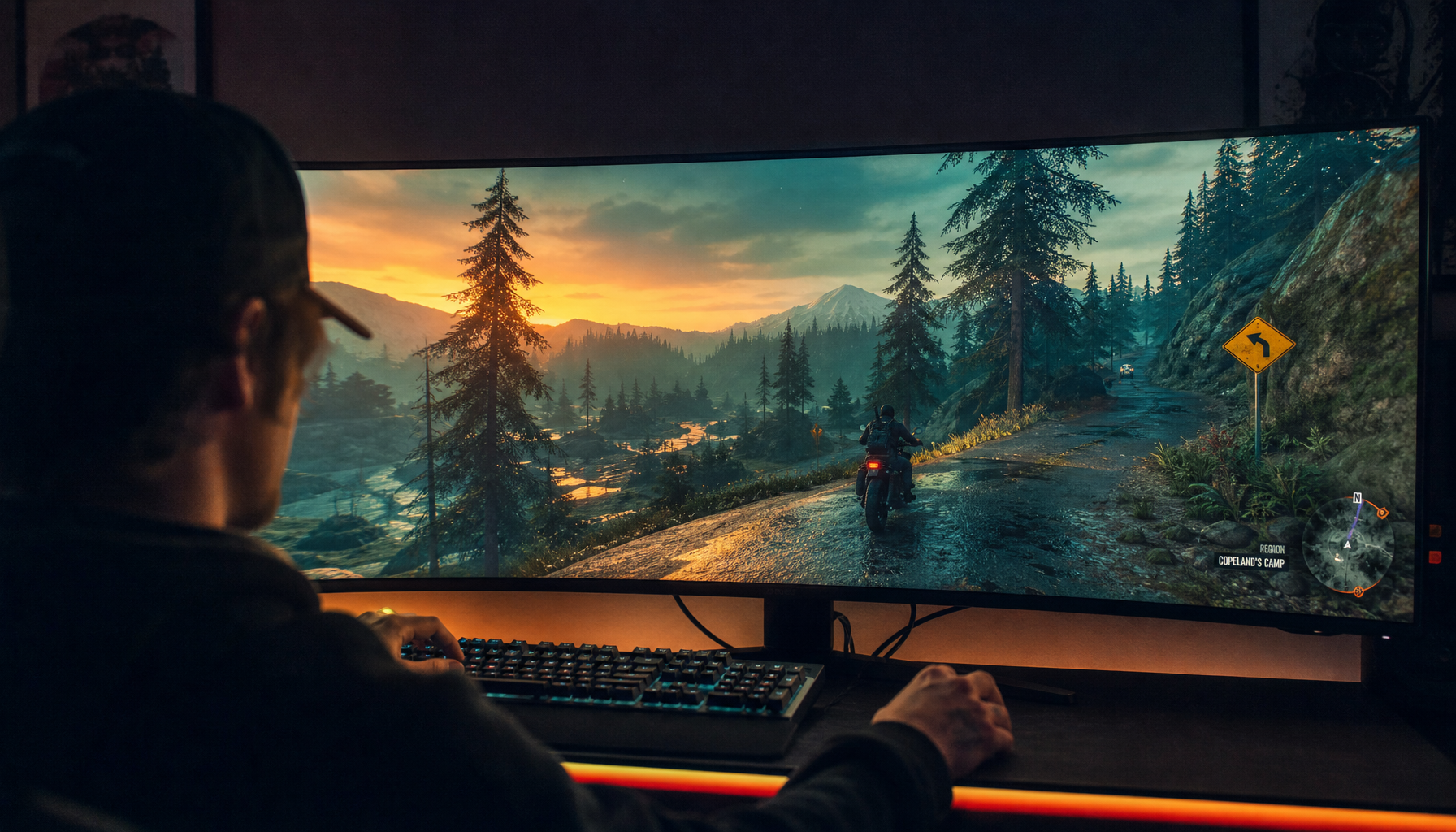
For gamers, the tradeoff is important. A high-refresh monitor can make tracking easier, but competitive play can also reduce blinking because concentration is intense and gaze is fixed. If your eyes feel dry after ranked matches or long simulation sessions, the solution is not simply a faster panel; it is also scheduled breaks, adjusted brightness, better room lighting, and a setup that does not require you to stare upward or lean forward.
Flicker control, brightness range, and glare handling are worth checking
Monitor brightness and glare can contribute to tired, dry-feeling eyes and make focusing harder near the end of the day. A display that cannot dim comfortably in a dark room, or one that reflects lamps and windows, can push users into squinting or staring more intensely. That behavior does not directly “cause” dry eye by itself, but it can worsen the screen habits that make symptoms appear.
When buying a monitor, prioritize a wide brightness adjustment range, a matte or well-controlled anti-reflective surface, stable brightness behavior, and clear text rendering. If a manufacturer advertises flicker-free dimming, low-blue-light modes, or eye-comfort certification, treat those as supporting features rather than the main reason to buy. Blue-light modes may make evening viewing feel warmer, but reduced blinking and tear evaporation remain the more direct dry-eye pathway.
Comparison: common display choices and dry-eye considerations
Display choice |
Potential comfort benefit |
Dry-eye risk to watch |
Best-fit guidance |
24-inch to 27-inch office monitor |
Easier to position at 20-28 inches; less head movement |
Text may be too small at high resolution |
Good default for dry-eye-prone workstations; increase scaling before leaning in |
32-inch 4K monitor |
Sharp text, large workspace, good for design and documents |
May sit too high or too close on shallow desks |
Use a deeper desk or monitor arm; keep the top of active content near or slightly below eye level |
Ultrawide monitor |
Reduces bezel breaks and window switching |
Wide gaze movement; side content may encourage fixed staring |
Keep primary work centered; avoid spreading tiny text across the full width |
High-refresh gaming monitor |
Smoother motion and lower perceived motion harshness |
Intense focus can reduce blinking during gameplay |
Choose high refresh for motion, but pair it with breaks, brightness control, and reminder cues |
Portable monitor |
Useful for travel, presentations, and laptop expansion |
Often placed too low, too close, or too bright |
Use a stand; avoid using it flat on a desk for long sessions |
Glossy display |
High perceived contrast in controlled lighting |
Reflections can cause squinting and visual effort |
Best only when lighting is controlled; avoid bright windows behind you |
Ergonomic Setup for Dry-Eye-Prone Monitor Users
Distance and height change how much eye surface is exposed
Monitor placement is one of the most practical fixes because it changes both viewing effort and eye exposure. An eye care organization recommends positioning the screen about 20-28 inches from the eyes, and a health platform notes that the monitor should sit about 4-5 inches below eye level to help reduce eye surface exposure and tear evaporation.

In a real desk setup, this usually means the top of the screen should not tower above your eyes. If you use a large gaming monitor on a thick stock stand, the panel may sit too high, especially on a tall desk. A monitor arm, lower-profile stand, or slightly reclined panel angle can make a large display more comfortable without changing the monitor itself.
Match brightness to the room instead of maxing it out
A common mistake is running a monitor at showroom brightness in a dim apartment or home office. If the display feels like a light source rather than a surface, you may squint, stare, and blink less. If the screen looks dull under overhead lights or window glare, you may also over-focus and strain.
A practical setup target is simple: the monitor should feel similar in brightness to the surrounding workspace. Use blinds or side lighting to control reflections, avoid placing a bright window directly behind the monitor, and do not work in a dark room with only the display lighting your face. For long evening sessions, reduce brightness gradually and use a warm color setting if it feels more comfortable, but keep enough contrast that text remains crisp.
Buying Guidance by User Type
Office workers and hybrid workers
The average American worker spends about 7 hours per day on a computer, either in the office or working from home, so monitor comfort should be treated as a daily-use requirement rather than a luxury. If your workday is mostly documents, browser tabs, spreadsheets, dashboards, and video calls, prioritize readable text, flexible height adjustment, low glare, and enough screen area to work without leaning forward.
A good practical setup is one main 24-inch to 27-inch monitor on an adjustable stand, placed 20-28 inches away, with text scaling set so you can read normal body text while sitting back. If you use two monitors, keep the primary one directly in front of you and the secondary one angled inward. Avoid placing both displays so wide that your head and eyes constantly scan from edge to edge.
Gamers and high-refresh-rate display shoppers
For gaming, a high-refresh-rate monitor can improve motion clarity, but dry eye symptoms often come from the way games hold attention. Fast shooters, MOBAs, racing sims, and strategy games can all reduce blink frequency because the player is tracking small changes continuously. A medical center notes that people may blink only about three to seven times per minute while looking at screens, and they may not fully close their eyes when focusing.
For dry-eye-prone gamers, choose a monitor with high refresh rate, good brightness control, a comfortable stand, and a screen size that fits your desk depth. A 27-inch 1440p high-refresh monitor is often easier to place ergonomically than a very large 32-inch panel on a shallow desk. If you prefer a 32-inch or ultrawide gaming display, make sure the desk is deep enough that you are not sitting too close.
Ultrawide and multi-monitor users
Ultrawide monitors are excellent for timelines, coding, market dashboards, and side-by-side documents, but they can create a different comfort challenge. The wider the workspace, the easier it is to place important content too far from the center of view. That can increase visual scanning and make users hold their eyes open while searching across a broad field.
For a 34-inch or larger ultrawide, keep the main task centered and use the side zones for supporting panels, chat, references, or tools. Do not maximize every document across the full width if it makes lines too long or forces small text. Curved ultrawides can help maintain a more consistent viewing distance across the panel, but they still need proper height, brightness, and break habits.
Portable monitor users
Portable monitors are convenient, but they are often used in the least comfortable positions: low on a desk, close to the face, next to a laptop, or under harsh travel lighting. That setup can make users look downward sharply, lean forward, or stare at small UI elements for long periods.
If you use a portable display for more than short sessions, buy a sturdy stand or case that raises it closer to your laptop screen height. Choose a model with enough brightness for varied rooms, but do not run it brighter than necessary. For travel work, a 15-inch to 16-inch portable monitor is usually easier to pack, while a larger portable screen may be more comfortable for text if your workspace allows proper distance.
Practical Next Steps
Use this checklist before replacing your monitor or assuming the display itself is the whole problem:
- Set your monitor about 20-28 inches from your eyes.
- Lower the screen so your gaze is slightly downward, with the display about 4-5 inches below eye level.
- Increase text scaling until you can read without leaning forward.
- Match screen brightness to the room and reduce window or lamp reflections.
- Take a short eye break every 15-30 minutes, or use the 20-20-20 rule during focused work.

- Blink deliberately during loading screens, meetings, reading pauses, or between game rounds.
- Use lubricating eye drops if appropriate, and consult an eye care professional if symptoms persist, worsen, or include pain, redness, light sensitivity, or ongoing blurred vision.
The most useful buying rule is to choose a monitor you can position well for the way you actually work or play. A premium display that sits too high, reflects a window, or forces tiny text can be less comfortable than a simpler monitor with better ergonomics.
FAQ
Q: Why do my eyes feel dry on a monitor but not while watching TV?
A: Monitor use usually happens at arm’s length or closer, often with text, small UI elements, and active concentration. A health publication notes that computer vision syndrome is most common with computers and typically occurs when viewing a screen at arm’s length or closer, where reduced blinking can dry the eyes and cause blurry vision or discomfort.
Q: Are gaming monitors worse for dry eye symptoms?
A: Not automatically. A gaming monitor with high refresh rate, good brightness control, and an adjustable stand can be comfortable, but gaming behavior can worsen dryness because players often stare intensely and blink less. The monitor is only one part of the system; game duration, room lighting, distance, and break habits matter just as much.
Q: Should I buy a blue-light monitor or special eye-care display for dry eye?
A: Eye-care features can be useful, but they should not be the only reason to buy a monitor. For dry eye during display use, the stronger evidence points to reduced blinking, incomplete blinking, tear evaporation, glare, viewing distance, and session length. Prioritize ergonomic adjustment, comfortable brightness, readable text, and glare control first.
References
- Long-term computer use and tear-film stability: Effects of long-term computer use on eye dryness
- Screen use, blink rate, and eye breaks: Electronic screen alert: Avoid this vision risk
- Digital eye strain symptoms and management: Computer Vision Syndrome
- Computer-related dry eye and reduced blinking: Why Do Computers Cause Dry Eyes?
- Monitor ergonomics and computer vision syndrome: Computer vision syndrome
- Computer eye strain and setup guidance: Tips for Computer Eye Strain and Dry Eye Relief
- Dry eye disease and digital screen use review: The Relationship Between Dry Eye Disease and Digital Screen Use
- Dry eye symptoms, causes, and prevention: Dry eyes - Symptoms & causes