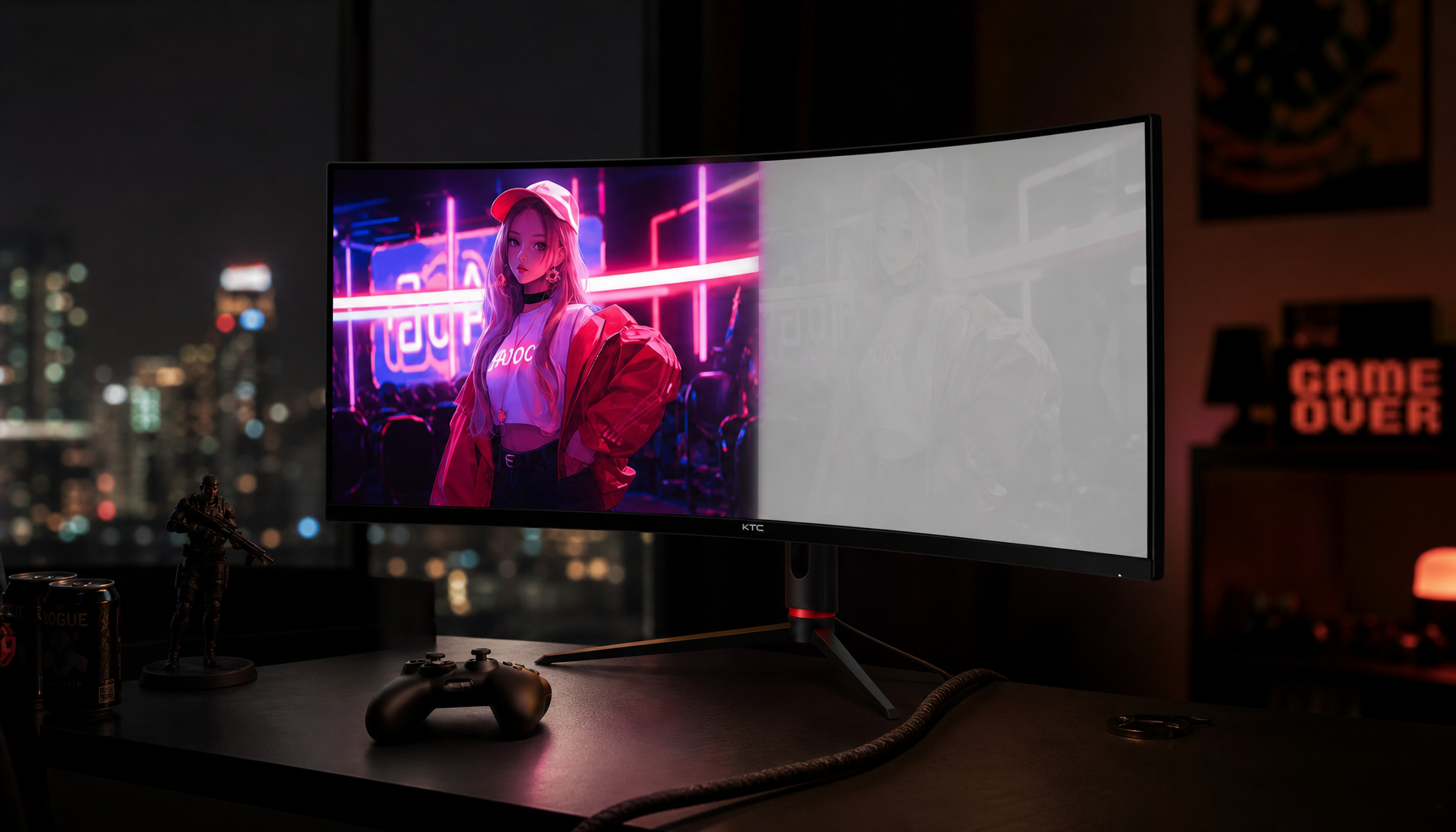
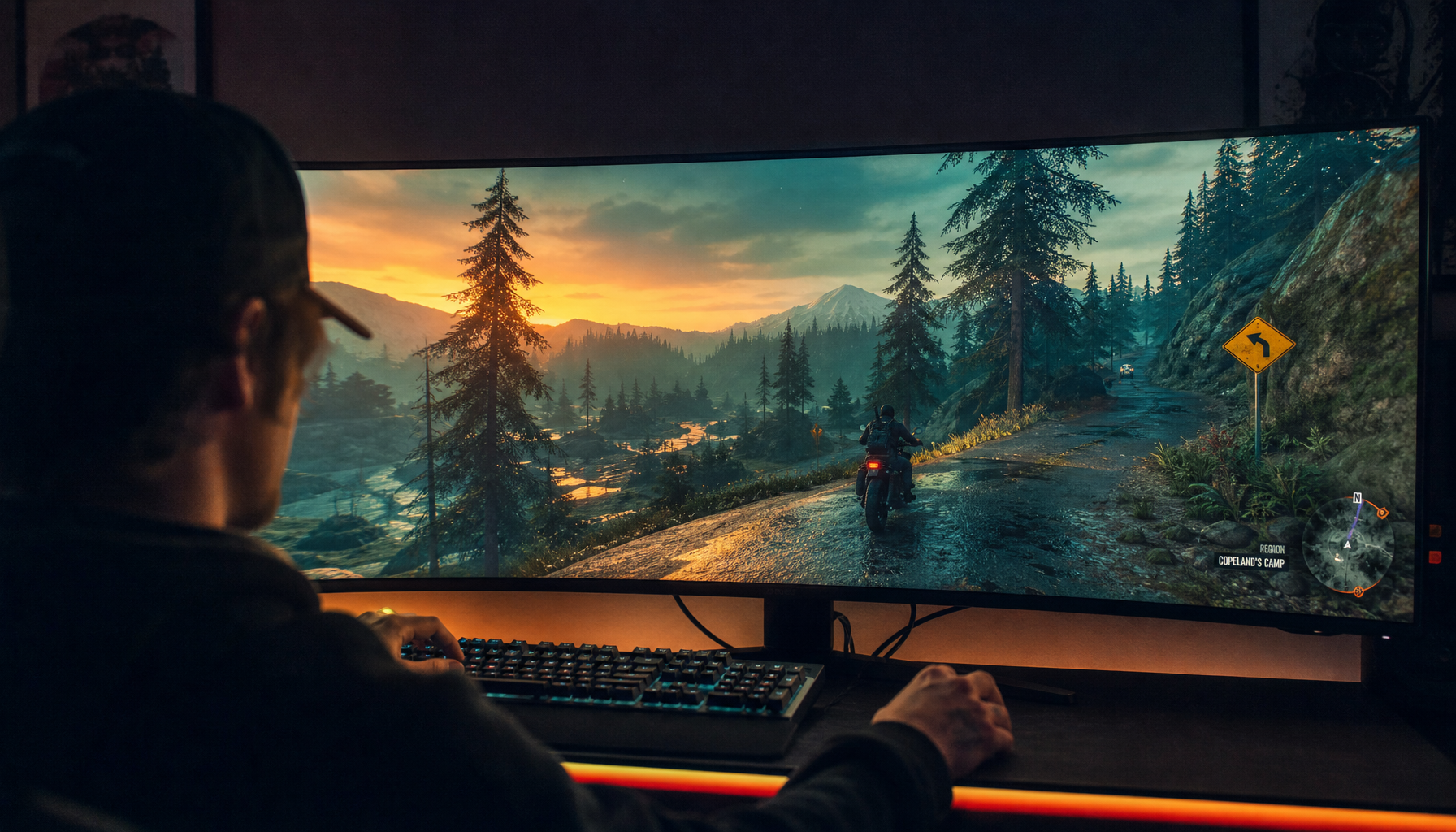
When a display receives colors it cannot physically reproduce, it does not show them exactly. It either clips them to the nearest reproducible color or remaps them into its smaller color range, which is why the same game, desktop wallpaper, or photo can look different from one monitor to another.
You have probably seen this in real life: a sunset looks flat on one monitor, neon signs look too intense on another, or skin tones shift oddly when you switch from a laptop to an ultrawide. The practical benefit of understanding gamut handling is simple: you can stop buying displays based on coverage percentages alone and start choosing models and settings that actually produce believable color for gaming, media, and everyday work.

What “Out of Gamut” Means on a Monitor
A monitor always works inside limits
A color gamut is the range of colors a device can reproduce, and every monitor has limits. That matters for gaming monitors, ultrawide displays, and portable monitors because the panel can only mix its red, green, and blue primaries within a fixed range, even if the source content asks for something more saturated.
The visible range of human color is also larger than any current consumer display. A finite set of display primaries cannot reproduce every visible color exactly, especially highly saturated greens, cyans, blues, and violets. In buying terms, that means even a strong DCI-P3 gaming monitor is still an approximation device, not a perfect window into all visible color.
Why the same image changes from screen to screen
The same RGB numbers do not guarantee the same appearance on different displays because each monitor has its own color space and behavior. A monitor and printer interpret identical color values differently, and the same is true when you compare a budget sRGB office display with a wide-gamut OLED gaming panel.
That is why a 34-inch ultrawide rated at 95% DCI-P3 can make a game world look richer than a portable monitor that barely covers sRGB, while a well-tuned sRGB screen may still look more correct in desktop apps on a platform. Wider gamut expands what the monitor can show, but it does not automatically guarantee that the content is being translated properly.
What Actually Happens to Colors Outside the Gamut
Clipping is the blunt solution
When content asks for a color the panel cannot hit, one common result is clipping. A publication discussion of monitor gamut testing notes that colors outside a display’s gamut are approximated rather than reproduced exactly; in practice, that often means extreme colors get pushed to the nearest boundary the display can reach.
On screen, clipping usually looks like lost nuance at the edges of color. A bright red UI accent in a game may become a flatter, less differentiated red on a narrow-gamut panel. In HDR scenes, intense foliage, warning lights, or sunset gradients can lose their subtle separation if the display runs out of color volume before the content does.
Gamut mapping is the smarter compromise
A more refined approach is gamut mapping, sometimes called compression or remapping. Instead of crushing only the most extreme colors, the monitor, GPU, or software can shift a broader range of colors so the image stays balanced inside the display’s limits. The color-management notes from a university frame this as correction after soft proofing and gamut warning: what is out of gamut in one profile may be in gamut in another, so the target space matters.
This is where buying guidance becomes practical. Two gaming monitors can both advertise 99% sRGB, yet the one with better firmware, an accurate sRGB mode, and lower color error will preserve more believable color relationships. Coverage tells you the size of the box; mapping quality determines how gracefully the image fits inside it.

Why HDR complicates the picture
HDR adds another layer because HDR content often targets wider gamuts such as DCI-P3, while Rec. 2020 remains a longer-term container target. A monitor-focused publication explanation of oversaturation notes that HDR commonly targets DCI-P3, so a monitor that only barely covers that space may still need aggressive remapping in bright, saturated scenes.
For buyers, this means HDR badges alone are weak signals. A monitor is more likely to handle wide-color HDR convincingly when it combines strong gamut coverage with real brightness and usable tone mapping, not just a checkbox on the spec sheet.
Why Wide-Gamut Monitors Can Look Worse With Normal Content
Oversaturation is the most common real-world problem
A wide-gamut monitor can oversaturate standard sRGB content when the app, game, or operating system does not manage color correctly. Instead of remapping sRGB colors into the intended space, unmanaged content is effectively stretched across the larger gamut, making ordinary shades look more intense than they should.
That shows up in very specific ways. Yellows can lean orange, oranges can push red, reds pop too hard, and skin or earth tones can look unnaturally warm. On a high-refresh gaming monitor, this can make a racing game or open-world title feel punchy at first glance but less accurate over time, especially if most of your play happens in SDR.

A platform and games do not always behave consistently
A forum discussion on managing WCG oversaturation on a platform explains why this is still a headache: ICC profiles describe monitor behavior, but they do not perform the actual gamut conversion by themselves, and non-color-managed apps may ignore them. That is why one monitor can look correct in a managed browser but too vivid on the desktop or in certain older games.
A real-world troubleshooting case on a hardware forum described colors becoming more saturated when specific games opened, even with HDR disabled and no obvious setting changes in a platform or the monitor OSD. For buyers, that is the warning sign: if you want a wide-gamut display mainly for everyday SDR gaming, an accurate sRGB mode is often more valuable than the widest native gamut.
Which Specs Matter Most When You Compare Monitors
Coverage numbers are useful, but only to a point
A practical buying guide for wide-gamut gaming monitors recommends at least 95% sRGB for a good all-around monitor and 90% or more DCI-P3 if you want richer color for games, media, or creation. Those are useful thresholds, especially when you are comparing gaming monitors in the $300.00 to $600.00 range against cheaper portable or entry-level office displays that may fall below 90% sRGB.
But coverage alone does not tell you whether the monitor is accurate. The same discussion of SDR testing and color error points out that dE 2000 above 3 is noticeable to a trained eye and above 5 is visible to most people. A display with 99% sRGB and sloppy tuning can still look less correct than a slightly smaller-gamut panel with tighter calibration.
Panel type and mode selection matter
The gaming-oriented guidance is directionally useful here: IPS panels are generally the safest choice for color-critical gaming and mixed use, VA offers higher contrast with some viewing-angle compromises, OLED delivers excellent blacks at a higher price, and TN still trails in color quality. That matters even more on ultrawide monitors, where off-axis behavior can become visible across the width of the screen.
Color modes also deserve more attention than they usually get in product listings. If a monitor has a well-implemented sRGB or Rec.709 clamp mode, it can prevent the oversaturated desktop look that frustrates many wide-gamut buyers. If it does not, you may spend more time fighting the monitor than enjoying the extra color range.
Comparison table for buying decisions
Typical color target |
What out-of-gamut handling looks like |
Best use case |
Main risk |
|
Standard-gamut SDR monitor |
95% to 100% sRGB |
Less room for saturated HDR-style color, but fewer surprises in normal desktop use |
Everyday gaming, office work, portable monitors |
Flat-looking wide-color content |
Wide-gamut monitor without good clamp mode |
90%+ DCI-P3, strong native gamut |
Can show richer color, but unmanaged SDR may look exaggerated |
HDR gaming, media, hybrid gaming/creation |
Oversaturated web, UI, and SDR games |
Wide-gamut monitor with accurate sRGB mode |
95%+ sRGB plus 90%+ DCI-P3 |
Lets you switch between controlled SDR and richer wide-color modes |
Best all-around pick for gaming monitors and ultrawides |
Quality depends on implementation |
Creator-leaning display with calibration support |
100% sRGB, often 90%+ a wide-gamut color space or DCI-P3 |
Better profile-based control and more predictable mapping |
Photo work, streaming, editing, gaming second |
Higher cost, setup complexity |
How to Set Up a Monitor So Color Looks More Believable
Start with the right baseline
A monitor tuning walkthrough recommends resetting to factory defaults, using a Custom or sRGB mode, setting brightness and contrast so both black and white steps remain visible, and targeting a color temperature around 6500K with gamma near 2.2 for standard use. Those are not glamorous tweaks, but they solve a surprising number of “bad color” complaints on gaming and portable displays.

This matters because many monitors ship in showroom-friendly modes with excessive contrast, overly cool white balance, or boosted saturation. On a 240 Hz esports monitor, those settings can make highlights clip and dark areas lose detail. On a portable monitor, they can make battery-conscious brightness limits feel even more restrictive because the panel is wasting contrast on poor defaults.
Use clamp modes or GPU tools when needed
A forum discussion of gamut-clamp options mentions a driver-level sRGB emulation feature, a vendor-specific clamp tool, and a LUT-based tool as ways to rein in wide-gamut oversaturation. The key idea is simple: if the monitor cannot clamp itself well, the GPU or OS layer may be able to simulate a more appropriate target space.
If you go down that route, consistency matters. ICC profiles describe the monitor, while a 3D LUT or clamp transform performs the actual conversion, so mismatched profiles can cause double correction or inconsistent behavior across apps. For most buyers, the easier path is still to favor a monitor with a reliable built-in sRGB mode over one that requires software workarounds.
Who Should Buy Wide Gamut and Who Should Not
Wide gamut makes the most sense for mixed HDR and creation use
A buying-oriented view of wide color gamut rates wide gamut as high priority for story-driven games, medium-high for competitive gaming, and very high for streaming or content creation. That tracks with real-world use: if you play cinematic titles, watch HDR content, and edit screenshots or video, the extra gamut has visible value.
It also makes sense on premium ultrawide and OLED monitors, where the whole package usually includes better panel uniformity, better contrast, and stronger HDR performance. In that class, wide gamut is part of a system that can actually use it.
Standard gamut is still the safer buy for many people
A forum discussion about sRGB output workflows captures the core tradeoff well: if your final output is almost always sRGB, a wider-gamut monitor is not automatically more useful. A forum question from a web-focused user raises the same point for screen-first work such as web design and light gaming.
If your main tasks are browsing, office work, SDR gaming, and occasional streaming, a monitor with near-complete sRGB coverage, low color error, and a good refresh rate is often the smarter purchase. That is especially true for portable monitors and budget gaming displays, where chasing wider gamut can come with weak clamp modes or inconsistent factory tuning.
FAQ
Q: Do out-of-gamut colors disappear on a monitor?
A: Not exactly. The monitor still shows something, but it substitutes the requested color with the closest color it can reproduce or remaps nearby colors to fit inside its gamut.
Q: Is a wide-gamut gaming monitor always more accurate than an sRGB monitor?
A: No. A wide-gamut panel can be less accurate with normal SDR content if color management is missing or if the monitor lacks a good sRGB mode.
Q: How can I test whether my monitor is handling wide color properly?
A: A practical starting point is the wide-gamut test page, which can reveal ICC support, wide-gamut behavior, and whether SDR and HDR images are being displayed as expected in your browser and system setup.
Final Takeaway
If a monitor receives colors outside its gamut, it cannot reproduce them literally. The real question for buyers is how gracefully it fails: cheap clipping looks harsh, good mapping looks natural, and poor color management can make ordinary content look worse on an otherwise impressive panel.
For most monitor buyers, the best choice is not “widest gamut wins.” It is a display with at least 95% sRGB, credible color accuracy, a usable sRGB mode, and enough brightness and panel quality to support your actual workload. Choose wide gamut when you will use HDR, creation apps, or premium gaming content that benefits from it; choose strong sRGB behavior when consistency matters more than maximum saturation.
References
- Cookbook - About Gamut
- Q&A forum discussion on full visible gamut
- Wide Color Gamut For Gaming How To Pick The Best
- Wide Color Gamut For Gaming How To Pick The Best
- Managing WCG Oversaturation on a platform
- Something is overriding my color profile when certain games are opened
- Is there any argument for a wide-gamut monitor if the output will be sRGB?
- Wide Gamut Test Page
- Color gamuts and over-saturation
- How your monitor’s color settings can be game-changing
- sRGB vs wide gamut for web design and graphics work
- Explaining color gamuts and color spaces in HDTVs and monitors