For most gamers, 1800R is the lowest curve that usually feels more immersive than flat, especially on 27-inch displays and 34-inch ultrawides. Stronger curves can help, but only when screen size, seating distance, and game type support them.
For most gamers, the minimum curve that reliably feels more immersive than flat is about 1800R, especially once you reach 27 inches or move into 34-inch ultrawide territory. Tighter curves like 1500R and 1000R can deepen the effect, but they are not automatically better on every desk, in every game, or at every screen size.
If you buy a bigger monitor expecting a dramatic jump in immersion, the edges can still feel far away, and the setup can even feel less focused after an hour. In real use, the shift from flat to a sensible curve is easiest to notice on mid-size and ultrawide gaming screens, while going too aggressive too soon can feel more dramatic than useful. The practical question is not how curved a monitor can be, but how much curve you need before it meaningfully improves the experience.
Why curvature helps at all
A screen shape that pulls the edges closer to your eyes makes the image feel more wrapped around your field of view instead of spread across a flat plane. That matters most when the display is wide enough that the corners sit outside your easy, relaxed vision. On a flat 34-inch ultrawide, for example, your eyes and neck do more work scanning the edges than they do on a smaller flat 24-inch esports panel.

The rating itself is straightforward. A lower R value means a stronger curve, so 1500R bends more than 1800R, and 1000R is more aggressive than both. In practice, that number is not a quality score. It is a fit score. The wrong curve can feel gimmicky, while the right one fades into the background and simply makes the screen feel more natural.
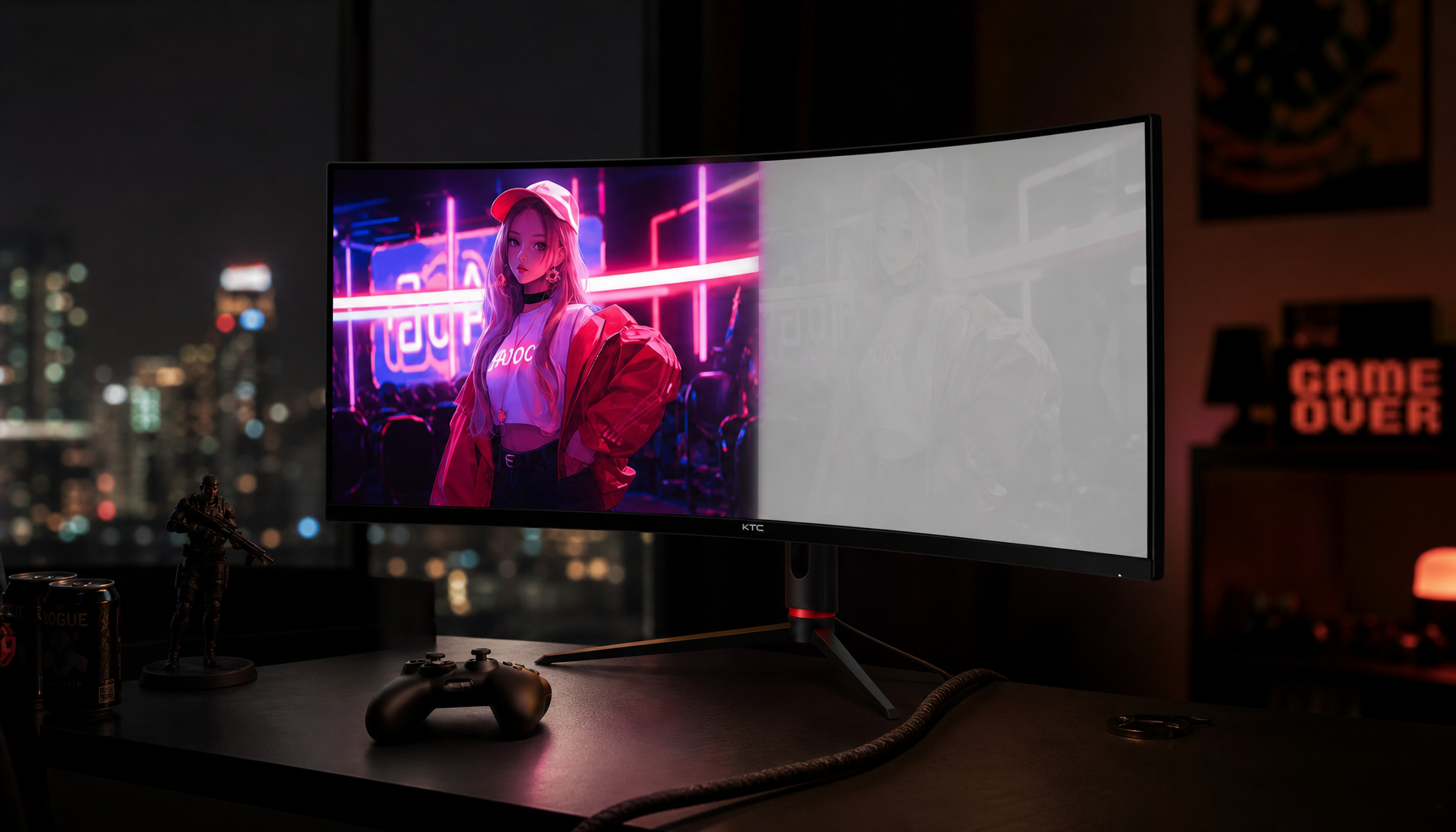
Across flat, 1800R, and tighter curved panels, the key threshold is not maximum bend but the point where the edges stop feeling detached. That is why mild curvature often works best for mixed gaming, while deeper curvature tends to shine in ultrawide and cockpit-style setups.
The minimum curve that usually makes a real difference
For mainstream gaming monitors, 1800R as a practical starting point is the first curvature that consistently delivers a noticeable improvement without pushing too far into distortion or adaptation issues. It is strong enough to make a 27-inch or 32-inch display feel less flat, yet restrained enough for mixed use, including web browsing, chat, and office work after gaming.
That recommendation also matches size-based curvature guidance, which places 1500R to 1800R on smaller curved monitors and suggests roughly 1800R to 2000R as a strong gaming range because it adds wraparound feel without overdoing the bend. In the broader market, 1800R also appears frequently on 34-inch ultrawides, which reflects where many buyers find the balance between immersion and everyday usability.
A simple example makes this easier. If you sit about 28 to 36 inches from a 27-inch or 34-inch display, 1800R usually feels like the point where the screen starts to hug your view instead of just sitting in front of you. Below that, especially on standard 16:9 monitors, the curve can be so subtle that it changes very little in play.

When 1500R or 1000R is worth it
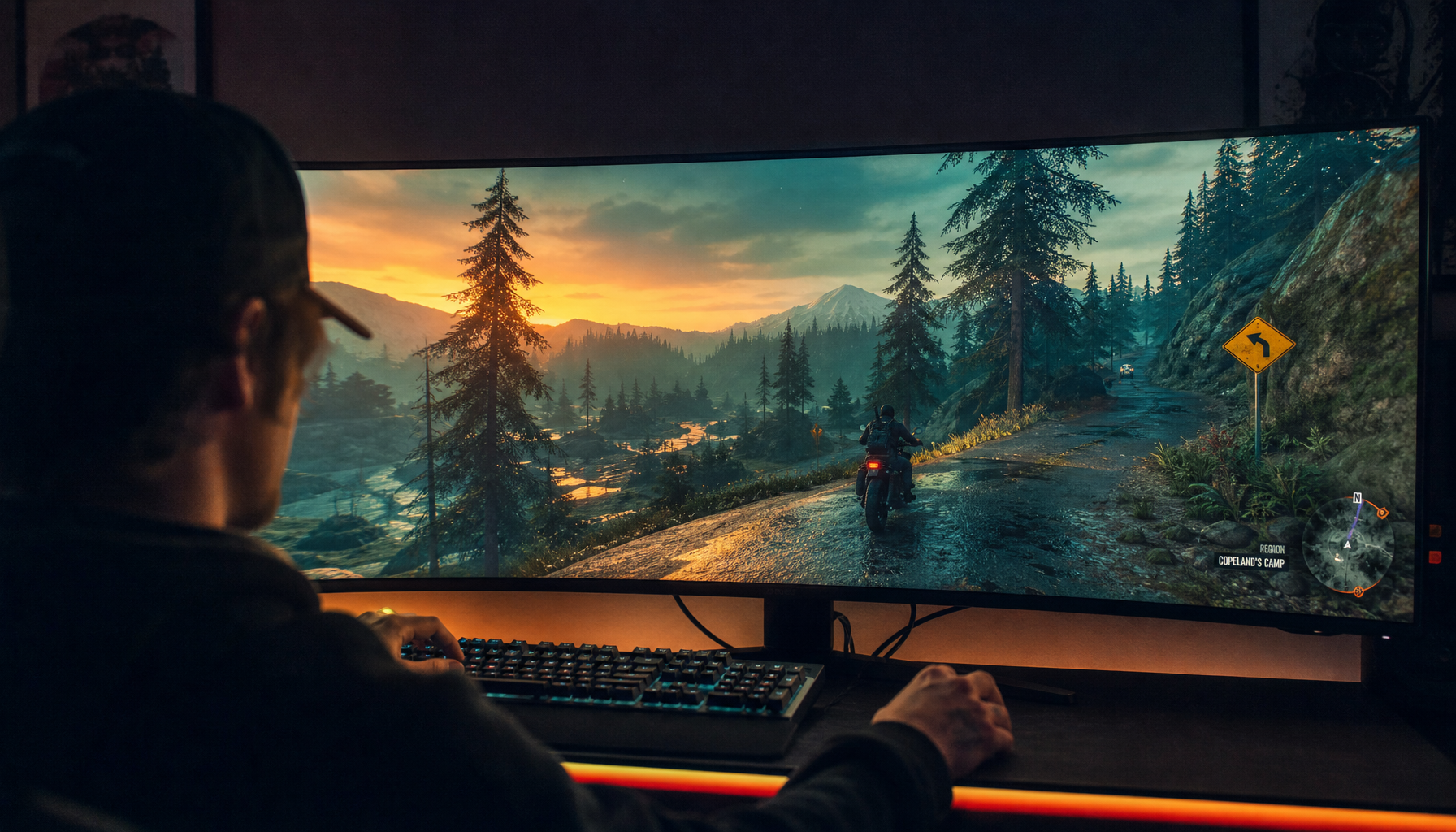
A 1500R curve becomes more appealing when the monitor is larger, the aspect ratio is wider, or the games are more environment-driven. Racing games, flight sims, open-world RPGs, and cinematic third-person titles gain more from a tighter wrap because you are not just tracking a crosshair; you are absorbing motion, scenery, and peripheral cues. On a 34-inch ultrawide, 1500R often feels purposeful rather than extreme.

A stronger wrap on very curved monitors can push immersion even further, but it is best treated as a specialized choice, not the minimum anyone should chase. Some sources favor 1000R more strongly, while others tie curve choice more closely to screen size and distortion risk. The difference is mostly about use case. A 1000R curve makes more sense on larger or more panoramic displays where the edges would otherwise sit far from your natural line of sight. On a smaller screen, that same curve can feel forced.
The practical takeaway is simple. If you mainly play competitive shooters on a standard 24-inch or 25-inch panel, 1000R is usually not where the value is. If you use a 34-inch to 49-inch ultrawide and spend hours in sim racers, survival games, or sprawling RPG maps, 1000R becomes much easier to justify.
Screen size changes the answer more than most buyers expect
The difference between 24-inch and 27-inch gaming monitors matters almost as much as the curve itself. A 24-inch screen already keeps most action inside your central field of view, which is one reason competitive players still prefer it. Add a mild curve there, and the immersion gain is often small. That is why many flat 24-inch esports monitors remain excellent choices.
Once you move to 27 inches and beyond, especially at 1440p, the case for curvature gets stronger. KTC notes that 27-inch displays tend to feel more immersive and that curved 27-inch panels may improve edge-to-edge comfort in long sessions. In plain terms, that is the point where a curve starts solving a real viewing problem rather than just adding style.
The same logic scales up quickly with ultrawides. 34-inch curved ultrawides in atmospheric and sim games stand out because the extra horizontal space benefits from being wrapped toward you. On those displays, a flat panel can feel broad; a curved panel can feel enclosing.

Immersion is not only about curvature
A curve that does not change frame rate or latency should never be chosen in isolation. If your monitor tops out at 60 Hz, the curve may look dramatic while motion still feels ordinary. For actual gameplay feel, refresh rate and response time still matter more in fast shooters.
That is why the best curved gaming setups pair sensible curvature with strong motion specs. Buying advice across the category consistently emphasizes high refresh rates, quick response times, and panel quality alongside the curved format. A 34-inch 1800R ultrawide at 165 Hz usually delivers more believable immersion than a tighter curve on a slower, blurrier display.
There is also a comfort factor. reduced perceived edge distortion and better long-session comfort can be real benefits, but only if you sit centered and at an appropriate distance. If you share the screen often, lean sideways, or play from a couch, the benefit drops.
So what should you buy?
The most reliable value point for gamers who want a real immersion bump without unnecessary tradeoffs is a 27-inch to 34-inch display with 1800R curvature, 1440p-class resolution, and at least a 144 Hz refresh rate. That is where the curve starts to matter, the image stays comfortable, and the hardware demands remain reasonable for a modern midrange to upper-midrange gaming PC.
If your setup is more cinematic than competitive, 1500R becomes the better choice. If your desk is deep, your screen is ultrawide, and your game library leans toward sims or open worlds, the stronger wrap can feel like a true upgrade rather than a spec-sheet flex.
If your priority is pure reaction speed, the refresh-rate tradeoff in fast gaming points to the more important truth: a smaller, faster flat or lightly curved monitor may help more than a dramatic curve. Immersion is only one part of performance, and the best monitor is the one that matches how you actually play.
The floor for meaningful gaming immersion is usually 1800R, not because it is the most extreme, but because it is the first curve that consistently improves the experience without demanding too many compromises. Go lower only when your screen is wide enough, your seating distance supports it, and your games will actually let that deeper wrap pay off.