Mini-LED blooming reduction is mostly about making halos less distracting in the room you actually work in, not about erasing them completely. If your mini-LED monitor sits near a window or lamp, the right preset, seating angle, and brightness level can make a bigger difference than chasing a perfect dark-room demo.

Why Blooming Stands Out at a Desk
Blooming gets easier to notice when a monitor has to handle text, spreadsheets, browser tabs, and taskbars instead of one full-screen game or movie scene. In mixed desk lighting, your eyes are already balancing screen brightness against room light, so halos around bright UI elements can feel more present even when the monitor looks impressive in a showroom.
A useful way to judge mini-LED blooming is to ask whether it distracts from your normal work posture. Ambient light changes display perception, so the same panel can feel calmer at noon and more noticeable at night.
That is why the goal for desk use should be reducing distraction, not eliminating blooming entirely. If you mostly notice halos while leaning in, changing posture, or switching into a darker app, the setup may already be usable. If the glow competes with text from your normal seat, keep tuning.
For a broader room-light strategy for that day-to-evening swing, this brightness setup guide is a good next step.
What Mini-LED Blooming Looks Like
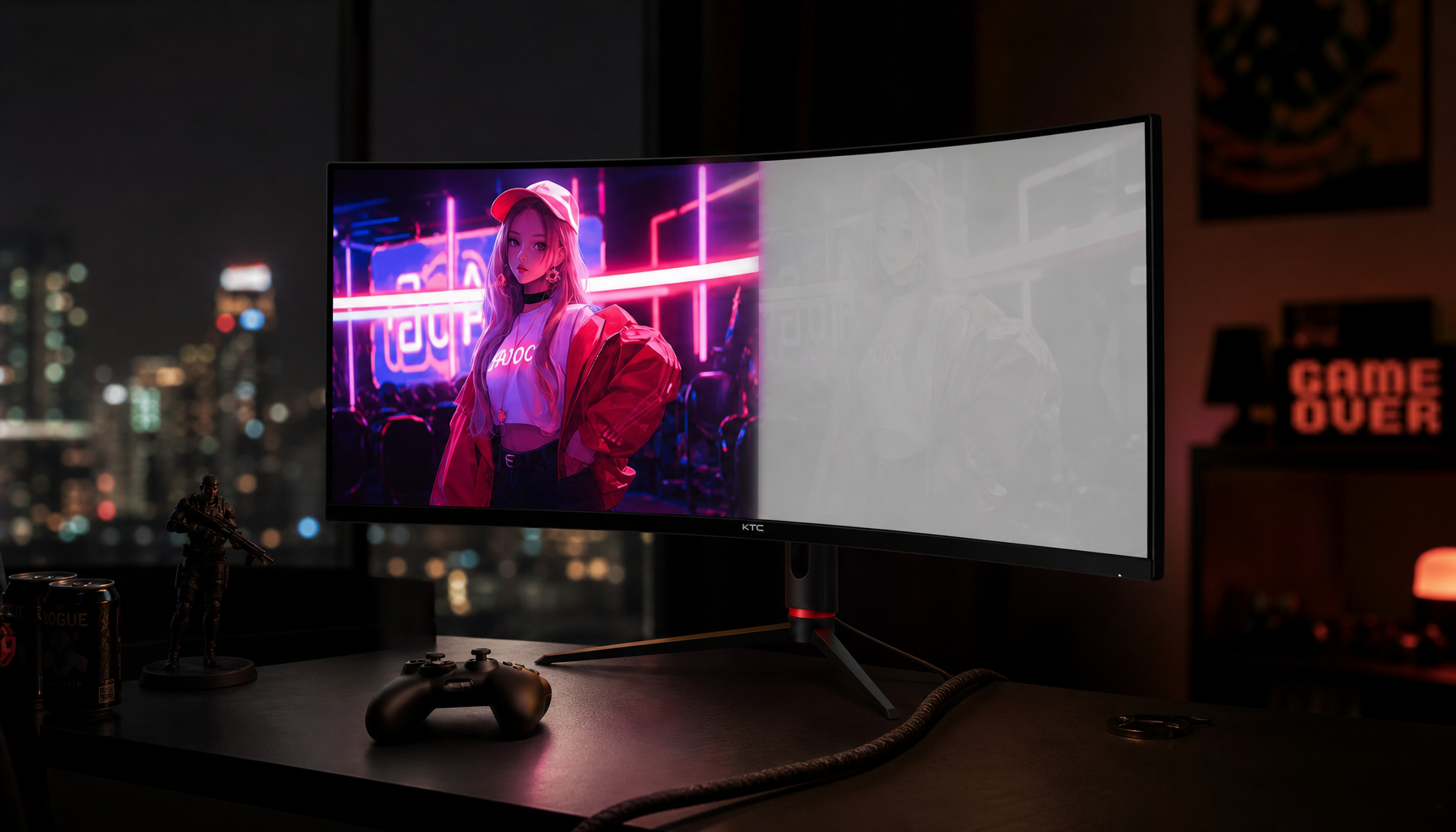
Mini-LED blooming is the halo or glow you see when backlight zones cannot line up one-to-one with pixels. In plain terms, the monitor can light a bright object very well, but the surrounding dark area may pick up some spill. That is why the effect often shows up first around white text on a dark background or a bright panel edge.
A lab analysis from Allion Labs found that halo intensity drops as you move away from the bright object, which matches what people notice at a desk: the glow is strongest right next to the edge and less obvious a little farther out. That makes close inspection misleading, because leaning in can make the halo look worse than it will during normal work.
For office scenes, blooming often appears around app headers, cursor highlights, notification cards, and dark-mode toolbars. It is not only a problem in dramatic content. Small bright elements on a dark canvas can be more distracting than a full-screen image.
Viewing angle matters too. If you sit off-center or tilt the screen too far, halos can become easier to spot. Viewing-angle behavior on mini-LED is one reason a monitor can look fine from one chair position and worse from another.
Common Desk Scenes Where Blooming Shows Up
The most obvious cases are dark-mode apps, document panes with bright text, and web pages with white cards on a darker background. People often expect blooming to show up only in movies or games, but productivity layouts can expose it faster because they keep small bright objects on screen for hours.
How Viewing Angle Changes Halo Visibility
If the monitor is too high, too low, or slightly rotated away from you, the black floor and haloing can look less even. In real desk setups, a small change in chair height or tilt can be enough to make blooming feel either manageable or annoying.
Which Image Elements Trigger the Effect Most
Bright text, thin borders, and pop-up panels are common triggers. Those elements matter because they sit right next to darker content, which is exactly where mini-LED local dimming has the hardest job.
Settings That Affect Haloing
Some settings help more than others, and the order matters. For office work, the biggest levers are usually local dimming behavior, HDR on or off, SDR brightness, contrast, and your viewing position. The catch is that these controls interact, so one aggressive setting can undo the benefit of another.
| Setting | What It Changes | Blooming Impact | Best Use For Office Work | Main Trade-Off |
|---|---|---|---|---|
| Local dimming | How tightly the backlight follows bright and dark areas | Often the biggest factor in visible halos | Use a calmer mode if the monitor offers one | Can flatten HDR pop or slightly change text stability |
| HDR mode | How the monitor maps bright highlights | Can make halos feel stronger in some scenes | Keep it off for routine text work unless HDR is needed | Less dramatic highlights in SDR tasks |
| SDR brightness | Overall screen brightness in normal desktop use | Lowering it often makes halos less distracting | Set it to the lowest level that still feels clear in your room | Too low can hurt readability in bright rooms |
| Contrast | Separation between dark and light tones | Can make bright edges feel harsher if pushed too far | Leave near the stable middle before fine-tuning | Overdoing it can crush shadow detail |
| Viewing position | How centered and level you sit relative to the panel | Poor positioning can make halos easier to see | Keep the screen straight on and at a comfortable height | Limits how much "tuning" a setting can do |
If local dimming also causes pulsing or flicker in some apps, this local dimming behavior guide can help you separate blooming from brightness pumping.
The Quick Read on Which Control Matters First
If halos are the main annoyance, start with local dimming behavior. If the whole screen feels too punchy in daylight, lower SDR brightness first. If the problem changes by time of day, the room is part of the issue, not just the monitor.
How to Calibrate for Office Use
For most desks, the cleanest mini-LED local dimming calibration workflow is simple: set the room first, then tune the screen, then verify with real work content. Do not calibrate in a dark room if you normally work with a lamp on, and do not trust a game demo to judge office use.
- Set the room the way you actually work. Turn on your normal lamp or open the blinds to your usual daytime level. Ambient light changes how contrast feels, so this step is part of the tuning, not a background detail.
- Sit in your normal position. Make sure the monitor is centered and tilted toward your eyes. Off-axis seating can make blooming look worse before any setting change.
- Start with SDR brightness. Bring it down until white windows and text feel comfortable, but not so low that the screen looks dimmer than the room.
- Check local dimming or HDR behavior. If the monitor offers more than one dimming behavior, test the calmer option for work. Some firmware labels differ, so focus on the effect, not the menu name.
- Test with office content. Use text, browser tabs, spreadsheets, and dark-mode menus, not just HDR demos. Those are the scenes that usually reveal whether the setup is actually usable.
- Save day and night presets if available. A daytime preset and an evening preset are often better than one compromise value that feels wrong half the time.
That two-preset approach is practical, not magical. KTC's room-shifting brightness guide aligns with the reality that a window-lit desk and a late-night desk rarely need the same brightness.

Which Mini-LED Monitor Fits a Mixed-Light Desk
If you want one display for office work and occasional gaming, the right choice is less about chasing the highest HDR headline and more about matching your desk conditions. The featured options below are all valid mini-LED paths, but they fit different priorities.
The most balanced all-around pick for this use case is the balanced all-around pick. It pairs a 27-inch 1440p panel with 200Hz refresh and 1152 local dimming zones, so it suits buyers who want a strong desktop speed-and-clarity balance. For a mixed-light desk, that kind of setup makes sense when you want office usability first and HDR second.
The stronger HDR option leans a little harder toward HDR brightness. That can be attractive if you still want mini-LED pop for games or video, but it is not automatically the calmer choice for spreadsheets and text-heavy work. Use it when entertainment matters as much as productivity.
The sharpest of the three is the sharpest of the three for text and detail, with 4K resolution and 1152 zones. It fits buyers who care about crisp office work, photo detail, and a premium mixed-use desk, as long as they are comfortable paying more for that extra sharpness.
If you want to browse the full category instead of choosing from a short list, the all mini-LED lineup is a sensible starting point.
What Trade-Offs Still Remain
Even after calibration, mini-LED blooming reduction is a trade-off, not a permanent fix. A few limits are worth accepting up front:
- Blooming usually gets less distracting, but it does not disappear in every scene.
- A calmer dimming setup can make HDR highlights look less dramatic.
- Some apps respond poorly to aggressive local dimming and may show brightness shifts or unstable edges.
- Better desk position helps, but it cannot fully overcome poor room lighting or a highly reflective setup.
That is why the right stopping point is "good enough for your desk," not "perfect in every test image." If office presets calm the screen and HDR still looks enjoyable enough for evenings, you probably found the right balance.
For buyers working in brighter rooms, this bright-room monitor guide is useful when you want to compare stand flexibility, glare handling, and brightness priorities.
Final Takeaway
The most practical mini-LED blooming reduction strategy is to tune for your real desk, not for a dark-room demo. Start with room light, keep the monitor centered, soften brightness before you overwork local dimming, and use separate day and night presets when you can. If you want a balanced mixed-use option, compare the M27T6S, M27T6, and M27P6 against your work setup and choose the one that keeps text comfortable without killing HDR pop. A mini-LED monitor can be a good fit when the goal is less distraction, not perfect black levels.
FAQs
Why Does Mini-LED Blooming Look Worse in an Office Than in a Game?
Office work uses lots of small bright elements, like text, tabs, and UI panels, on darker or neutral backgrounds. That pattern exposes halos more often than full-screen content, where bright and dark areas are spread out differently.
Can Lower Brightness Alone Fix Mini-LED Haloing?
Lower brightness often helps, but it is not a full fix. Viewing angle, room lighting, and the monitor's dimming behavior still affect how noticeable halos feel, so the best result usually comes from a small set of changes, not one slider.
Should I Turn Off Local Dimming for Text Work?
Sometimes, yes, if the monitor's dimming behavior is too aggressive for office apps. The better choice depends on the model and the way you use it. For some people, a calmer dimming mode is worth a small HDR trade-off.
Does a Better Stand or Viewing Angle Reduce Blooming?
It can. Keeping the screen straight in front of you and at the right height often makes halos less obvious. If you sit off-axis or tilt too far, the same monitor can look less even before you touch the picture settings.
Can I Keep HDR on and Still Reduce Distraction?
Usually, but with compromise. A brighter HDR mode can stay usable if you also control room light, use a sensible seating position, and avoid overly aggressive settings. The result is often better than all-or-nothing HDR, but not as clean as pure SDR for office work.