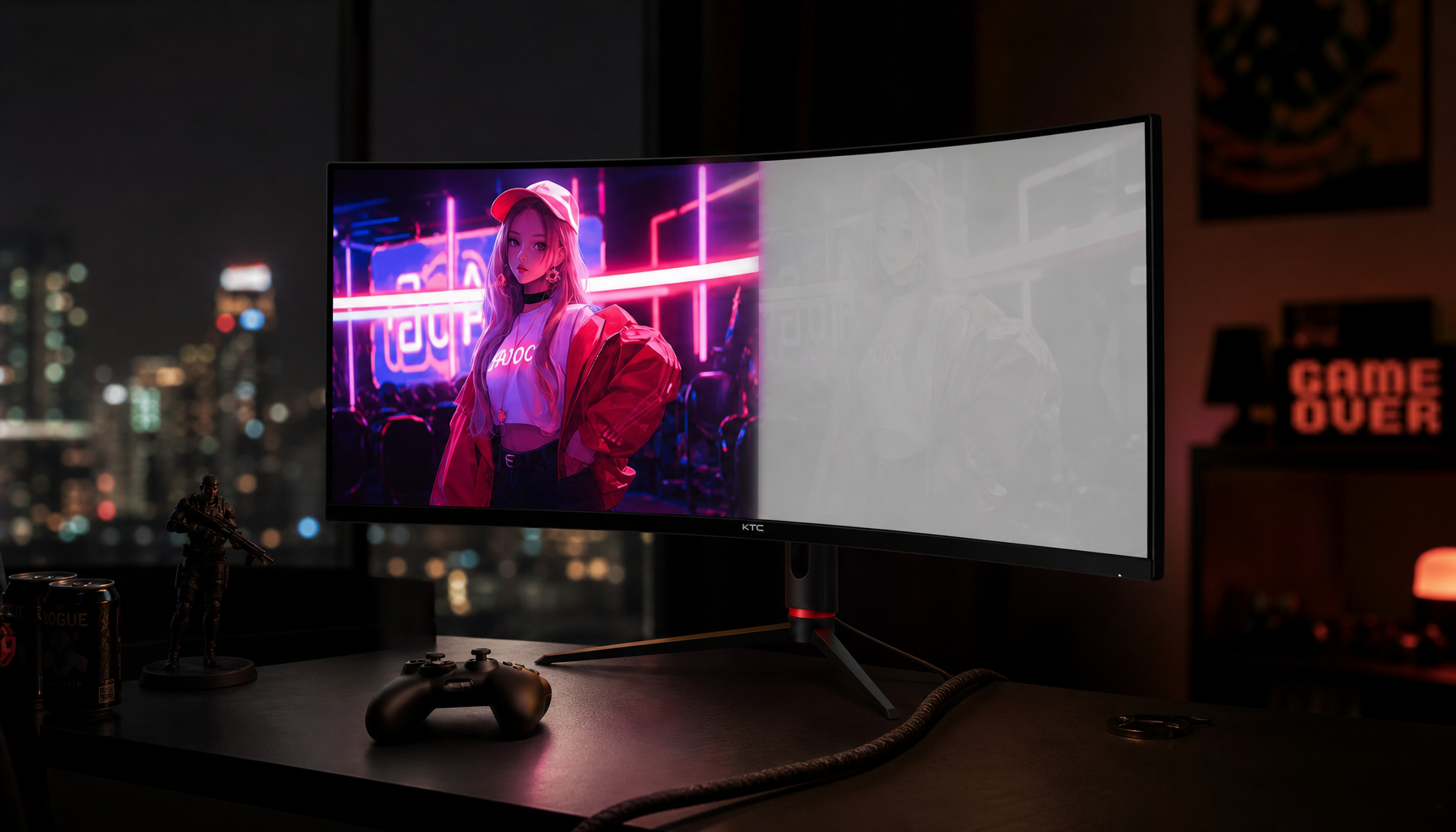
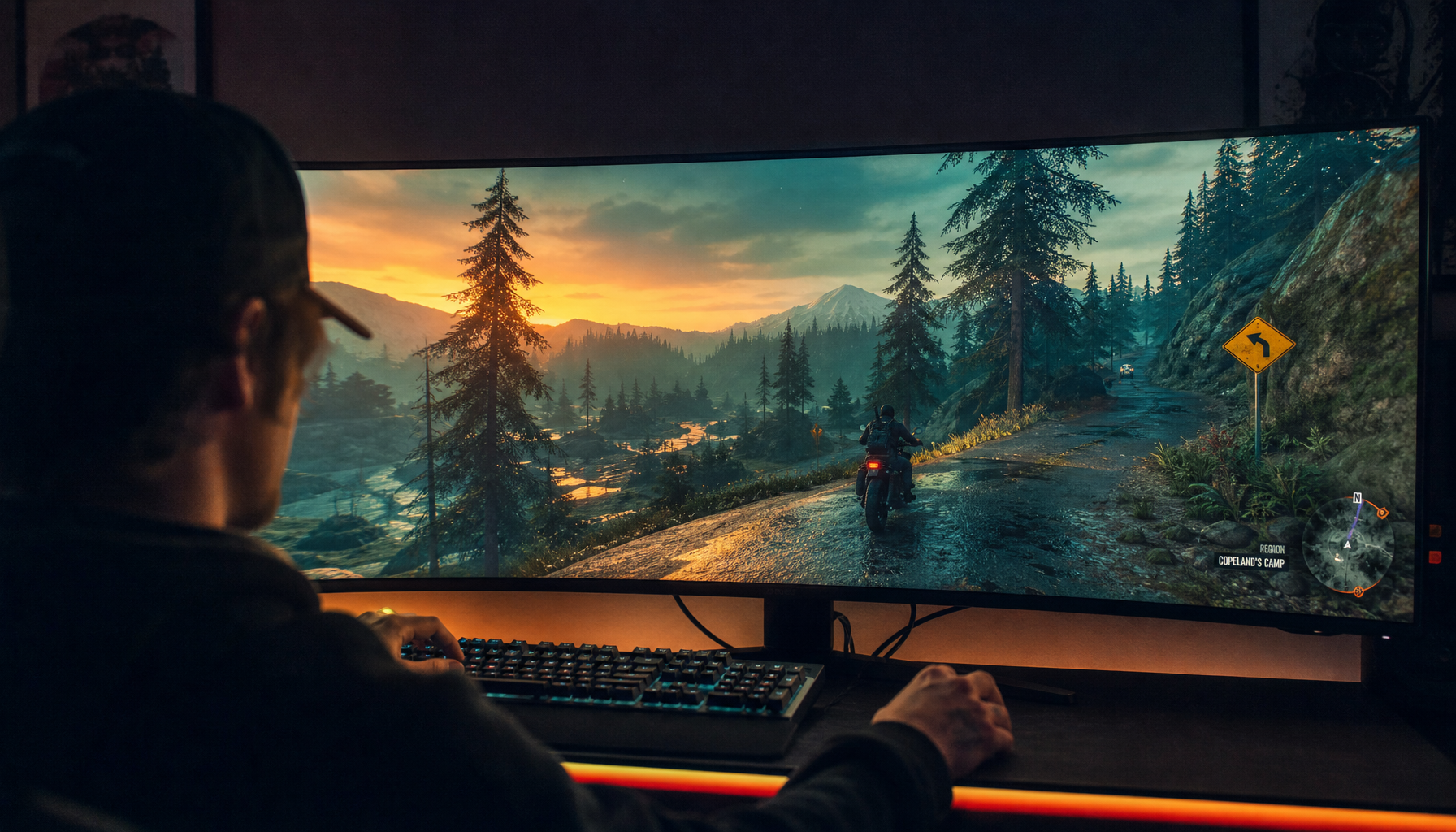
Ambient light raises the visible black floor on any LCD, but IPS loses perceived depth sooner because its native contrast is lower. VA keeps darker blacks longer until reflections, viewing angle, or dark-level smearing become the limiting factor.
Does your premium gaming monitor look punchy at night but oddly flat by lunch, even though you never changed the settings? A simple room-light adjustment, screen-angle change, or brightness reset can make dark scenes, spreadsheets, and videos look more stable without buying a new display. Here is how IPS and VA react differently, and how to tune your setup for the room you actually use.
Why Ambient Light Changes Contrast Before Your Monitor Does
Contrast ratio is the gap between the brightest white and darkest black a screen can show. On an LCD, the backlight is always part of the equation, so “black” is never perfectly black; it is the darkest state the panel can hold while blocking that backlight. Room light adds another layer by reflecting off the panel surface, visually lifting blacks and narrowing the difference between dark and bright areas.
That is why a monitor can measure well in a dark test room but feel weaker beside a window. Ambient light intensity affects color perception, with bright surroundings making a display appear darker and lower in contrast, while a dim room can make the same display appear brighter and richer. In practical terms, your monitor did not lose contrast at noon; your eyes and the screen surface are fighting more light.
For a simple desk example, imagine a 27-inch monitor facing a bright side window. A dark game cave, black terminal theme, or letterboxed movie now has reflected light sitting on top of the image. You may turn brightness up to compensate, but that mostly lifts whites and midtones. The reflected black floor remains the problem.

IPS vs. VA: Same Room, Different Failure Point
IPS and VA panels differ in how their liquid crystals move to control backlight. IPS crystals rotate parallel to the glass, which helps preserve color and brightness from wider angles. VA crystals tilt from a vertical position, blocking more backlight and usually producing stronger blacks.
That difference matters immediately in ambient light. IPS commonly starts from a lower native contrast base than VA, so reflected light eats into its usable contrast faster. VA starts with deeper blacks, so it tends to preserve movie depth, shadow mood, and high-contrast game scenes better in a moderately lit room. However, VA is not immune. Once reflections are strong enough, even a high-contrast VA panel can look washed out, especially if the coating is glossy, the screen faces a window, or the user sits off-center.
Panel Type |
What Ambient Light Usually Does First |
Practical Strength |
Practical Weakness |
IPS |
Makes blacks look gray sooner |
Stable color and viewing angles |
Lower dark-room depth |
VA |
Reduces its black-level advantage gradually |
Stronger perceived depth head-on |
More angle sensitivity and possible dark smearing |
VA panels are strongest in contrast, with typical figures often described around 2,500:1 to 6,000:1, while IPS is commonly described around 700:1 to 1,500:1. Those numbers are not a full buying decision, but they explain why two monitors at the same brightness can feel different when showing the same dark scene.
Perceived Contrast Is Not Just a Spec
Human vision adapts to surrounding brightness, so contrast is partly a viewer experience, not just a panel measurement. Display measurements alone may not predict perceived image quality because contrast perception changes with scene brightness and stimulus size. A small bright HUD element on a black background, a full-screen white document, and a dark movie scene all push your eyes differently.
This is where IPS can feel more consistent for office work even when VA wins the black-level contest. A spreadsheet, code editor, or browser window is mostly midtone and bright content, so IPS viewing-angle stability and color consistency often matter more than absolute black depth. VA, by contrast, can feel more cinematic in a dark game or movie because black bars, shadows, and night scenes remain denser when viewed head-on.
For example, if you use one 32-inch monitor for both spreadsheets during the day and single-player RPGs at night, the best panel depends on which discomfort bothers you more. IPS will usually keep the image more even if you shift in your chair or share the screen. VA will usually make caves, space scenes, and dark cutscenes feel more dimensional when your room lights are controlled.

Bright Rooms Punish IPS Blacks Faster
In a bright office, IPS blacks can turn charcoal because the panel already allows more backlight leakage than VA. That does not make IPS bad; it means you should buy and set it up for its strengths. IPS remains a strong choice for productivity, design review, shared viewing, multitasking, and fast gaming models where motion clarity matters.
The best IPS strategy is to reduce reflections rather than simply maxing brightness. Place the monitor perpendicular to windows, avoid lamps pointed at the screen, and use bias lighting behind the display instead of a bright overhead fixture. Multiple light sources give a room better control for different activities, and that flexibility is valuable at a workstation because you can keep the desk usable without blasting the screen surface.

A practical IPS target is simple: make the screen the brightest object in your immediate view, but not the only bright object in a dark room. If the screen looks dull during the day, first rotate it away from the light source, then raise brightness. If blacks still look gray in movies, that is the panel’s native contrast showing through.
VA Holds Depth Better, But Control the Viewing Zone
VA’s native advantage is black reproduction. Because it blocks more backlight, it can keep perceived contrast stronger under moderate ambient light, especially for movies, console gaming, and atmospheric computer games. This is why VA often feels like a better value for immersion when the screen is viewed mostly straight on.
The tradeoff is that VA is more sensitive to seating position and dark transitions. If you sit off-axis, brightness and color can shift. In fast dark scenes, some VA monitors may show dark smearing, where shadow transitions trail behind motion. That does not erase the contrast advantage, but it matters for competitive shooters and racing games where clarity during movement can matter more than black depth.

For a head-on solo setup, VA can be excellent. For a dual-monitor workstation where one side display is viewed at an angle, IPS may look cleaner and more predictable. The room-light decision and the seating decision are connected.
Settings That Actually Help
Do not treat calibration profiles as magic contrast fixes. An ICC profile describes measured display behavior, and while some systems can load gray calibration data, ICC profiles typically store descriptive color and tone information rather than physically changing what the monitor panel can do. To change perceived contrast meaningfully, start with monitor brightness, room lighting, panel angle, and the display’s real on-screen controls.
Use the monitor’s standard, sRGB, creator, or calibrated mode as a baseline. Avoid vivid modes for serious work because they can crush shadow detail, exaggerate saturation, and make the monitor harder to match across lighting conditions. In a bright room, raise brightness enough for white backgrounds to look clean, but stop before whites become glaring. In a dim room, lower brightness and add soft light behind or around the monitor so your eyes are not constantly adapting between a bright screen and a black room.
Retail and showroom lighting research is useful here because displays compete with their environment. Ambient lighting is general lighting from natural light and fixtures, and it shapes comfort, perception, and attention. At a desk, the same principle applies at a smaller scale: your monitor is not viewed in isolation; it is part of a lighting system.
Choosing IPS or VA for Your Room
Choose IPS if your monitor lives in a brighter productivity space, if you value consistent color from different seating positions, or if you use multi-monitor arms where side angles are unavoidable. IPS is also the safer pick for mixed office and gaming use when motion clarity, text stability, and wide viewing angles outweigh deep blacks.
Choose VA if your room lighting is controllable, you sit centered, and you care about cinematic contrast. VA is especially compelling for dark-room entertainment, story games, streaming, and budget-conscious users who want stronger depth without moving to OLED or Mini LED.
If your desk faces a window, the panel decision matters less than the reflection path. A VA panel facing direct daylight can look worse than an IPS panel placed correctly. If your room has strong overhead lighting, a matte coating and careful tilt can outperform a higher contrast ratio on paper.
FAQ
Does more brightness restore lost contrast?
Brightness can improve visibility, but it does not remove reflected light from the black level. If ambient light is washing out blacks, screen placement and lighting control usually help more than simply pushing the backlight higher.
Is VA always better for contrast?
VA usually has better native contrast than IPS, but perceived contrast depends on reflections, viewing angle, content, and room brightness. A poorly placed VA monitor in a bright room can still look flat.
Should I use ambient light behind the monitor?
Yes, especially in dim rooms. Soft rear lighting can reduce eye strain and make screen brightness feel more natural without shining directly onto the panel.
The performance move is not choosing IPS or VA in isolation. Match the panel to your room: protect IPS from reflections to preserve clarity, give VA a centered viewing position to unlock its depth, and tune lighting as part of the display system rather than an afterthought.