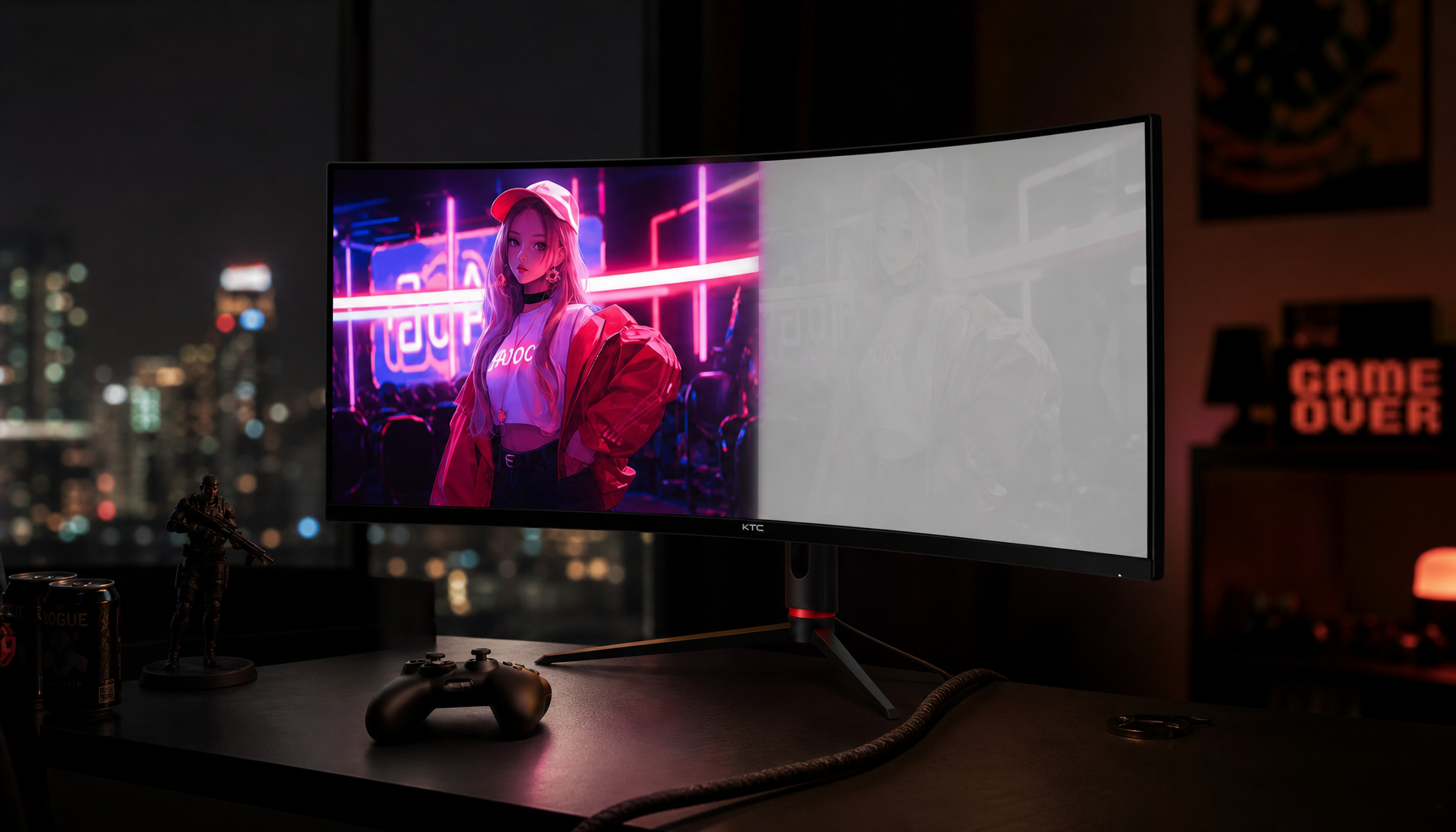
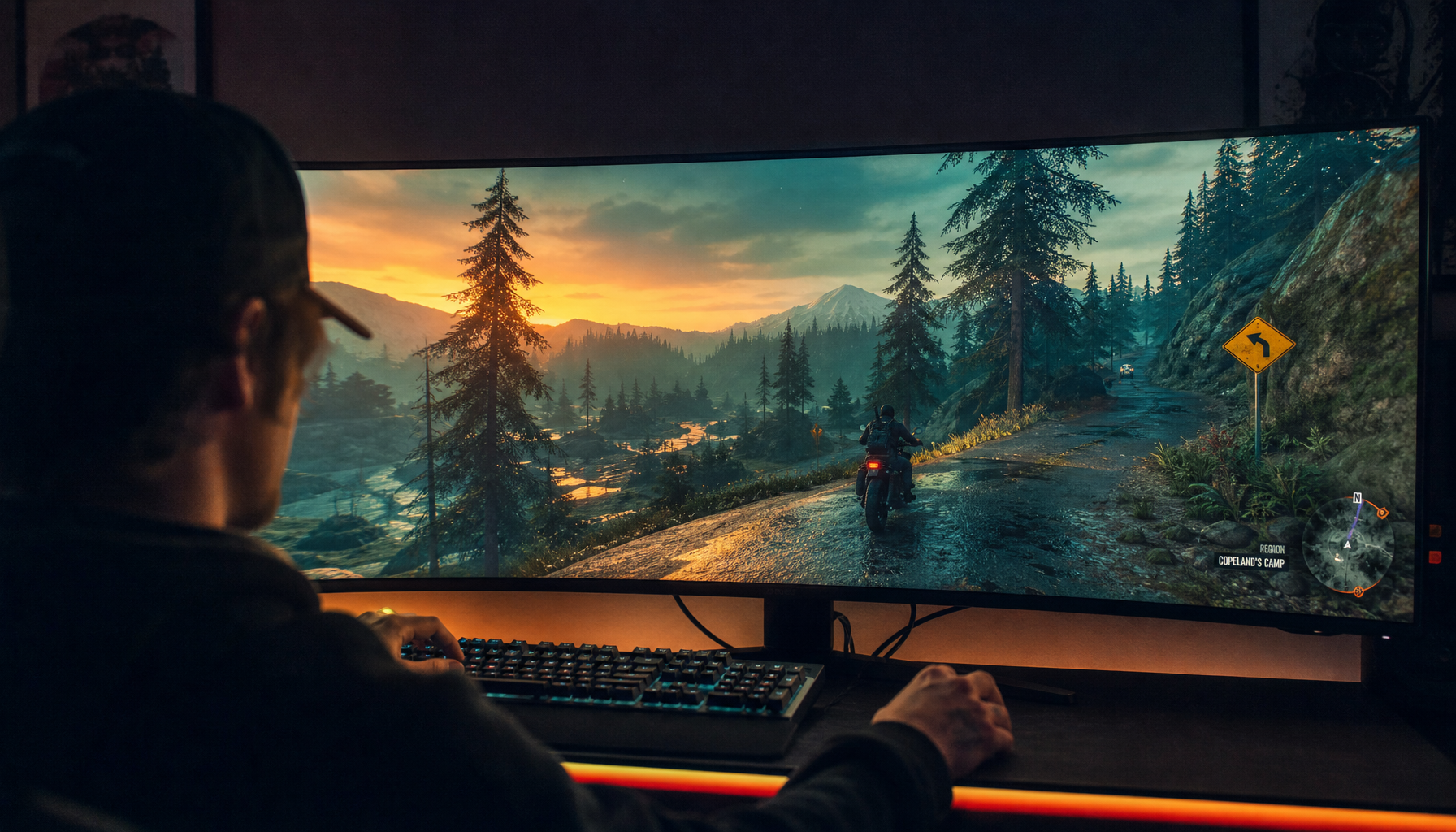
Some IPS panels shift color with small head movements because the light path through the LCD stack changes off-axis, affecting brightness, gamma, and sometimes color temperature.
IPS Is Stable, Not Magic
IPS stands for In-Plane Switching, where liquid crystals align more parallel to the glass to improve off-angle consistency. That is why IPS monitors are widely used for design, gaming, and productivity displays that need wide viewing angles.
The catch is that the panel still uses a backlight, polarizers, liquid crystals, filters, coatings, and glass. When your eyes move slightly above, below, or to the side, the angle of that light changes before it reaches you.
On a good IPS panel, the shift may be subtle: a gray background looks a little warmer, a dark corner looks brighter, or a blue UI element loses a touch of saturation. On a weaker unit, that small tilt can become obvious.

What You Are Actually Seeing
Most users call it “color shift,” but several effects can stack together.
IPS glow is one of the biggest culprits in dark scenes. It shows up as a milky or silvery brightness change, especially near corners, and it becomes more visible when your head is low, close, or off-center.

Gamma shift can also make tones look different. A mid-gray may appear lighter from one angle and deeper from another, which makes the color feel changed even if the hue itself has not moved much.
Panel uniformity matters too. Two monitors with the same model number can behave differently because manufacturing tolerances affect backlight diffusion, polarizer performance, and liquid crystal alignment.
IPS usually has less hue shift than VA, but VA often has deeper blacks; gamma shift is one reason VA can look less consistent from the edges.
Why Slight Head Movement Can Matter
A small head tilt can create a bigger viewing-angle change than expected, especially on large screens. On a 32-inch display at a close desk distance, your eyes already view the top, bottom, and corners from noticeably different angles.

That is why 27-inch to 32-inch monitors are more likely to reveal off-axis behavior than a compact laptop panel. Ultrawide displays and portable smart screens used beside a laptop can also exaggerate the effect if they sit too low or too far off-center.
Brightness settings amplify the problem. High brightness in a dark room makes glow more visible, while low-quality anti-glare coatings can add haze when light hits the screen from the side.
Color work adds another layer. A display can advertise strong gamut coverage, but color accuracy still depends on calibration, uniformity, and a stable viewing position.
How To Reduce IPS Color Shift
Start with geometry before blaming the panel. Your eyes should land near the upper third of the screen, with the panel tilted so the center faces you directly.
Quick setup fixes:
- Sit centered and slightly farther back.
- Lower brightness for dim-room use.
- Tilt the monitor a few degrees up or down.
- Avoid vivid, night, or dynamic color modes.
- Use neutral room lighting behind or around the desk.
For color-sensitive work, warm the screen up and calibrate it in a consistent environment. A basic IPS calibration workflow should include brightness, white point, contrast, and an ICC profile; even calibration guidance recommends keeping the viewer close to center to avoid visible Delta E shifts.
When It Is a Dealbreaker
For competitive gaming, mild IPS shift is usually less important than response time, refresh rate, and motion clarity. A fast IPS panel can still be a strong value for players who want sharp color without OLED pricing.
For office productivity, the bigger concern is comfort. If spreadsheets, code editors, or white documents change tint every time you adjust posture, choose a better IPS panel, an improved black-level IPS option, or an OLED portable screen.
For grading, design approval, and product color work, do not buy on panel type alone. Look for strong factory calibration, uniformity compensation, solid sRGB or DCI-P3 coverage, and reviews that test viewing angles.
IPS remains a reliable, high-performance choice, but the best monitor is the one that keeps your image stable from your real seating position, not just from a spec-sheet angle.