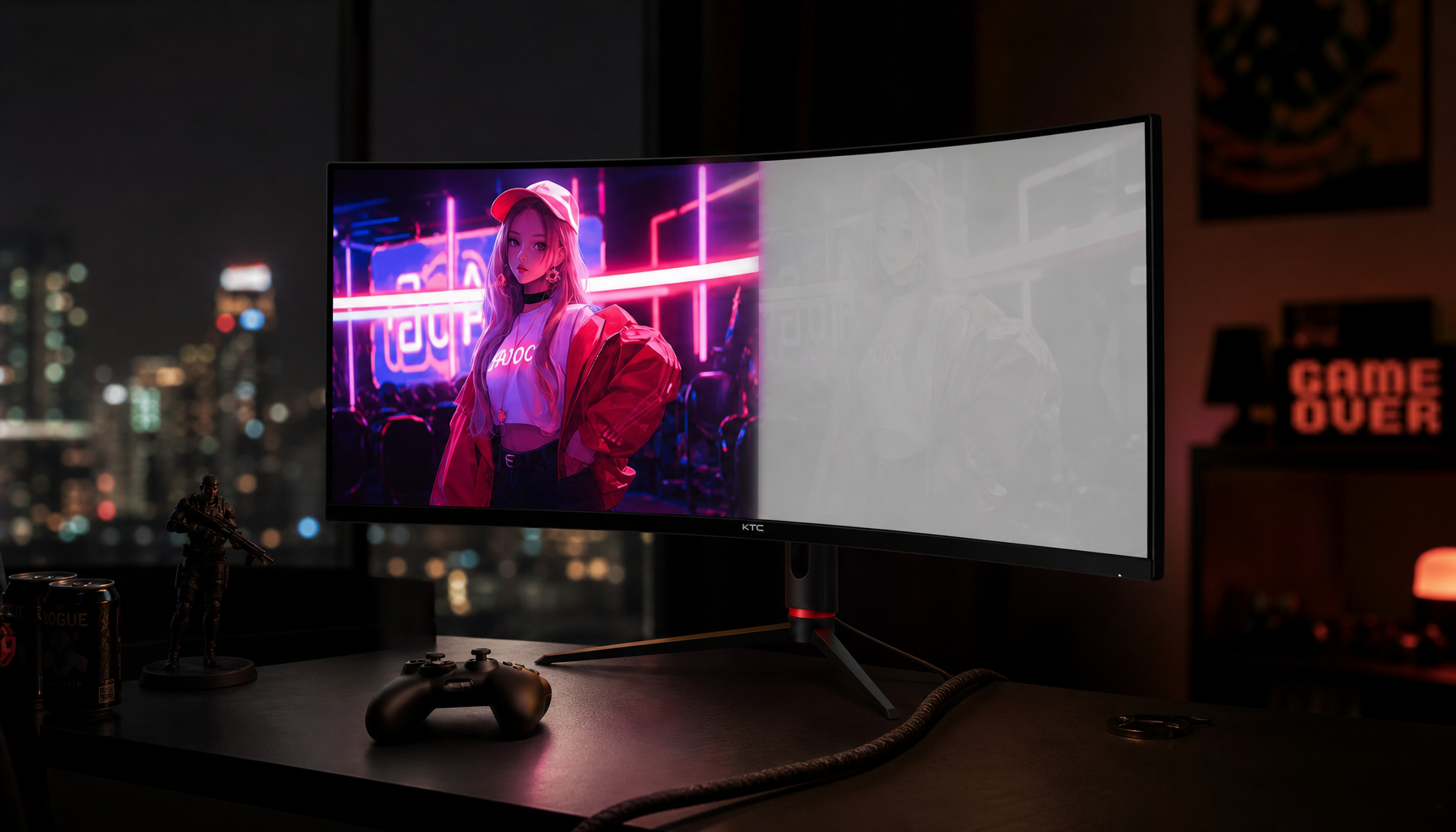
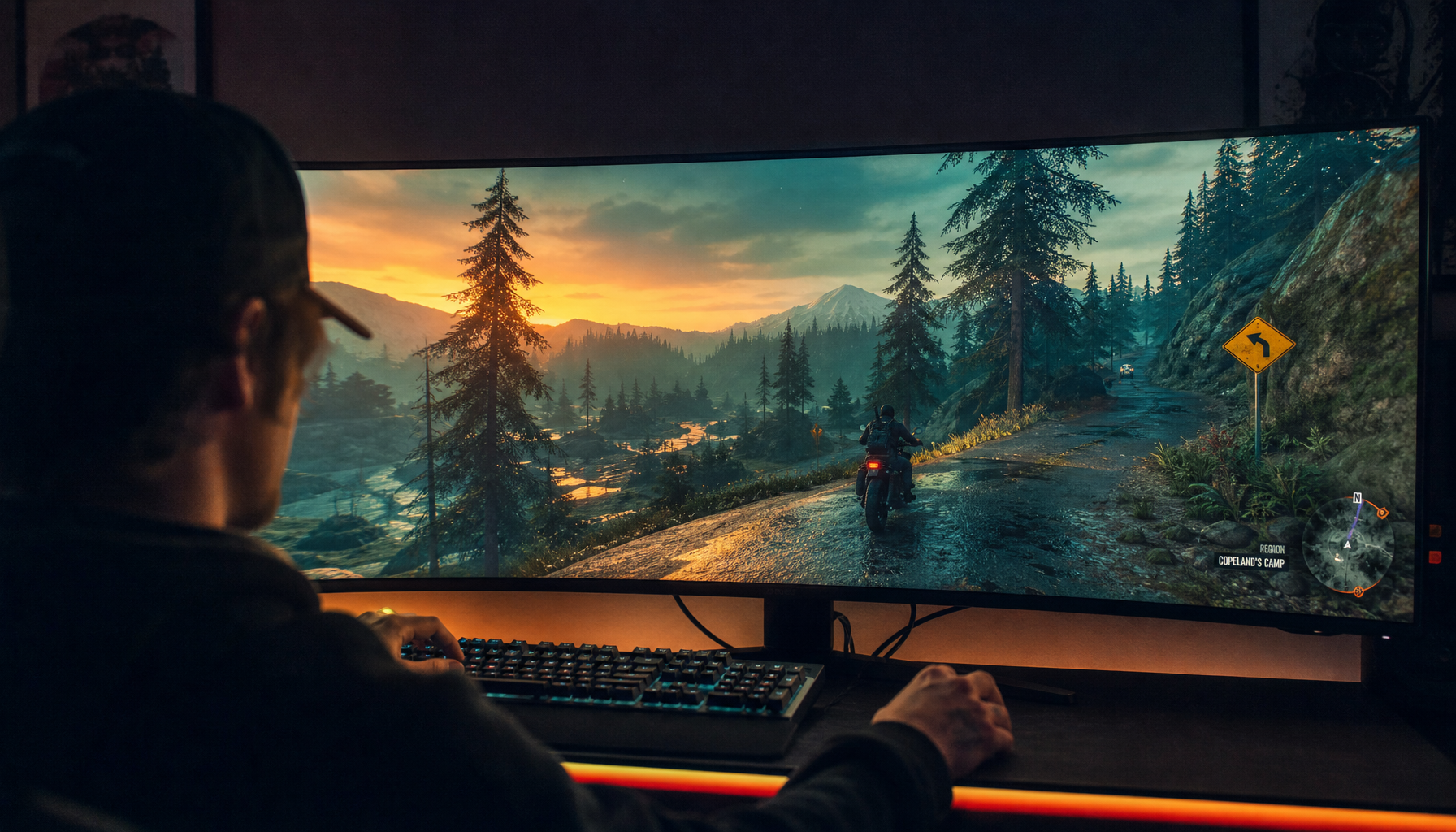
Response time affects in-game motion blur because your monitor must finish changing pixels before the next frame arrives. When it cannot, the game’s intended blur stacks on top of physical display blur, making motion look smeared instead of cinematic.
Does a quick flick in a shooter turn enemy outlines into a haze, even after you lowered the motion blur slider? A 240Hz screen shows a new frame every 4.17 ms, so slow pixel transitions can visibly trail behind the game’s own blur effect. You’ll learn how to separate game blur from monitor blur, tune settings, and choose a display that keeps motion sharp without reducing immersion.
Game Blur and Monitor Blur Are Different
In-game motion blur is a rendered visual effect. The game engine intentionally smears movement to simulate speed, camera exposure, or cinematic motion. Motion blur can make racing games feel faster, make 30 FPS gameplay feel less choppy, and give single-player scenes a more film-like look.
Monitor response time is hardware behavior. It measures how long pixels take to change from one color state to another, usually in milliseconds. Monitor response time matters because slow transitions leave ghost trails, especially during fast camera pans, strafing, or high-contrast movement.
The problem is overlap. If a game adds motion blur and the display also creates pixel blur, you are not seeing one clean effect. You are seeing a rendered smear plus a physical smear. That is why the same motion blur setting can look acceptable on a fast OLED or well-tuned IPS panel but muddy on a slower VA monitor with dark-level smearing.

Why Pixel Response Changes the Look of Motion Blur
A monitor is always racing the frame clock. At 60Hz, each frame remains on screen for about 16.67 ms. At 144Hz, that drops to about 6.94 ms. At 240Hz, it is about 4.17 ms. If a pixel transition takes too long, the next frame arrives before the previous color has settled, so edges look softer and moving objects leave remnants behind.
Fast response times reduce motion blur in real gameplay, but response-time blur is not the only factor. Persistence blur comes from frames being held on screen. Even a fast pixel can look blurry if the display holds each frame too long, while a high-refresh monitor can still smear if its pixels are slow.
A simple example makes the effect obvious. On a 240Hz monitor, a “1 ms” transition has enough time to complete before the next refresh in ideal cases. A 7 ms transition does not. If your game adds camera blur during a fast 180-degree turn, that unfinished pixel transition makes the blur thicker and less controlled. The game intended speed; the monitor adds haze.
Response Time, MPRT, and GtG Are Not the Same Thing
Gray-to-gray response time, usually written as GtG, measures how quickly pixels move between gray levels. It is useful because many real game colors are not pure black or white. MPRT, or Moving Picture Response Time, describes how long pixels remain visibly present during motion, so it is closer to perceived blur.
Manufacturers often advertise ideal numbers, but real monitors vary by transition, refresh rate, and overdrive setting. Overdrive settings can speed up transitions, but if pushed too hard, they create overshoot, where pixels go past the target color and produce bright inverse trails.

Term |
What It Tells You |
Why It Matters in Games |
GtG |
Pixel transition speed between gray shades |
Helps predict ghosting behind moving objects |
MPRT |
Visible persistence during motion |
Helps explain perceived blur while tracking targets |
Overshoot |
Pixel transition goes too far |
Creates bright or colored halos around motion |
Refresh rate |
How often the display updates |
Shortens frame time but does not guarantee clean pixels |
This is why independent testing is more useful than relying on the box. A monitor advertised as 1 ms can still have weak dark transitions, aggressive overshoot, or a poor overdrive mode at lower refresh rates.
Why In-Game Motion Blur Can Look Good on One Monitor and Bad on Another
In-game motion blur is not automatically bad. It depends on the type of blur, the frame rate, and the display. Per-object motion blur can make a sword swing, racing car, or fast animation feel smoother while keeping the camera view readable. Full-screen camera blur is more controversial because it smears the whole image when you move the mouse or right stick.
Screen-space blur applies a broad full-screen smear, while per-object blur targets moving objects more precisely. Screen-space motion blur is cheaper to render, but it often hurts clarity more than it helps, especially when screenshots, aiming, or target recognition matter.
Response time changes the tolerance window. On a fast 240Hz OLED with near-instant pixel response, a low per-object blur setting can add speed without burying detail. On a slower VA panel, especially in dark scenes, the same setting can amplify black smearing and make shadowy enemies harder to track. The game did not change; the display’s motion handling did.
Competitive Play: Turn Blur Down, Then Fix the Monitor Side
For competitive shooters, battle royale, and fast arena games, motion blur usually costs more than it gives. Competitive players often disable motion blur because target visibility and reaction accuracy matter more than cinematic smoothness. If you are trying to read a shoulder peek or track a fast slide, extra blur is a visual tax.

The practical sequence is clear. First, disable camera motion blur. If the game separates camera blur from object blur, keep object blur low or off depending on preference. Then set the monitor to its highest refresh rate in Windows or the graphics control panel. A 240Hz display only helps when the PC, cable, port, and game frame rate can actually support it.
After that, tune overdrive. The fastest overdrive preset is not always best. If you see pale halos or sharp bright trails behind moving objects, step down one level. If you see dark smears trailing behind objects, step up if the monitor allows it. The best setting is the one that minimizes both ghosting and overshoot at the refresh rate you actually use.
Immersive Play: Use Blur Selectively, Not Automatically
Single-player games, racing titles, and cinematic adventures can benefit from motion blur when it is controlled. At 30 FPS or 60 FPS, blur can hide some frame gaps and make camera movement feel less stuttery. At 120 FPS and above, motion is already much smoother, so blur becomes less necessary and easier to overdo.
This is where a fast display gives you more creative freedom. With cleaner pixel response, you can leave a small amount of object blur on for speed effects without turning the whole scene into smear. In racing games, for example, keeping the car crisp while the roadside softens can enhance velocity. In a tactical shooter, the same treatment on the whole camera view can bury the exact information you bought a high-refresh monitor to reveal.
Television motion research is useful here because it explains that sample-and-hold blur remains a major reason fast movement loses detail on modern displays. Gaming monitors fight this with higher refresh rates, faster pixel response, and sometimes backlight strobing. But strobing can reduce brightness or introduce flicker, so it is powerful for clarity and not ideal for everyone.
Panel Type Changes the Result
OLED is the current motion-clarity benchmark because pixels respond extremely quickly, often with minimal ghosting. Modern QD-OLED gaming monitors can offer 240Hz or 360Hz refresh rates and 0.03 ms response-time claims, showing why OLED gaming monitors are attractive for players who want both speed and contrast. They still cost more and carry burn-in considerations, but their motion handling is a major advantage.
Fast IPS is the strongest all-around LCD choice for many gamers. It offers good color, wide viewing angles, and response times that are now close enough for serious play on many models. TN can still be extremely fast and value-oriented for esports, but weaker color and viewing angles make it less appealing for hybrid gaming, work, and media use.
VA is the trickiest. Its high contrast makes dark scenes and RPG worlds look rich, but slower dark transitions can cause black smearing. That does not mean every VA panel is bad, but it does mean motion blur settings need more restraint. If dark doorways or night maps smear during camera movement, lowering in-game blur will not fully solve it unless the panel’s response behavior is also under control.

Practical Settings That Usually Work
For esports, start with motion blur off, the highest refresh rate enabled, VRR on if frame rates fluctuate, and overdrive set to the best balanced mode rather than the most aggressive one. If your monitor has a tested recommended mode from a review lab, use that as the baseline.
For cinematic single-player games, try camera blur off or low, per-object blur low to medium, and frame rate capped to a stable level your PC can hold. A stable 90 FPS often feels cleaner than an unstable 120 FPS that swings constantly, especially when blur and VRR are interacting.
For racing and flight games, motion blur can be more valuable. Keep the vehicle, cockpit, or HUD readable, then adjust blur until the environment conveys speed without hiding braking markers, apex points, or enemy silhouettes. If the blur helps sensation but hurts control, it is too strong.
Pros and Cons of Keeping Motion Blur Enabled
Choice |
Advantages |
Trade-Offs |
Motion blur off |
Maximum clarity, better screenshots, cleaner target tracking |
Motion can look harsher at low frame rates |
Low per-object blur |
Adds speed and realism while preserving readability |
Costs some performance and may vary by game |
Strong camera blur |
Can hide low-FPS judder and feel cinematic |
Often reduces visibility and precision |
Backlight strobing |
Major clarity boost on supported monitors |
Can reduce brightness and cause flicker sensitivity |
Final Buying Advice
If response time is weak, in-game motion blur becomes harder to tune because the display is already adding blur before the game effect starts. Look beyond the advertised “1 ms” label and check real response behavior, overshoot, refresh-rate performance, and panel type. For competitive gaming, prioritize fast response and clean overdrive first; for immersive gaming, add motion blur only after the monitor is already delivering clear motion.
A high-performance display should give you choice. The best setup lets you turn blur off for precision, add it back for cinematic speed, and trust that the monitor is not smearing the decision for you.