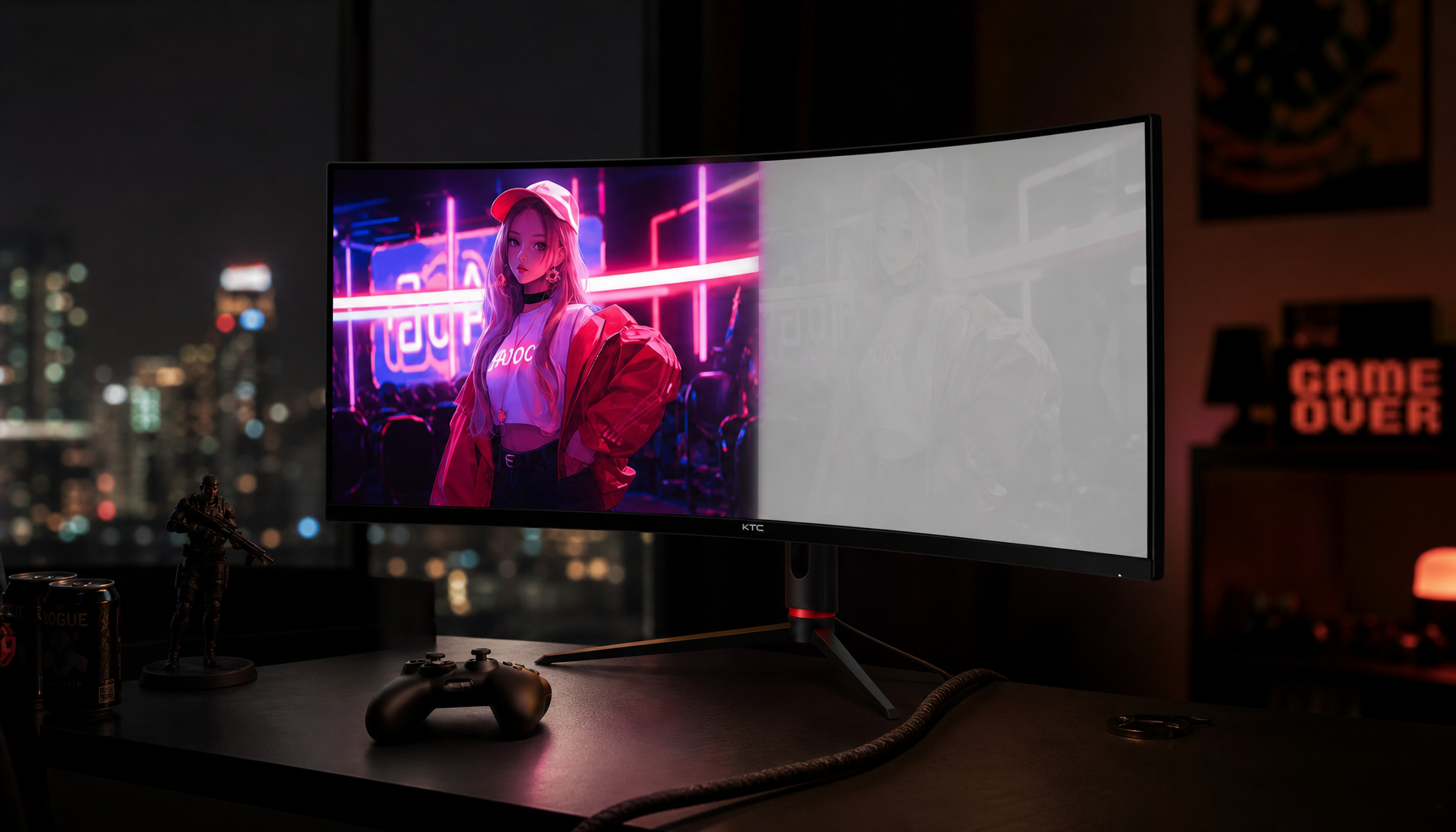
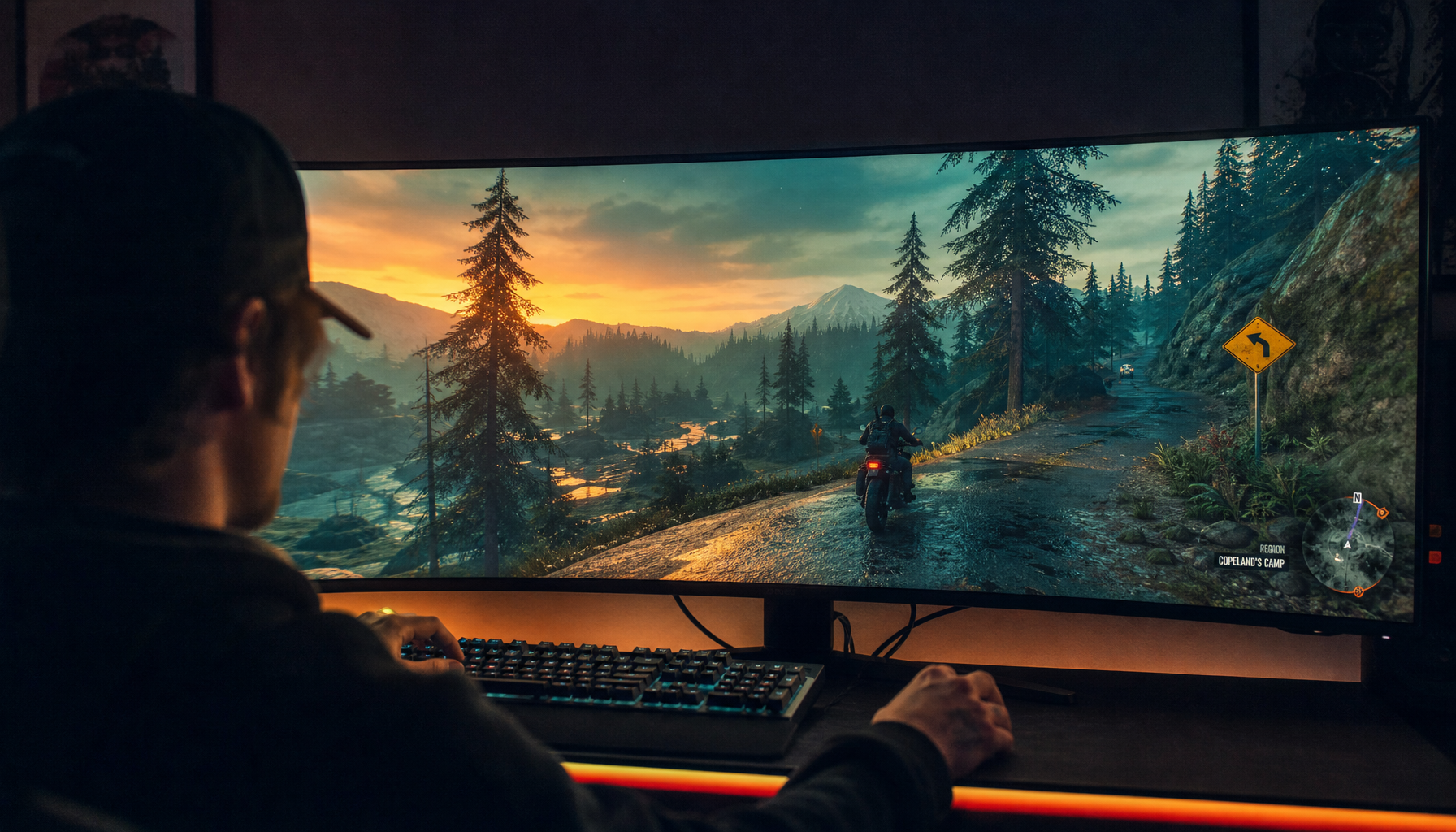
Mini LED reduces visible backlight bleed by replacing a broad LCD backlight with many smaller light sources grouped into controllable dimming zones, so dark parts of the image receive less stray illumination.
Ever load into a dark game scene or watch a letterboxed movie and notice pale corners pulling your eyes away from the action? A well-tuned Mini LED monitor can make those same scenes look cleaner by lowering backlight output where the image should stay dark, while still keeping bright highlights punchy. Here is how the technology works, where it helps, and what to check before buying or adjusting one.
What Backlight Bleed Really Is
Backlight bleed is unwanted light leakage from an LCD backlight, usually visible around the edges or corners of the screen during black or near-black content. On a standard LCD monitor, the panel does not create light by itself. A backlight shines through layers of filters, liquid crystal cells, diffuser films, and the front panel. If pressure, assembly tolerance, edge sealing, diffuser alignment, or chassis stress lets more light escape in one area, that patch looks brighter than the rest of the black screen.

This is why light leakage is most obvious in dim rooms or on black backgrounds. Some degree of light leakage is common across LCDs and is not automatically a defect. That distinction matters because a monitor that looks flawed in a pitch-black room at 100% brightness may look normal during everyday office lighting, browsing, spreadsheets, and gaming.
Backlight bleed is not the same as IPS glow. Bleed tends to stay fixed in the same corner or edge, even when you move your head. IPS glow shifts with viewing angle and distance. In practical testing, if a pale corner changes or fades when you sit farther back or adjust your angle, you are likely seeing panel glow. If it stays locked in place through black screens, dark gray screens, and real content, it is more likely physical light leakage.
Why Conventional LCD Backlights Struggle
Traditional LED LCD monitors often use edge-lit or simpler direct-lit backlights. In many budget and midrange designs, large areas of the screen are illuminated together. The LCD panel then tries to block light where the image should be dark. That works well enough for documents and web pages, but it is less convincing in a dark scene where a small torch, cursor, subtitle, or HUD element sits against a black background.
The core limitation is control. If the backlight is lighting a large region, some illumination remains behind pixels that are supposed to look black. The liquid crystal layer can reduce that light, but it cannot eliminate every trace of it. This is why an ordinary monitor can look acceptable on a white spreadsheet yet reveal cloudy corners during a dark loading screen.
A good real-world test is a dark game menu with white text. On a basic edge-lit LCD, the whole side or corner may look lifted. On a stronger local-dimming display, only the area near the bright UI element should rise, while the surrounding black field stays darker.
How Mini LED Changes the Backlight System
Mini LED is still LCD technology, but the backlight is more advanced. Instead of relying on fewer, larger LEDs, Mini LED monitors use thousands of tiny LEDs, often grouped into independently controlled dimming zones. Those zones can brighten for highlights and dim for shadows.
That zone control is the main reason Mini LED can reduce visible backlight bleed. When the image is dark, the monitor can lower the output in those dark regions instead of pushing a uniform backlight across the whole panel. Less light behind the LCD means less stray light available to leak through panel edges, corners, and dark pixel areas.

The best way to think about it is not “Mini LED fixes the panel,” but “Mini LED gives the monitor finer control over where light is delivered.” If a physical corner leak exists because of pressure or imperfect assembly, Mini LED cannot reseal the panel. But by reducing the backlight intensity in dark zones, it can make that leakage less visible during real content.
Local Dimming: The Key Mechanism
Local dimming is the feature that makes Mini LED useful for black levels. The display analyzes the image, divides it into zones, and adjusts the brightness of each zone. In a night scene, zones behind the sky, shadows, or black bars can dim down. Zones behind explosions, headlights, or bright UI elements can stay bright.

Local Dimming relies on a Mini LED backlight system divided into hundreds or thousands of independent zones rather than one uniform backlight. That matters because backlight bleed is fundamentally a light-control problem. Better backlight control reduces the amount of unnecessary light pushing through the LCD stack.
Zone count helps, but it is not the whole story. A 27-inch Mini LED monitor with 1,152 zones has much finer control than a basic edge-lit screen, yet each zone still covers many pixels. The dimming algorithm, zone density, panel contrast, diffuser design, and response behavior all affect whether the result looks clean or distracting.
Backlight Type |
Light Control |
Black-Level Behavior |
Main Trade-Off |
Basic edge-lit LCD |
Low |
More visible edge glow and corner leakage |
Lower cost |
Direct-lit LCD without strong local dimming |
Moderate |
More even than edge-lit, but limited dark-scene control |
Thicker design |
Mini LED LCD |
High |
Deeper blacks and less visible bleed in dark zones |
Blooming can appear |
OLED |
Pixel-level |
No LCD backlight bleed |
Static-image burn-in risk for some users |
Why More Zones Usually Mean Less Visible Bleed
A dimming zone is a group of Mini LEDs controlled together. More zones generally mean the display can match the shape of the image more closely. If a small bright object appears in one part of the screen, fewer surrounding dark areas need to be lit.
That is why many Mini LED buying guides push buyers toward higher zone counts. One buying guide recommends avoiding models with fewer than 500 dimming zones unless budget is the main constraint, and it points to 576 zones for 27-inch QHD and 1,152 zones for 32-inch 4K as stronger targets. KTC’s bright-office guidance similarly emphasizes that local dimming zones improve perceived contrast and shadow detail compared with standard edge-lit displays.
For example, imagine a 27-inch monitor showing a black desktop with a white mouse cursor near the lower-left corner. A low-zone system may brighten a large block around the cursor, making the corner look hazy. A higher-zone Mini LED system can restrict that light to a smaller area, so the rest of the corner stays darker. The bleed has not been repaired, but the visible light pressure behind that part of the panel is lower.
The Trade-Off: Blooming Replaces Some Bleed
Mini LED reduces broad, washed-out backlight leakage, but it can introduce blooming. Blooming is the halo that appears when a bright object lights up a dimming zone that also covers nearby dark pixels. You may see it around subtitles, white cursors, star fields, HUD elements, or bright icons on a black desktop.
This is the central Mini LED trade-off. You gain stronger HDR brightness, deeper perceived blacks, and less obvious edge haze, but you may notice halos in high-contrast scenes. A well-tuned monitor keeps those halos controlled. A poorly tuned one can trade one distraction for another.
Settings guidance is useful here because it separates office use from HDR use. For SDR office, web, and desktop work, leaving local dimming off and using brightness uniformity can provide steadier desktop brightness. For HDR, local dimming should be enabled because HDR depends on strong contrast between dark areas and bright highlights. In practice, your best setting for spreadsheets may not be your best setting for dark game scenes with bright lights.
Mini LED vs OLED for Bleed and Productivity
OLED does not have LCD backlight bleed because each pixel emits its own light. When a pixel is black, it can turn off. That gives OLED the cleanest dark-room black levels and eliminates the LCD backlight leakage problem entirely.
Mini LED remains compelling because it avoids OLED-style burn-in concerns and can be a better fit for mixed desktop use. Static taskbars, spreadsheets, dashboards, browser tabs, and productivity apps can sit on screen for hours. For users who work all day and game at night, Mini LED offers a powerful compromise: stronger HDR and contrast than ordinary LCD, with less anxiety around static UI.
Many office employees spend 6-9 hours per day in front of a screen, which makes comfort, clarity, and long-session reliability more than luxury specs. If your display is a work tool first and an entertainment screen second, Mini LED’s durability profile can matter as much as its dark-scene performance.

How to Test Whether Mini LED Helps Your Setup
Start with normal use, not a torture test. Warm the monitor for 20 to 30 minutes, set it to native resolution, and turn off aggressive image enhancements such as dynamic contrast, black stabilizer, and oversharpening. Then compare black, dark gray, 50% gray, and white screens at your normal brightness and at moderate brightness levels.
A practical SDR brightness range is often around 30% to 50% on many monitors, depending on the panel and room. Testing at 100% brightness in a black room can exaggerate flaws you may never see during real work or gaming. If a bright patch remains obvious at everyday brightness, across multiple inputs, after warm-up, and during real scenes, it is more likely worth an exchange or warranty claim.
Evaluating leakage in normal ambient lighting is especially important for office users. A display that looks imperfect in a dark-room photo may be fully acceptable in a desk setup with soft room lighting. A simple bias light behind the monitor can also reduce perceived bleed by raising the room’s visual baseline, making black-level unevenness less distracting.
Buying Advice for Lower Bleed Risk
When choosing a Mini LED monitor, do not shop by “Mini LED” alone. Look for zone count, HDR certification, panel type, local dimming behavior, brightness control, warranty support, and real review photos of black uniformity. A model with 1,152 zones and poor dimming logic may feel worse than a lower-zone model with more stable tuning.
For HDR gaming and mixed creative work, HDR 1000-class certification or higher is a more meaningful signal than vague “HDR Ready” wording. For a 27-inch QHD gaming monitor, 576 zones should be treated as a practical floor for serious Mini LED benefits, while 1,152 zones is a stronger target when budget allows. For 32-inch 4K, 1,152 zones is a more sensible starting point because the larger, denser image needs more backlight precision.
Panel type still matters. Fast IPS usually delivers strong viewing angles and color consistency, but it can show glow. VA panels often provide higher native contrast, which can help dark scenes, though some VA monitors smear in fast motion. For esports-first players, response tuning and refresh behavior may matter more than Mini LED. For cinematic gaming, HDR video, and mixed productivity, Mini LED becomes much more valuable.
Settings That Reduce Visible Bleed Day to Day
For regular desktop work, lower brightness before you do anything else. High brightness pushes the backlight harder and makes leakage easier to see. In a typical office or home setup, a moderate brightness level with anti-glare positioning usually feels cleaner than max brightness with local dimming constantly chasing desktop windows.
For SDR productivity, local dimming can sometimes cause distracting brightness shifts around windows, cursors, and menus. Keeping local dimming off for office work is often sensible because consistent brightness supports reading comfort. For HDR games and movies, turn local dimming on and tune halo controls or dimming strength until black levels improve without crushing shadow detail.
If your monitor has brightness uniformity mode, use it for writing, spreadsheets, coding, and color-checking layouts. Turn it off for HDR content if the monitor requires that for peak contrast. The fastest way to find the right balance is to test three real scenes: a white document, a dark web page with text, and a dark game scene with bright highlights.
Pros and Cons of Mini LED for Backlight Bleed
Mini LED’s biggest advantage is practical contrast control. It reduces the amount of unnecessary light behind dark areas, so edge haze and corner bleed are less obvious during real content. It also delivers high brightness for HDR and bright rooms, while avoiding OLED burn-in concerns for static productivity layouts.
The downside is that Mini LED is still an LCD. It cannot provide pixel-level black control, and it cannot correct every physical assembly flaw. Blooming, panel glow, local-dimming artifacts, heat, power draw, and inconsistent factory calibration can still appear. A strong return policy matters because panel variance is real, even within the same model line.
For a performance-driven buyer, the best mindset is simple: Mini LED is not a cure for every uneven screen, but it is one of the most effective LCD-based tools for reducing visible backlight problems while preserving brightness, sharpness, and long-session reliability.
FAQ
Can Mini LED completely eliminate backlight bleed?
No. Mini LED can reduce visible bleed by dimming dark zones, but physical leakage caused by panel pressure, sealing, or assembly tolerance can still remain. OLED is the display type that avoids LCD backlight bleed entirely because it has no separate backlight.
Should local dimming be on all the time?
Not always. For HDR games and movies, local dimming usually improves contrast and black levels. For SDR office work, web browsing, spreadsheets, and coding, it may be more comfortable to turn local dimming off and use brightness uniformity if your monitor offers it.
Is a higher zone count always better?
Higher zone count usually helps, but it does not guarantee a better monitor. Dimming algorithms, panel contrast, HDR tuning, diffuser design, and real-world behavior around cursors, subtitles, and menus matter just as much.
When should I return a monitor for bleed?
Consider returning or exchanging it when a fixed bright patch remains visible after warm-up, at normal brightness, across multiple inputs, and during real content rather than only on a black screen in a dark room.
Mini LED reduces backlight bleed by giving the monitor finer command over light. Choose enough zones, test with the content you actually use, tune SDR and HDR separately, and you get the real prize: a screen that stays bright when it should, dark when it matters, and dependable through long workdays and late-game sessions.