Mini LED does not replace the LCD panel. It upgrades the backlight behind it by using many smaller LEDs and far more local dimming zones, which improves HDR brightness and contrast on gaming monitors while still leaving some LCD-style tradeoffs.
If you’ve ever loaded a dark game and watched black areas turn charcoal while bright HUD elements glow too far into the scene, the backlight is usually the reason. Newer monitor designs can split that light into hundreds or thousands of smaller controlled sections instead of treating the whole screen like one lamp. That gives you a clearer way to judge whether Mini LED is actually worth it for a gaming, ultrawide, or portable display.
Mini LED Sits Behind the LCD, Not Inside It
The layer stack still looks like an LCD
A Mini LED monitor is still an LCD display, so the screen still relies on a backlight, diffusion layers, a liquid-crystal layer that modulates light, and a color layer that creates the final image. The big change is behind the panel: the light source becomes denser and more controllable, but the pixels themselves are still LCD pixels.
That matters because LCDs use either edge-lit, direct-lit, or full-array backlights, and those layouts define how precisely the screen can control brightness from one area to another. A basic edge-lit monitor spreads light from the rim, while a stronger full-array design places LEDs across the back of the panel so darker and brighter regions can be treated more independently.
The LCD stack behind modern displays is easiest to picture as a lamp shining through shutters. Mini LED improves the lamp and how tightly it can be controlled, but the LCD layer in front still decides how much light passes through and how much leakage remains in dark scenes.
What Smaller LEDs Actually Change
More LEDs create more local dimming zones
Mini LED uses much smaller backlight chips, typically around 0.004 to 0.012 inches across, so far more LEDs can fit behind the same monitor size. Those LEDs are then grouped into local dimming zones that can brighten, dim, or switch off independently depending on what is happening in that part of the image.

Higher zone density improves light control because each zone covers less of the screen. On 27- to 32-inch gaming monitors, roughly 576 zones is now a practical entry tier, about 1,152 zones is a common sweet spot, and 2,304 or more is where hard HDR scenes usually look more controlled.
Mini LED buying targets make those numbers more useful in practice: around 576 zones is a meaningful floor for a 27-inch 1440p monitor, while a 32-inch 4K buyer should look closer to 1,152 zones or more if HDR is a priority. Stronger models often reach about 1,000 to 1,600 nits, which is why sunlight, sparks, and glossy reflections can look much more convincing than they do on a standard SDR monitor.
What You Actually See in Games and HDR Video
Better highlights and deeper blacks at the same time
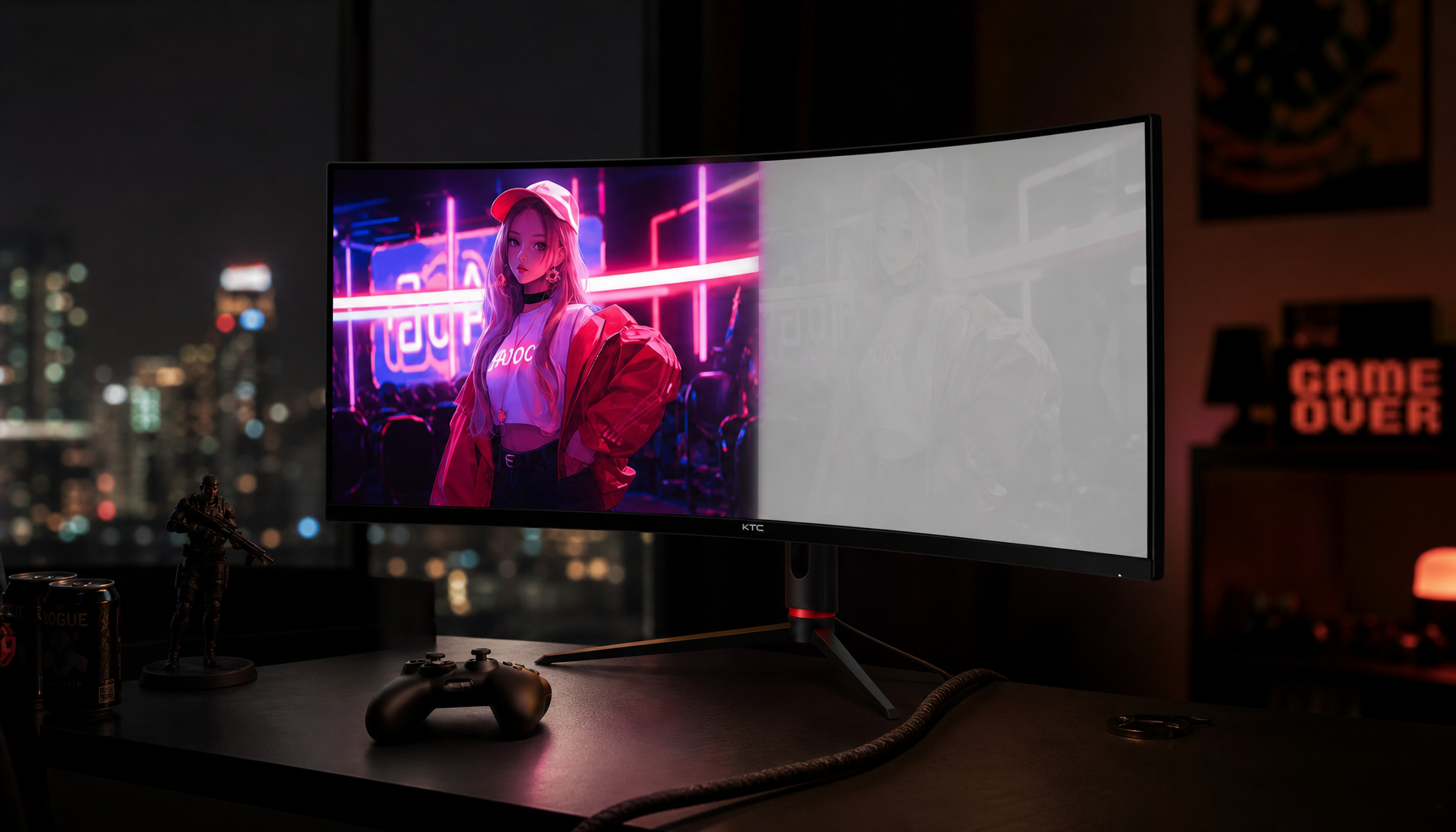
Local dimming lets bright highlights and dark areas appear together, which is the main reason Mini LED matters on gaming monitors. In a night map with streetlights, muzzle flashes, and shadowed corners, the monitor no longer has to brighten the whole screen just to make one highlight stand out.

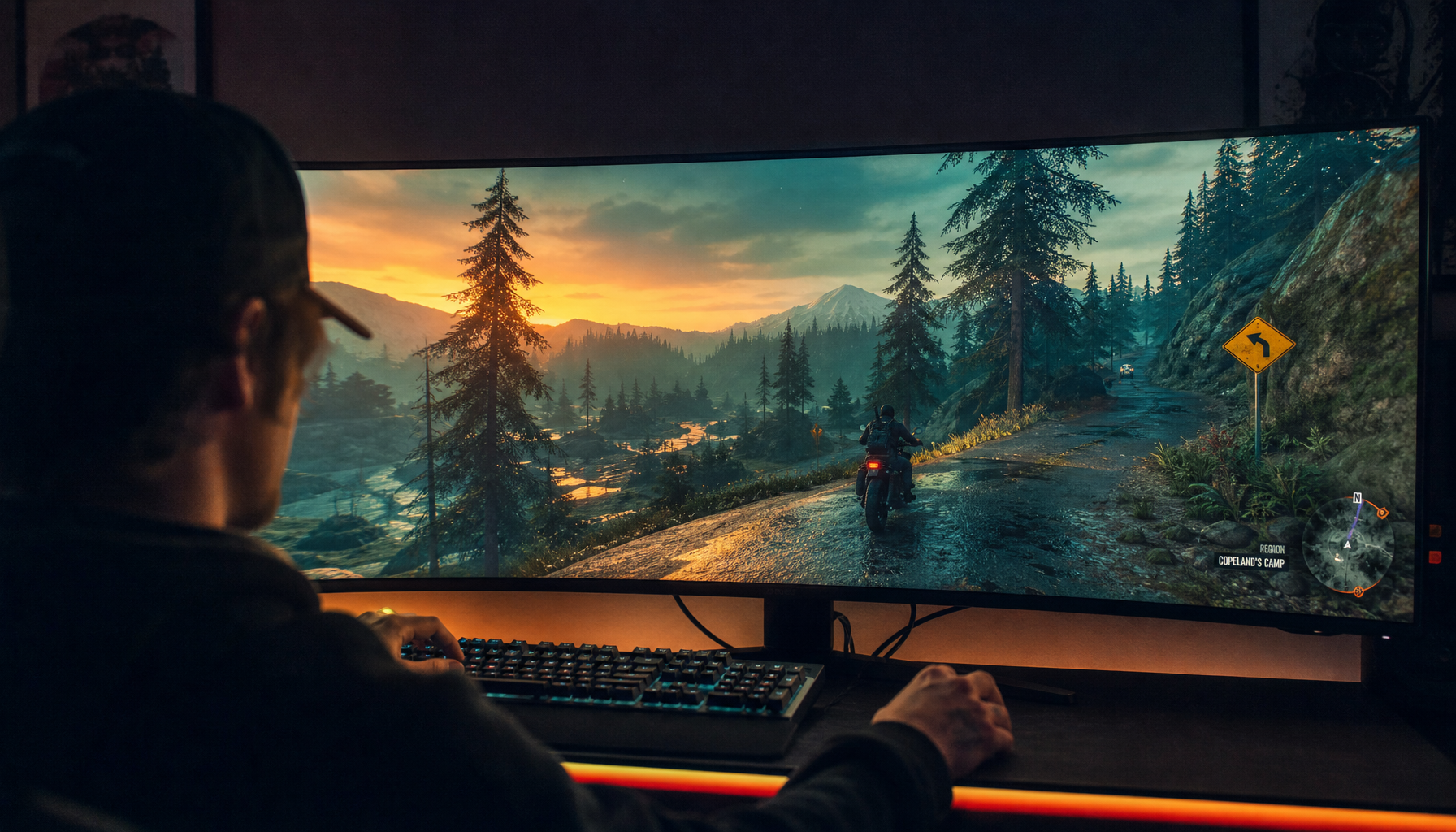
Premium Mini LED displays can exceed 1,000 nits while keeping nearby dark areas visibly deeper than a typical LED-lit IPS panel. That is especially useful on HDR-capable ultrawide monitors, where the wider field of view makes washed-out blacks and uneven backlighting easier to notice.
Why blooming never fully disappears
Blooming or haloing still happens because each dimming zone controls many pixels, not one pixel at a time. The artifact is easiest to spot around subtitles, starfields, HUD icons, or a bright cursor on a nearly black background.

Zone-based dimming matters most in dark-room viewing, where any extra glow around bright objects stands out immediately. In a brighter room, Mini LED can still help with HDR punch, but the contrast advantage is usually less dramatic because ambient light already lifts the darkest parts of the image.
Why Panel Type Still Matters on High-Refresh-Rate Monitors
Mini LED does not replace IPS or VA behavior
Mini LED monitors usually still use IPS or VA panels, so the backlight upgrade does not automatically change pixel response time, viewing angles, or native contrast. That is why two high-refresh-rate Mini LED monitors can feel very different in motion even if both advertise strong HDR brightness.
Mini LED is especially useful for gaming, detailed graphics, and HDR video, but it still needs a good LCD panel in front of it. If the panel has weak overdrive, poor viewing angles for your setup, or inconsistent SDR tuning, the backlight alone will not fix those weaknesses.
VA and IPS show Mini LED differently
VA panels usually show less visible blooming than IPS because VA starts with higher native contrast before local dimming even turns on. That gives the backlight system less work to do when a bright object appears in an otherwise dark scene.
An IPS-based Mini LED monitor can still make sense if you care about wider viewing angles, a more consistent image across a wide desk, or a creator-and-gaming hybrid setup. On ultrawide displays in particular, the better fit depends on whether you value darker-room contrast more than off-center image stability.
When Mini LED Is Worth Choosing Over Standard LED
Best-fit use cases
Mini LED is worth paying for when HDR is part of the plan, especially if you want a gaming monitor that can combine high brightness, better dark-scene control, and no permanent burn-in risk from the backlight itself. It also fits mixed-use desks well, where one monitor has to handle daytime work, late-night gaming, and streaming video without looking flat in bright scenes.
Basic LED-backlit LCDs use fewer and larger lighting elements, so they remain cheaper and perfectly fine for office work, web browsing, SDR-first gaming, and buyers who care more about refresh rate than cinematic contrast. If your room is usually bright and you rarely use HDR, a well-tuned standard IPS or VA monitor may deliver better value.
A 27-inch 2K 180Hz Mini LED model such as a brand’s 27-inch 180Hz 2K HDR1400 gaming monitor shows the kind of spec combination buyers often compare against standard LED options: 1,152 zones and HDR1400 in a size and resolution class that is common for gaming desks.
Backlight layout is the clearest way to compare options:
Backlight type |
Typical control |
What it looks like in games |
Best fit |
Edge-lit LED LCD |
Whole screen or very few coarse zones |
Grayish blacks, limited HDR effect, more obvious bleed |
Budget monitors, office displays, portable use where cost and thinness matter most |
Standard full-array LED LCD |
Dozens to a few hundred zones |
Better contrast, but halos can still be fairly broad |
Midrange HDR displays and buyers who want some dark-scene improvement |
Mini LED LCD |
Hundreds to thousands of zones |
Brighter highlights, deeper blacks, tighter light control, but still some blooming |
Gaming monitors, HDR ultrawides, and mixed work/play setups |
The most useful Mini LED buying filters are zone count, sustained brightness, panel type, and whether HDR behavior is actually well tuned. The label alone is not enough; a weak dimming algorithm or too few zones can leave a Mini LED monitor looking better than basic LED, but still far short of its marketing promise.
FAQ
Q: Does Mini LED turn an LCD monitor into a true LED display?
A: No. It is still an LCD monitor with a backlight behind it. Mini LED changes the backlight system, not the fact that the image is formed by an LCD layer controlling transmitted light.
Q: Is 576 zones enough for a gaming monitor?
A: It is a real step up from a basic LED-lit monitor, especially around 27 inches, but it is better treated as a starting point than an endpoint. Around 1,152 zones usually gives noticeably finer HDR control and less visible blooming.
Q: Is Mini LED a good match for ultrawide or portable monitors?
A: It can be excellent on ultrawides because a larger viewing area makes weak backlighting easier to spot. On portable monitors, it only makes sense if HDR quality is a real priority, because many buyers will get more value from lower cost, lower power draw, and simpler SDR-focused designs.
Practical Next Steps
If you are shopping for a monitor, focus on the backlight as a system rather than a buzzword. For a 27-inch 1440p gaming display, treat about 576 zones as the minimum for meaningful Mini LED HDR; for a 32-inch 4K or larger ultrawide, aim closer to 1,152 zones or more. Then match that backlight to the right panel type: VA if you want stronger dark-room contrast and lower visible blooming, IPS if you care more about viewing angles and broad all-around consistency.