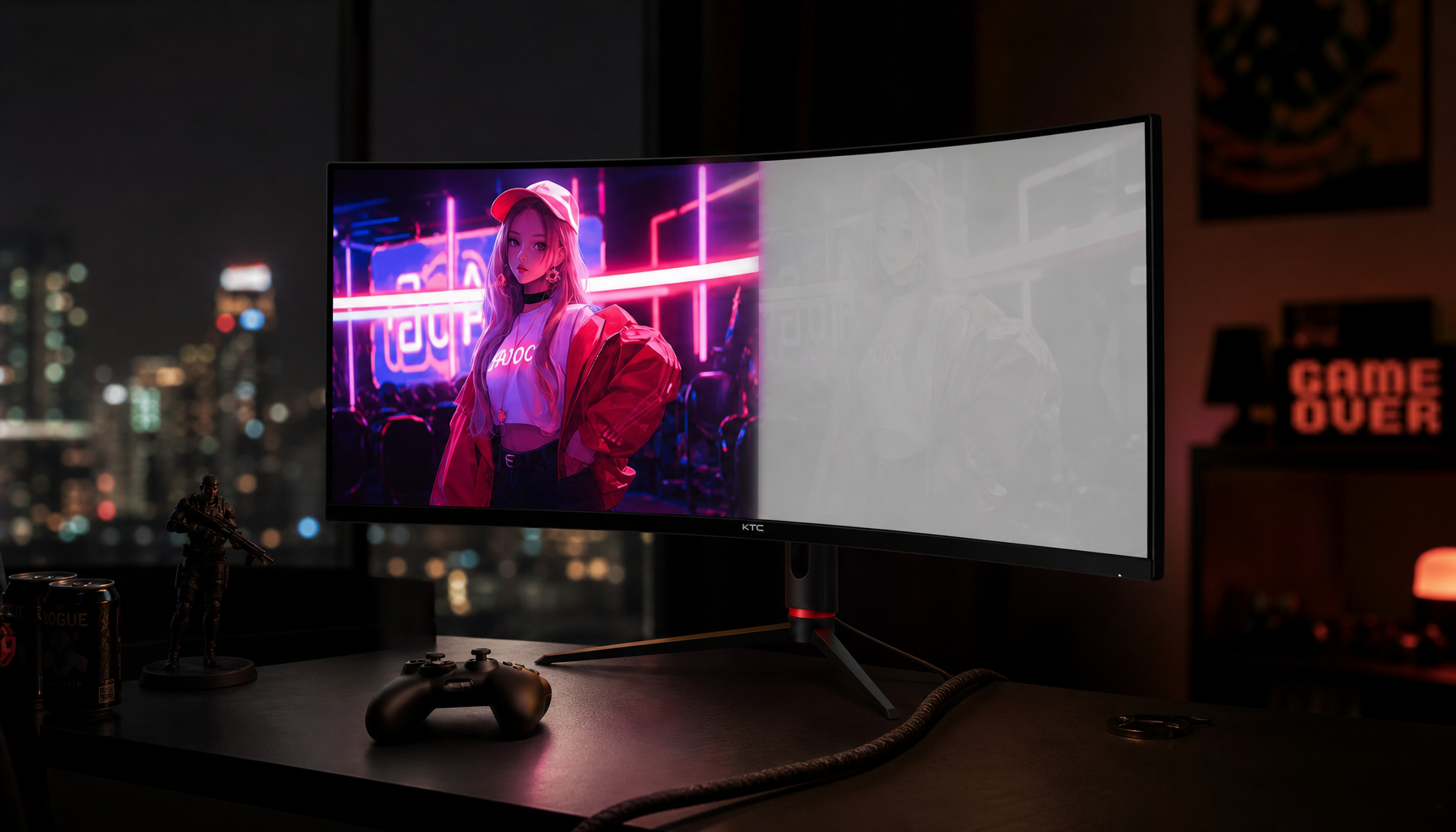
HDR displays map colors they cannot reproduce by clipping, compressing, or perceptually reshaping them to preserve brightness, detail, and believable color relationships.
Why Out-of-Gamut Colors Matter in HDR
A color is out of gamut when content calls for a color a display cannot physically reproduce. SDR content usually targets sRGB, while HDR content often uses wider color spaces and higher bit depth. A wide color gamut extends beyond sRGB and can represent roughly 1 billion colors instead of the 16.7 million common in 8-bit SDR.
That range can make molten lava, neon signage, sunset clouds, spell effects, and bright reflections feel more lifelike. The display still has limits. If a game sends a saturated red within DCI-P3 or Rec.2020, but the monitor covers only most of sRGB, it must clip the red, compress nearby reds into a smaller range, or reduce saturation while preserving brightness detail.
This is why HDR support alone does not ensure strong HDR performance. A basic 300- to 400-nit monitor with weak contrast may accept an HDR signal but cannot preserve the color and luminance structure of content mastered for 1,000 nits. The result can be raised blacks, muted highlights, or vivid color without depth.
Clipping, Compression, and Perceptual Mapping
Clipping: Simple but Destructive
Clipping maps any color beyond the display’s range to the nearest color it can show. This method is fast and can retain visual punch, but it destroys separation among colors near the gamut boundary.
In a night racing scene, red brake lights, red paint, and red neon signage can collapse into nearly the same red-orange patch on a limited HDR monitor. The scene remains saturated, but glass, paint, and emitted light no longer look distinct.

Clipping may be acceptable in competitive gaming, where visibility and response matter more than fine color fidelity. For movies, cinematic games, and image review, it is usually the least graceful approach.
Gamut Compression: Better Separation
Gamut compression draws out-of-range colors back into the display’s usable color space while preserving relationships among nearby colors. It is generally more effective for skin tones, foliage, skies, and interface elements.
The tradeoff is reduced intensity at the extremes. A 400-nit monitor mapping a 1,000-nit scene cannot reproduce every bright color as mastered, so it may darken or desaturate highlight colors to retain visible detail instead of turning them into flat white.
For productivity displays that occasionally show HDR video, compression is often preferable because it limits exaggerated desktop color and reduces the washed-out appearance that can occur when SDR apps are shown in HDR mode.
Perceptual Mapping: Preserve What Matters Most
More capable tone and gamut mapping protects the image features viewers notice first: skin tones, midtone contrast, shadow definition, and highlight texture. Convincing HDR depends on contrast, black level, brightness, and wide color, along with how effectively a display maps content to its limits.
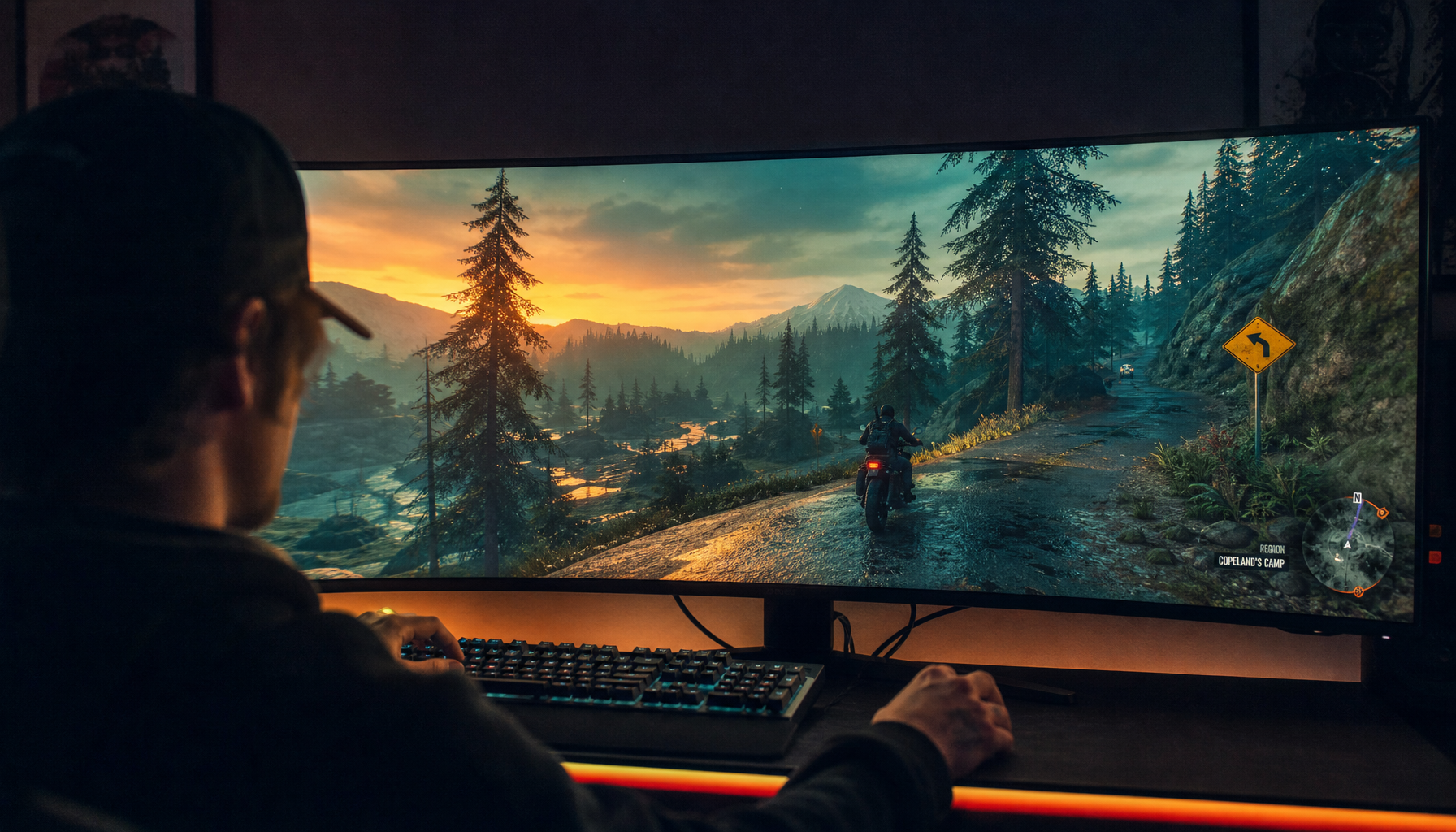
Consider a 1,000-nit HDR game shown on a 600-nit monitor. The brightest sparks cannot appear at full intensity, so the display must balance spark color, texture, and surrounding scene brightness. Strong processing rolls highlights down smoothly. Weak processing turns sparks into white dots, dims the whole image excessively, or raises shadows until nighttime scenes look gray.
Static, Dynamic, and Broadcast HDR Mapping
HDR systems differ primarily in the metadata they provide and the equipment that supports them. Metadata describes mastering brightness and color conditions, helping a display fit the content to its actual capabilities.
HDR approach |
How it tends to handle out-of-gamut color |
Practical monitor impact |
Static-metadata HDR |
Applies broad mastering information across an entire title |
Widely supported on PC monitors, but scene-by-scene color handling depends heavily on the monitor’s own mapping |
Dynamic-metadata HDR |
Allows color and brightness guidance to change by scene or frame |
Can retain color intent more effectively when supported, although monitor support is less common |
Controlled dynamic HDR pipeline |
Combines dynamic metadata with tighter playback requirements |
Often performs well on televisions, but monitor support remains limited |
Broadcast-oriented HDR |
Prioritizes live-production and compatibility workflows |
Less central to PC gaming monitors |
For PC monitor buyers, static-metadata HDR is the most relevant approach because it is broadly supported across operating systems, games, graphics hardware, and displays. Its limitation is that the monitor receives less scene-specific guidance than it would from a dynamic system. A dark cave, snowy mountain, and neon city may be processed under the same broad assumptions unless the game engine or display performs additional dynamic tone mapping.
Two monitors receiving the same static HDR signal can therefore look very different. One may emphasize highlight brightness, another may retain saturation, and another may raise overall brightness at the expense of black depth and accurate color.
Panel Technology Sets the Mapping Limits
HDR processing cannot overcome a panel’s physical limitations. Panel technology determines how much brightness, contrast, and color volume the mapping system has available.
OLED displays use pixel-level dimming, allowing each pixel to darken independently. Saturated color beside black can therefore appear especially deep in dim rooms. Quantum-dot OLED panels can also maintain stronger color volume than white-OLED and many LCD examples, although full-screen brightness is typically lower than on bright full-array LCD designs.

Mini-LED LCDs approach HDR differently. They often sustain greater brightness across large bright areas, which helps with daylight scenes and bright-room viewing. Their limitation is local-dimming precision: when zones are too coarse, a saturated object against a dark background can show blooming or lose edge detail.
IPS and fast IPS monitors can be effective for productivity, text, and calibrated SDR work. However, models without capable local dimming often struggle to create convincing HDR contrast. They may map out-of-gamut colors adequately, but without deep blacks and strong luminance separation, the result can resemble bright SDR rather than compelling HDR.
Why HDR Can Look Oversaturated or Washed Out
Oversaturation commonly occurs when a display, operating system, or application mishandles color management. A wide-gamut panel can make sRGB content appear excessively vivid if it does not clamp or translate color correctly.
Washed-out HDR has different causes: limited brightness, weak black levels, inadequate local dimming, or poor SDR-to-HDR conversion. Many entry-level HDR monitors accept the signal without producing the contrast or color volume needed to show it convincingly. Blacks appear gray, desktop colors seem dull, and highlights fail to stand apart.
On PCs, HDR quality depends on the monitor, graphics hardware, cable, driver, operating system, application, and content working together. A reliable routine is to enable HDR for native HDR games, movies, and editing workflows, then use the operating system’s HDR calibration tool and each game’s HDR controls to match the panel’s realistic peak brightness.
Practical Tuning for Gaming, Creative Work, and Office Use
For Gaming Monitors
Set peak brightness to the display’s measured or realistic capability rather than an inflated advertised number. If a monitor performs like a 400-nit edge-lit display, configuring a game for a 1,000-nit target can force excessive compression and strip color from bright effects.
Use in-game calibration screens carefully. Raise black level only until the near-black symbol is barely visible, then set paper white so menus and daylight scenes remain comfortable. If a game offers saturation or tone-mapping controls, avoid increasing them solely for immediate impact. Competitive play may justify brighter visibility settings, while single-player games generally benefit from preserved shadow depth and smooth highlight rolloff.
For Creative Displays
Separate the working color space from the delivery color space. Editing in a wider gamut can preserve color data, while export settings should match the intended viewing environment. For general web viewing and unknown displays, sRGB remains the safest target; for color-managed workflows on capable devices, Display P3 can preserve richer reds and greens.
Calibration is especially important in HDR because display behavior remains less consistent than in established SDR color-managed workflows. A monitor with dependable factory calibration, hardware calibration, or a credible creator mode is generally more useful than a louder specification sheet. Delta E below 2 is commonly considered difficult for most viewers to distinguish from reference, but wide-gamut OLED and IPS panels still require correct profiles to produce accuracy rather than exaggerated color.
For Office Productivity and Portable Screens
For documents, spreadsheets, browser applications, and dashboards, keep HDR off unless the display presents SDR content cleanly within HDR mode. Text clarity, steady brightness, ergonomic controls, USB-C operation, and consistent color are usually more valuable during routine work.
Portable companion screens deserve particular scrutiny. A small HDR-capable panel may produce striking video highlights, but poor brightness control, weak color modes, or soft text rendering can make it less suitable for an eight-hour workday than a simpler SDR display. The practical goal is a screen that changes cleanly between SDR productivity and HDR entertainment.
Visual Comfort and Flicker
HDR and wide color can increase visual intensity, but viewing comfort still matters. Research on photosensitive sensitivity and display discomfort indicates that brightness, flicker, refresh behavior, and saturated red content deserve attention; higher refresh rates are associated with fewer adverse effects such as eye strain, fatigue, and headaches.
This matters on high-refresh gaming monitors that offer backlight strobing, black-frame insertion, motion-blur reduction, or pulse-width dimming. These modes can improve motion clarity but may introduce visible or perceptible flicker. If HDR gaming causes discomfort, try a higher refresh rate without strobing, reduce peak brightness, avoid low-brightness flicker behavior where possible, and select flicker-free dimming when available.
What to Look for Before Buying an HDR Monitor
A credible HDR display combines meaningful brightness, strong contrast, wide color, effective dimming, and capable tone mapping. Entry-level HDR certification should be treated as signal compatibility rather than a guarantee of cinematic results. Higher brightness capability, strong Mini-LED dimming, or OLED-class contrast generally produces more convincing HDR.
Do not choose a monitor on gamut percentage alone. A wide-color display can still mishandle out-of-gamut mapping, oversaturate SDR content, or crush highlight color. Independent testing is valuable because marketing specifications often highlight peak brightness while omitting sustained brightness, blooming, local-dimming quality, or actual response behavior; entry-level HDR certification alone does not guarantee meaningful HDR.
The essential question is whether the display preserves color relationships when content exceeds its range. When it does, HDR looks immersive and controlled. When it does not, the image may appear bright at first glance but inconsistent in games, video, and creative work.
Final Word
HDR systems handle out-of-gamut colors by balancing brightness, saturation, accuracy, and visible detail. For the strongest results, match panel technology, mapping quality, calibration tools, and use case: OLED for deep cinematic contrast, Mini-LED for brighter-room HDR, calibrated IPS for dependable productivity and creative work, and SDR mode for text-heavy tasks that require stable color. A strong HDR monitor does more than show vivid color; it preserves the image’s intended relationships when the panel reaches its limits.