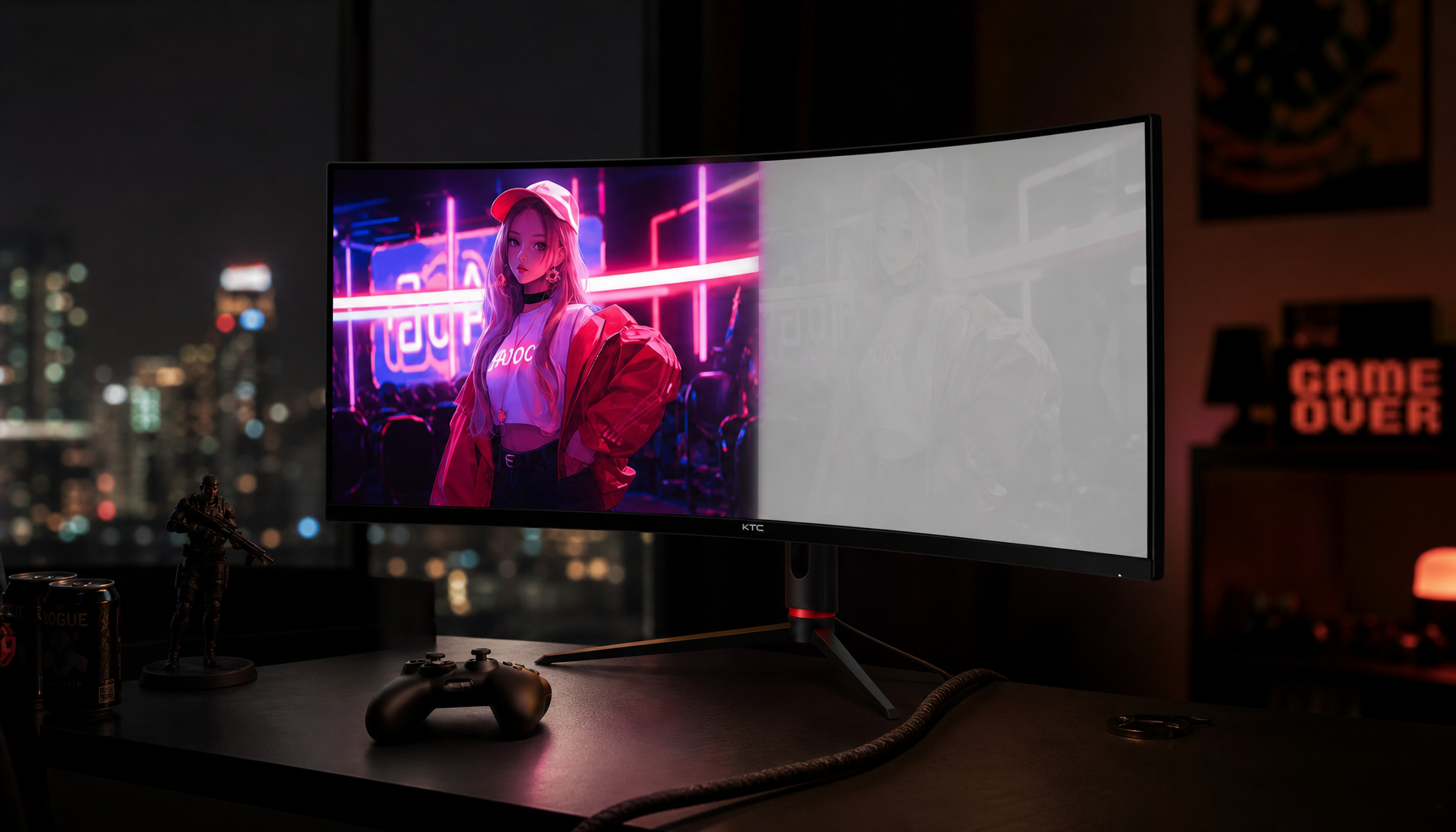
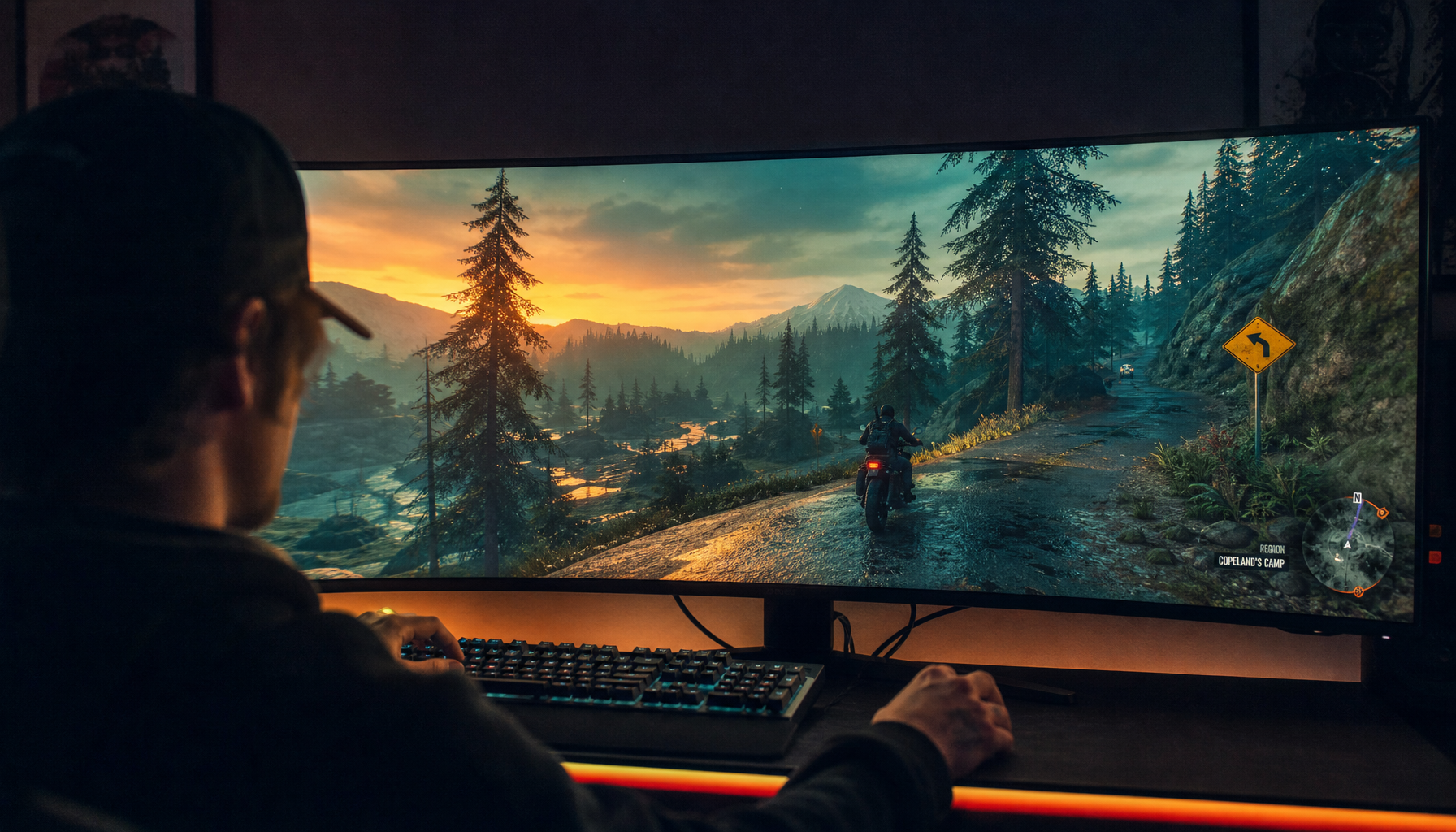
Colors can change because full-screen HDR and windowed SDR often use different brightness ranges, color spaces, bit depths, tone mapping, and display presets. The same game, movie, or web video may be translated by the operating system, the app, and the monitor in different ways.
Does your game look rich in full-screen HDR, then oddly dull, gray, or oversaturated when you switch into a window? Understanding the display chain helps you isolate whether the shift comes from the content, operating system HDR handling, the app mode, or the display preset. That makes HDR gaming, SDR desktop work, and color-critical viewing easier to keep consistent.
The Core Difference: HDR Is Not Just “Brighter SDR”
SDR, or Standard Dynamic Range, is the long-standing baseline for most desktop apps, web pages, office tools, and older video content. It typically works in a narrower brightness and color range, commonly around 100 to 300 nits, while HDR can target far higher peaks and richer color volume; wider brightness and color range is the real difference between the formats.

That matters because your monitor is not merely turning up the lights. In HDR, the system may use 10-bit or 12-bit color processing, wider color gamuts, and tone mapping that decides how bright highlights, midtones, and shadows should appear on your specific panel. In SDR, the image is usually mapped into a more predictable, smaller container. A bright red health bar, a sunset gradient, or a white spreadsheet cell can land in different places depending on which container is active.
A simple example: an SDR white window on the desktop may be treated as a comfortable paper-white level, while an HDR game can reserve its strongest brightness for explosions, sunlight, neon, and reflections. If both are shown together or switched quickly, your eyes notice the mismatch immediately.
Why Full-Screen HDR Often Looks Different
Full-screen HDR usually gives the game or video player a cleaner path to the display. The app can trigger HDR output, send HDR metadata, and let the monitor switch into its HDR picture mode. That can unlock higher contrast, brighter highlights, and smoother gradients, especially in modern games and mastered HDR video.

The tradeoff is that HDR depends on the full chain. The GPU, operating system, cable, display, app, and content all need to agree on the signal. When that chain works, HDR gaming can look deeper and more dimensional, with brighter reflections and better texture detail; improved contrast and highlight realism make scenes with varied lighting more convincing.
When the chain is imperfect, full-screen HDR can look washed out. Community testing around desktop HDR shows a recurring pattern: some users report flat or pale output across multiple monitors and even TVs that otherwise perform well with other devices. That points to a practical conclusion: if HDR looks wrong on a computer, do not blame the panel first. Compare the same monitor with a console, streaming box, or built-in TV app before deciding the display is defective.
Why Windowed SDR Can Look More Stable
Windowed SDR often feels more predictable because it stays inside the desktop environment most apps were designed for. Office suites, browsers, email, dashboards, spreadsheets, code editors, and older media typically expect SDR behavior. Their colors were not built to exploit HDR highlights or wide color volume.

That stability is useful. If you spend eight hours in documents and browser tabs, SDR usually provides cleaner text, less brightness fluctuation, and fewer surprises. For OLED productivity setups, a steady desktop brightness around 120 to 180 nits is often more sensible than chasing peak HDR brightness; steady desktop brightness can also make low-gray tint and uniformity issues easier to manage.
The downside is obvious for immersive content. Windowed SDR cannot reproduce the same highlight punch or shadow detail as a well-mastered HDR signal on a capable display. A 4K SDR web video may look sharp, but a lower-resolution HDR game scene can still feel more lifelike because contrast and color depth are doing more perceptual work than pixel count alone.
The Hidden Variable: Tone Mapping
Tone mapping is the translation step between the content’s intended brightness and your display’s actual capability. If a game or movie expects very bright HDR highlights but your monitor cannot hit those peaks, the system must compress the image. That compression can preserve detail, but it can also make the image look dim, flat, or oddly colored.
This is why two HDR monitors can behave differently with the same content. A Mini LED monitor with strong local dimming may hold bright highlights while keeping blacks convincing. An entry-level HDR monitor that accepts an HDR signal but lacks strong contrast may technically support HDR while delivering an image that looks less pleasing than SDR.
A university LIVE HDR/SDR comparison is useful here because it tested perception instead of just specifications. In its paired HDR and SDR video database, viewers significantly preferred HDR for bright, vivid scenes, while SDR was sometimes preferred for darker or less colorful material because tone mapping and display limitations changed the result; viewers significantly preferred HDR under the right scene conditions.
Display Presets Can Change the Same Signal
A monitor or TV may store separate picture settings for SDR, HDR, game mode, cinema mode, and dynamic HDR modes. That means the same color is not necessarily being shown through the same settings. Brightness, backlight or OLED light, color temperature, gamma, local dimming, saturation, and sharpening may all change when you switch modes.
One technical discussion on mixed SDR and HDR brightness explains the problem well: if SDR Game mode uses one backlight level and SDR Cinema mode uses another, the same 100% SDR white can appear much brighter in one mode than the other; separate picture settings make one universal brightness match unrealistic.
For a real desk setup, imagine running a 32-inch OLED monitor with HDR enabled for a racing game, then switching to a windowed browser. The HDR game may activate a punchy preset with aggressive contrast, while the browser returns to SDR desktop mapping. If your monitor also has different color temperatures saved per mode, whites may swing from cool blue to warm cream even though the content itself did not change.
Full-Screen Versus Windowed: What Actually Changes?
Viewing Mode |
Typical Color Behavior |
Best Use |
Common Problem |
Full-screen HDR |
Wider brightness range, wider color volume, tone mapping active |
HDR games, HDR movies, cinematic content |
Can look washed out if operating system, app, or monitor mapping is poor |
Borderless HDR |
Convenient switching, often similar to full-screen when supported |
Modern computer games, multitasking setups |
Mixed SDR desktop elements may look inconsistent |
Windowed SDR |
Predictable desktop color and brightness |
Office work, browsing, SDR video, spreadsheets |
Lacks HDR highlight impact and depth |
SDR on HDR display |
Compatible and stable when calibrated |
Everyday productivity |
Does not make SDR content truly HDR |
The performance-focused choice is not always HDR or always SDR. It is mode matching. Use HDR when the content is actually HDR and your display has enough contrast, brightness control, and color capability to benefit. Use SDR when the task is productivity, web browsing, screenshots, document work, or older content that was mastered for SDR.
Practical Fixes for Better Color Consistency
Start by separating content modes. Keep HDR off for normal desktop work if SDR apps look distorted, then enable HDR for games and video that genuinely support it. If your monitor has software controls, use them to create fast presets for gaming and productivity. For example, manufacturer-provided monitor software can let users adjust brightness and image settings and apply changes quickly through hotkeys; fast preset switching matters on hybrid gaming and work displays.
Next, calibrate HDR where possible. Use the game’s HDR sliders, the operating system calibration tool, and your monitor’s HDR mode carefully. Do not max every slider. Set black level so dark areas retain detail without turning gray, set peak brightness to what your display can actually handle, and avoid oversaturating color just because HDR mode looks less familiar at first.
Then compare like with like. If a game supports exclusive full-screen HDR, borderless HDR, and SDR, test the same scene in each mode. Choose a scene with a bright sky, a dark interior, a skin tone, and a saturated object such as red signage or a green HUD marker. If only full-screen HDR looks correct, keep it there. If SDR looks more accurate and HDR only adds glare, your display or the game’s tone mapping may not justify HDR for that title.
For OLED users, check low-gray behavior separately. OLED tint shift can show green, pink, or blue casts at low brightness, especially in spreadsheets, blank documents, browser tabs, and gray UI panels. A panel may look neutral at higher brightness but show color drift at dim settings; OLED color tint shift is often most visible in near-black or uniform desktop content.
Screenshots Can Mislead You
A screenshot does not always prove what your eyes saw. It captures the software output, not necessarily the final behavior of your monitor’s HDR mode, panel dimming, or tone mapping. Modern operating systems offer several capture methods, including full-screen, active-window, and snipping captures; built-in screenshot options may not represent the display’s real HDR presentation.
For troubleshooting, use screenshots to document settings and app modes, not to judge HDR quality alone. Your eyes, a consistent test scene, and a second playback device are more useful. If a TV’s built-in streaming app shows HDR beautifully but the computer looks washed out, the issue is likely in computer output, app handling, calibration, or operating system HDR behavior.
Pros and Cons of HDR Versus SDR for Monitors
HDR’s advantage is immersion. On a good panel, it can make sunlight, sparks, reflections, neon, and dark-room detail feel more convincing. It also supports richer gradients and more color depth, which matters in skies, fog, metallic textures, and cinematic lighting. For competitive gaming and premium entertainment, HDR is worth using when the title is mastered well and the monitor has real HDR hardware behind the badge.
HDR’s weakness is inconsistency. It can demand better cables, better app support, correct operating system settings, capable panel hardware, and thoughtful calibration. Poor HDR can look worse than clean SDR, especially on displays with weak peak brightness, limited contrast, or crude tone mapping.
SDR’s advantage is reliability. It is broadly compatible, comfortable for office work, predictable for browsers and productivity apps, and easier to match across displays. Its weakness is limited visual range. It cannot deliver the same highlight intensity, shadow detail, or color volume as strong HDR content on a strong HDR display.
A Reliable Setup Strategy
For a gaming monitor that doubles as a work display, build two habits. Run SDR for normal desktop work at a comfortable brightness, with an sRGB or accurate picture mode if available. Switch to HDR only for HDR games, HDR movies, and creative review where the content and app support it properly.
For portable smart screens, be even more conservative. Smaller panels and travel setups often prioritize compatibility, battery behavior, and stable brightness over peak HDR spectacle. Use HDR when the screen clearly supports it well; otherwise, SDR will usually be the cleaner mode for presentations, spreadsheets, web apps, and second-screen workflows.
For OLED and Mini LED buyers, do not shop by the HDR logo alone. Look for strong contrast, effective local dimming or true black capability, wide color gamut, good gradient handling, and usable desktop controls. Long-term OLED experience also shows why moderate everyday brightness and built-in mitigation tools matter; 2,656 hours of screen-on time can still produce acceptable real-world results when brightness and static elements are managed sensibly.
FAQ
Should I leave HDR on all the time?
Usually no. For most office productivity, browsing, and SDR video, SDR mode tends to look more consistent. Enable HDR when you launch HDR games or HDR movies, then return to SDR for daily desktop use if colors or brightness look wrong.
Why does HDR sometimes look washed out?
HDR can look washed out when SDR content is being remapped into an HDR desktop, when the monitor’s HDR mode has poor tone mapping, when the game’s HDR sliders are wrong, or when the operating system and app disagree about color handling. A display that accepts HDR is not automatically a strong HDR performer.
Is full-screen HDR better than borderless HDR?
It can be. Full-screen mode may give the game a cleaner path for HDR metadata and display mode switching. Many modern games handle borderless HDR well, but if colors look inconsistent, test exclusive full-screen before changing monitor settings.
Why do colors change when I move a video between monitors?
Each monitor may have different brightness, gamut coverage, calibration, HDR support, and picture presets. Even two units of the same model can vary, especially with OLED low-gray tint or local dimming behavior.
The most reliable display setup is content-aware: SDR for clean, comfortable desktop work, HDR for content built to use it, and separate presets for each. Treat HDR as a performance mode, not a permanent desktop filter, and your monitor will deliver stronger immersion without sacrificing everyday color reliability.