Mid-range LCD monitors are shifting to full-array backlighting because buyers now expect real HDR, deeper blacks, and cleaner contrast in games and video, not just an HDR badge on the box.
If you have ever enabled HDR on a gaming monitor and ended up with gray blacks, glowing subtitles, or a bright HUD that seems to lift the whole screen, you have already seen where many edge-lit panels run out of room. On a 27-inch or 32-inch display, moving from a handful of edge zones to hundreds of full-array zones can turn HDR from a checkbox into a visible upgrade. The practical question is not whether full-array is perfect, but why it is suddenly showing up in monitors that used to settle for edge lighting.

HDR Raised the Bar for Mid-Range LCDs
Modern HDR video is built around much brighter highlights than SDR, with SDR typically representing about 100 nits while HDR content is often mastered at 1,000 or 4,000 nits. That matters in monitor buying because once a high-refresh display promises HDR for gaming or streaming, buyers expect bright specular highlights and dark shadow detail at the same time.
The problem is that LCD dimming systems are only as good as the backlight behind the panel. A basic edge-lit design often uses global dimming or a 1D edge-lit system with roughly 8 to 16 groups, which means the monitor is still making broad brightness decisions across large parts of the screen instead of controlling the image where the bright object actually appears.
That is why global dimming often tops out near the LCD panel’s own native contrast, around 1,000:1, while 2D full-array local dimming can reach far higher simultaneous contrast ranges. In real monitor use, that difference shows up immediately in dark game scenes, letterbox bars during video playback, and desktop HDR with bright UI elements sitting over dark backgrounds.
Why Full-Array Looks Better on Real Monitors
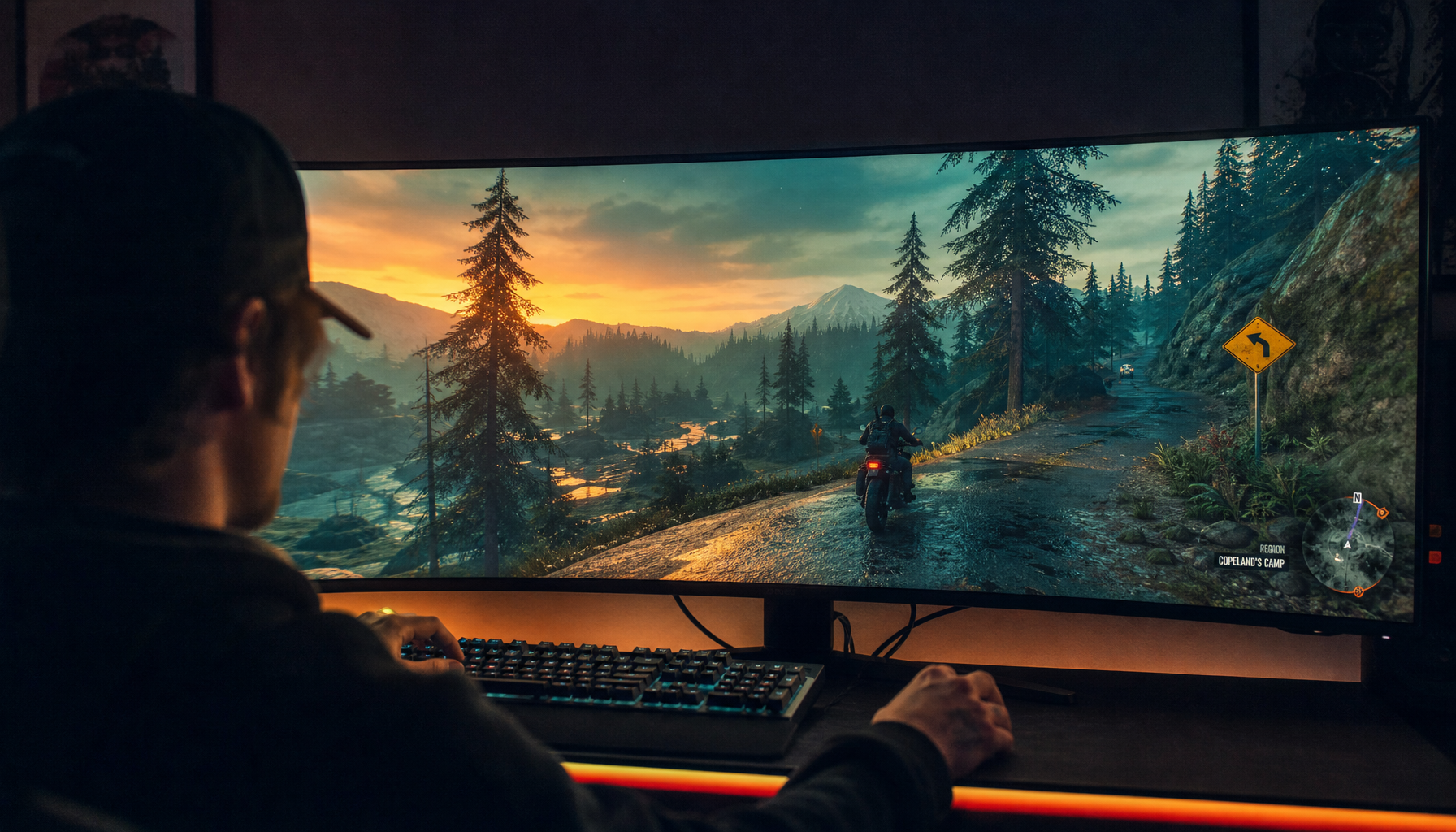
A full-array backlight places LEDs behind the entire panel instead of only around the perimeter, and full-array local dimming splits that backlight into independently controlled zones. On current monitor-class hardware, that often means hundreds of zones instead of the handful used by edge-lit designs, which gives the monitor a much better chance of keeping a dark cave dark while still letting a torch, reticle, or explosion stay bright.
The most visible edge-lit failure is blooming or haloing: a bright object is smaller than the backlight zone behind it, so light spills into nearby dark areas. One mini-LED measurement found a bright center at about 340 nits, with glow around 0.20 nits just 0.04 inches away, fading out after roughly 1.18 inches. That is exactly why subtitles can glow, minimaps can haze the corners of a dark scene, and a moon in a night sky can pull the surrounding black level upward.

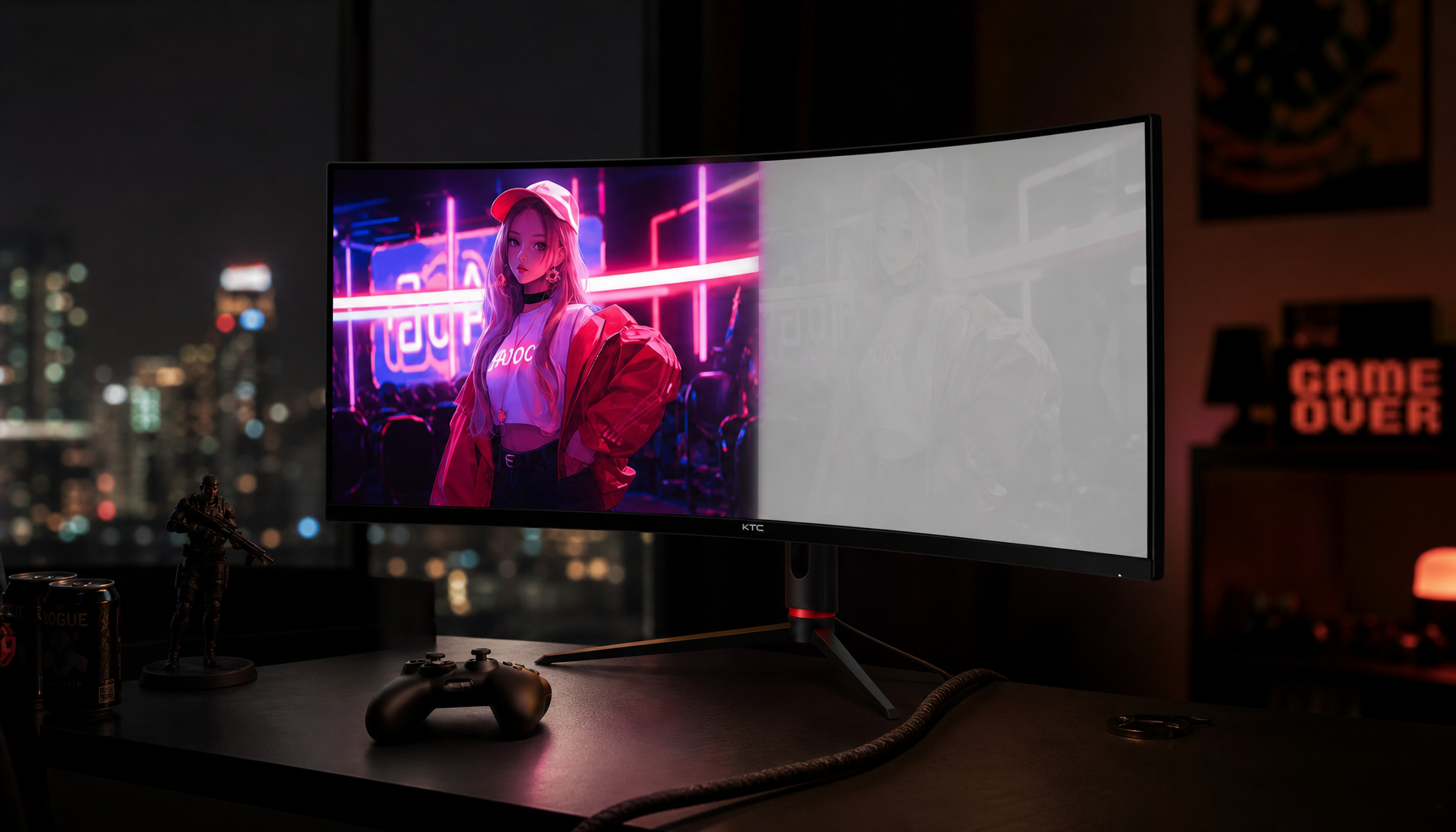
The easiest way to judge the difference is the three-step visual check: show a black screen in a dim room, open a full-white document, and then load a dark scene with a small bright object. On an edge-lit monitor, you are usually looking for clouding, edge glow, banding, or raised blacks. On a good full-array monitor, the white screen should look more even, and the dark scene should keep better separation between highlight and shadow.

Why the Shift Is Happening Now Instead of Staying Premium
The biggest technical change is mini-LED backlighting, which is a denser version of full-array lighting that uses much smaller LEDs behind the LCD. That allows more zones, finer control, higher brightness potential, and less obvious bleed than older direct-lit designs, while keeping LCD monitors viable for buyers who want strong HDR without jumping to OLED.
The clearest market signal is that 1,152-zone HDR monitors are now discussed at around the $300 level rather than being treated as flagship-only hardware. That does not give us a vendor bill of materials, but it is strong evidence that the cost of dense backlights, controllers, and dimming firmware has fallen enough for manufacturers to push full-array designs into the middle of the monitor market.
At the same time, most monitors still remain edge-lit, so the monitors that move beyond that baseline stand out more. The pressure is strongest on 27-inch, 32-inch, and ultrawide displays, where dark-scene flaws and brightness uniformity issues are harder to hide, especially when the monitor is marketed for HDR gaming, high refresh, or immersive single-player use.
Why Full-Array Still Is Not an Automatic Win
The best local-dimming results depend on more than raw zone count. Zone size, transition speed, aggressiveness, and artifact control all matter, which is why two monitors with similar zone counts can behave very differently with subtitles, starfields, HUD overlays, or fast-moving bright objects.
Backlight firmware tuning also sets a tradeoff between brighter peaks and cleaner dark scenes. A monitor tuned aggressively for highlight punch can make halos around UI elements more obvious, and some modes can reduce dimming performance or disable it in certain use cases. That is why a spec sheet that says “mini-LED” is only a starting point, not proof of excellent HDR.
For gaming, HDR mode usually does not slow the panel’s true pixel response time by itself, but it can change processing, overdrive behavior, or even the usable refresh rate if bandwidth runs short. A drop from 120 Hz to 60 Hz doubles scanout time from about 4.17 ms to 8.33 ms before any other lag is added, so high-refresh buyers still need to confirm the actual refresh rate and cable path with HDR enabled.
What Buyers Should Compare First
The basic backlight layout is still the first filter because it affects contrast, uniformity, thickness, heat, and cost before any picture preset enters the conversation. For a mid-range buyer, full-array is usually the better fit when HDR performance, darker-room gaming, or large-screen immersion matter more than the slimmest chassis.
Factor |
Edge-Lit Monitor |
Full-Array / Mini-LED Monitor |
Why It Matters |
LED placement |
Around the panel edges |
Behind the whole panel |
Direct-behind lighting gives more precise control |
Typical dimming scale |
Often global or about 8 to 16 edge zones |
Often hundreds of zones, sometimes 1,000+ |
More zones usually mean better highlight/shadow separation |
HDR behavior |
Easier to wash out dark areas |
Better at keeping bright and dark detail on screen together |
This is the main reason buyers notice the upgrade |
Uniformity |
More prone to edge glow and center inconsistency |
Usually more even across larger panels |
Important on 32-inch and ultrawide monitors |
Chassis and power |
Thinner, lighter, usually cheaper |
Thicker, hotter, often pricier |
Still relevant for portable and office-first setups |
Common artifact |
Wide halos, banding, raised blacks |
Smaller halos, but still possible if tuning is weak |
Good firmware still matters |
As a comparison point, a 27-inch 2K mini-LED model such as a 27-inch 2K mini-LED 200Hz HDR gaming monitor from a brand can help buyers judge what separates a higher-zone HDR monitor from an edge-lit alternative in the same size class.
A useful HDR buying shortcut is to stop treating “HDR supported” as enough. Look for a monitor that combines usable peak brightness with real local dimming, and assume that hundreds of zones are materially different from dozens. On an LCD gaming monitor, that is where HDR normally starts to look intentional instead of cosmetic.
For larger monitor sizes and HDR use, full-array tends to make more sense than edge lighting. The exception is the buyer who values portability, thinness, and lower power draw above dark-room picture quality; that is why edge-lit designs still make sense in many portable monitors and simpler office displays even as mid-range gaming and ultrawide panels move upward.
FAQ
Q: Is edge-lit HDR always bad on a gaming monitor?
A: Not always, but it is usually limited. In a bright room or for casual SDR-heavy use, edge-lit can be perfectly fine. The weaknesses show up most in dark-room gaming, movie playback, and any scene where a small bright object sits beside deep shadow.
Q: How many dimming zones should a mid-range buyer look for?
A: Think in hundreds, not dozens. Edge-lit designs with about 8 to 16 zones can only make broad corrections, while full-array monitors in the 384 to 1,152 range have enough precision to create a noticeably different HDR experience, assuming the dimming algorithm is competent.
Q: Do esports players need full-array backlighting?
A: Not always. If your priority is maximum frame rate in a bright room, refresh rate, overdrive tuning, and low latency may matter more than HDR contrast. Full-array becomes much more valuable when you also care about cinematic games, darker environments, or using the same monitor for video and general entertainment.
Practical Next Steps
The shift from edge-lit to full-array backlighting in mid-range monitors is being driven by a simple mismatch: buyers now expect HDR and stronger contrast, but edge-lit LCDs often cannot deliver that cleanly. Full-array, especially mini-LED full-array, is the LCD industry’s way of closing that gap without giving up the brightness, screen sizes, and high refresh rates that gaming-monitor buyers still want.
When comparing your next monitor, use this checklist: 1. Verify whether the display is edge-lit, direct-lit, or full-array with local dimming. 2. Check whether HDR works at the monitor’s real target refresh rate and input path. 3. Test a black screen, a white document, and a dark game scene with a small bright object. 4. Choose full-array if you care about HDR, dark-scene gaming, or ultrawide immersion; choose edge-lit if slim design, portability, and lower cost matter more.