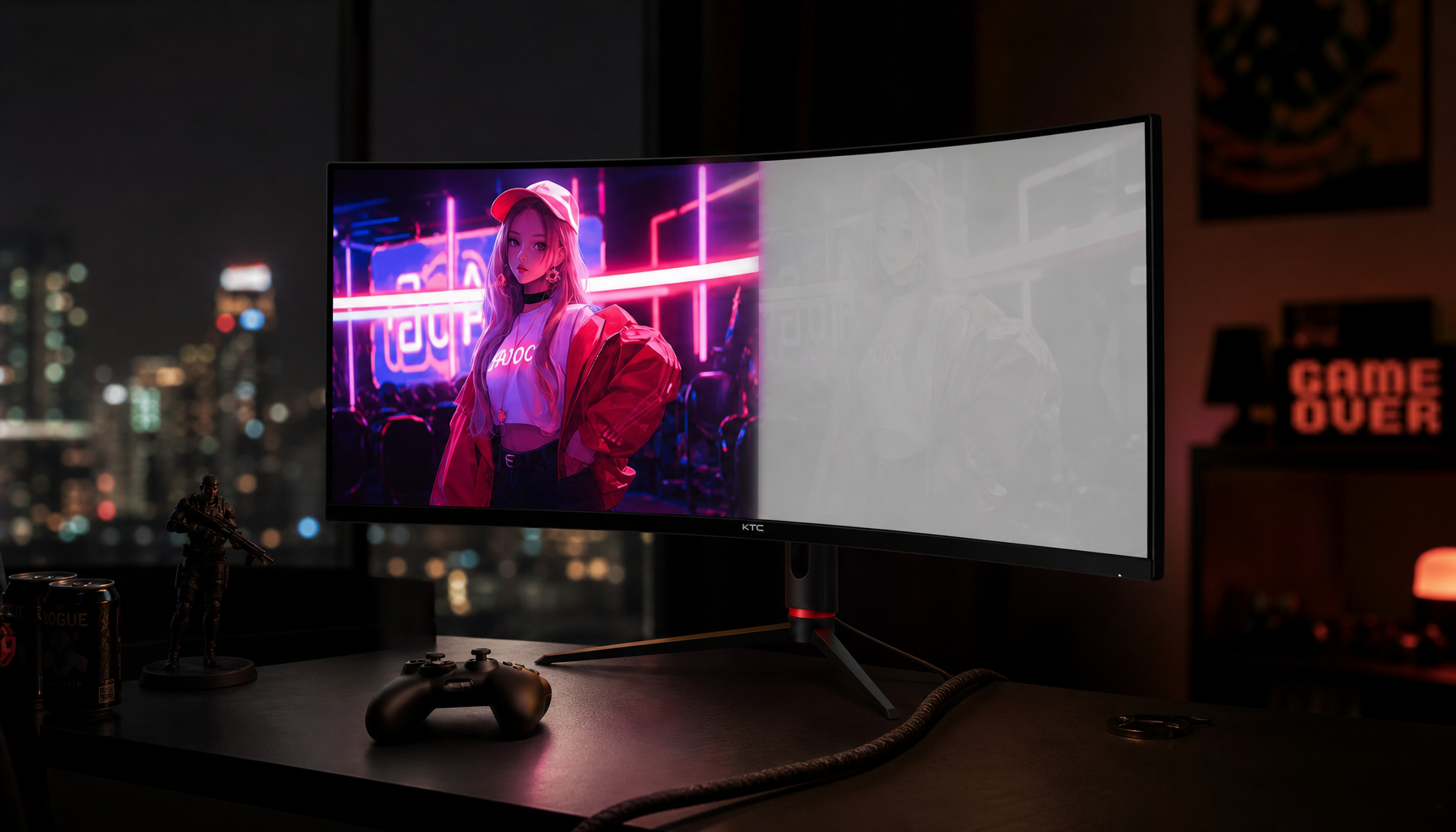
Esports pros use different monitor settings because each game rewards a different visual priority: target detection, motion tracking, map awareness, color separation, or long-session comfort. The best setup is not the sharpest or prettiest one; it is the one that helps you make the right decision faster in your specific game.
Ever copy a pro player’s settings and wonder why your screen suddenly looks washed out, overly bright, or harder to aim on? A 240Hz display can cut the frame interval from about 6.94 ms at 144Hz to about 4.17 ms, but that advantage only matters when your PC, game, and visual settings support the way you actually compete. This guide explains why FPS, MOBA, battle royale, racing, and immersive games push pros toward different monitor choices, and how to build settings that fit your own play.
The Real Reason Pro Settings Look So Different
Professional players are not tuning monitors for beauty first. They are tuning for information speed. A tactical shooter player may want flatter colors, raised dark visibility, low motion blur, and a compact 24-inch screen because the job is to catch a shoulder pixel before the opponent fires. A battle royale player may accept a slightly wider field of view and richer image separation because scanning terrain, movement, and distance cues matters more.

Refresh rate is the easiest example. A higher refresh rate updates the image more often each second, which can reduce blur and latency in fast motion. But the value depends on the game. In a tactical shooter, the 2.77 ms per-frame advantage from 240Hz over 144Hz can help during peeks and flicks. In a slower strategy game, that same upgrade may feel nice, but it will not replace readable UI, stable colors, and comfortable brightness.
The same logic applies to resolution. Competitive players often favor 1080p because it is easier to drive at very high frame rates. A pro who needs 240 FPS will usually lower demanding visuals before choosing a prettier but slower image. A player focused on productivity, creation, or immersive single-player sessions may prefer 1440p or 4K because text clarity, detail, and workspace matter more than absolute reaction speed.
FPS Games Reward Visibility, Latency, and Motion Clarity
First-person shooters are the most aggressive category for monitor tuning. Here, a good image is one that exposes enemies quickly, keeps motion clean, and avoids delay between mouse input and on-screen response. That is why many FPS players use high refresh rates, low response-time modes, reduced shadows, and visibility tools such as black equalizer or brightness adjustments.
A 240Hz monitor can refresh four times as often as a 60Hz screen, but the panel is only part of the chain. If your game runs at 150 FPS on a 240Hz display, the monitor cannot show a fresh 240-frame-per-second feed. That is why FPS pros often pair 1080p resolution with low visual settings: less GPU load, more stable frames, and more consistent aim timing.
The tradeoff is image richness. Lower shadows, lower post-processing, and brighter dark areas may make the game look less cinematic. The upside is practical: dark corners become easier to read, fast strafes smear less, and target edges stay clearer. For shooters, that is usually a winning exchange.

MOBAs and Strategy Games Need Readability More Than Raw Speed
MOBA and RTS players still benefit from smooth displays, but their monitor priorities are different. They need clean text, readable health bars, predictable color separation, and a screen size that supports map awareness without forcing excessive head movement. An aggressive FPS profile can make a MOBA look harsh, oversaturated, or tiring over a long ranked session.
For these games, optimized display settings should balance smoothness with clarity and comfort. A 144Hz or 165Hz monitor is often enough for responsive camera movement and cursor control, while a neutral color temperature around 6500K can keep the image natural for long sessions. Text clarity settings in your operating system also matter more here than many players realize, especially if you constantly review builds, chat, minimaps, and item panels.
A practical example: if you play a MOBA for four-hour sessions, a slightly lower brightness matched to your room may improve consistency more than a maxed-out backlight. You are not just reacting to a single target; you are processing cooldowns, lanes, minimap pressure, and teamfight effects for hours.
Battle Royale Settings Sit Between Shooter Speed and World Scanning
Battle royale games combine close-range duels with long-distance scouting. That makes their monitor settings less extreme than pure arena or tactical shooters. You still want a high refresh rate, low blur, and strong frame stability, but you also need enough detail to read terrain, distant silhouettes, and lighting changes.
A high FPS setup can make controls feel more responsive, especially in fast-paced competitive games, but unstable frame rates can feel worse than a slightly lower, steadier frame cap. This is where many players make the wrong upgrade decision. They chase a higher average FPS, then tolerate frame drops during fights. For battle royale, consistency often beats peak numbers.

A strong starting point is 1080p or 1440p depending on your GPU, the highest stable refresh rate your monitor supports, adaptive sync if it behaves well on your setup, and visual settings low enough to avoid late-game drops. If you can hold 200 FPS in quiet areas but fall to 110 FPS during crowded fights, tune for the fight, not the lobby.
Immersive and Story-Driven Games Favor Color, HDR, and Resolution
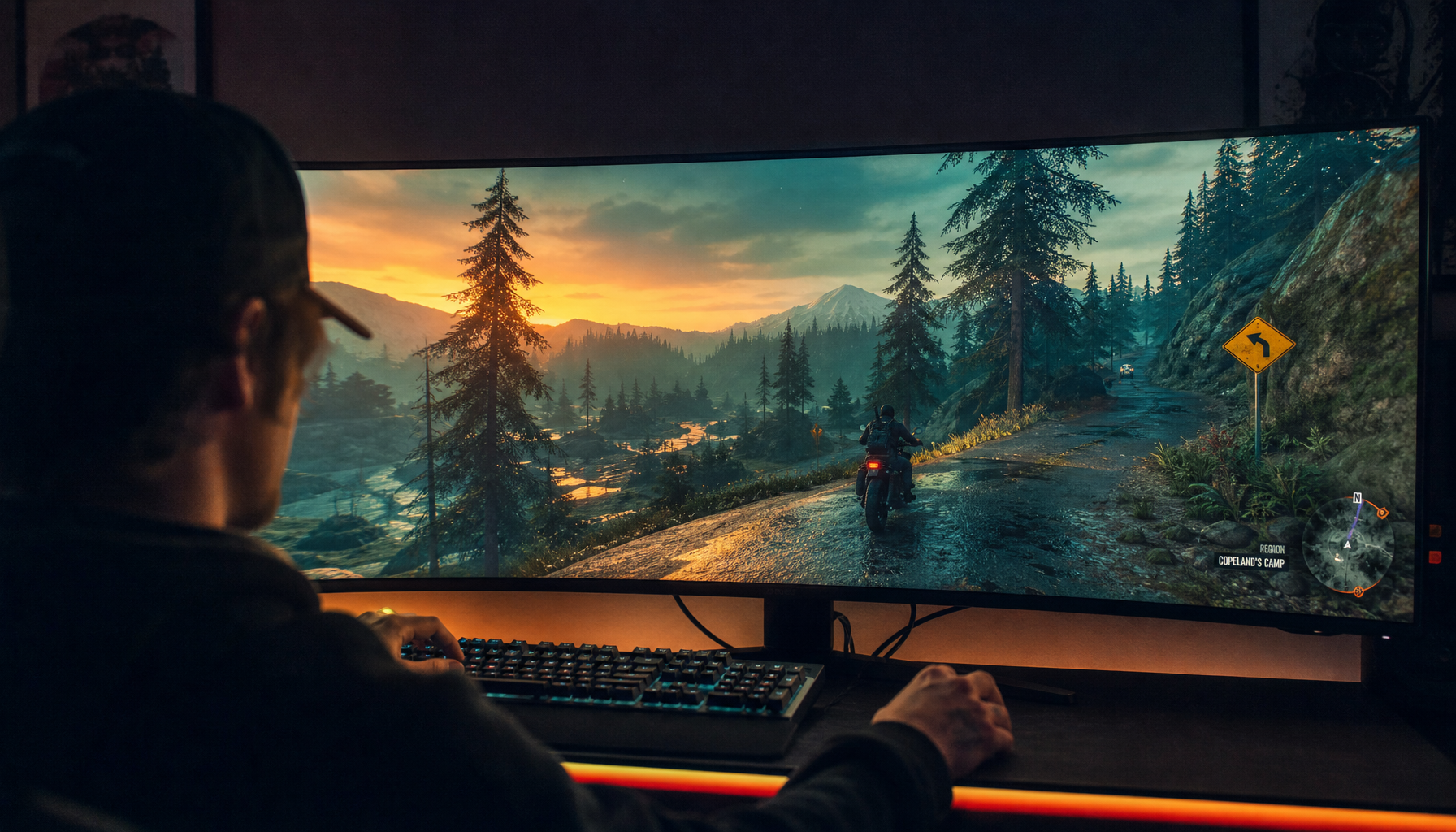
Not every game should be tuned like an esports shooter. RPGs, open-world games, racing titles, and cinematic games often reward richer color, higher resolution, HDR when properly supported, and a larger screen. In these games, monitor settings shape immersion as much as reaction speed.
That is why a 27-inch monitor is often a stronger fit for multitasking, 1440p gaming, design work, and immersive play, while a 24-inch display remains popular for competitive FPS because it is easier to scan quickly. Size changes behavior. On a 24-inch screen, key action can sit inside your central vision. On a 27-inch or larger screen, the world feels more expansive, but your eyes travel more.

The pro-style takeaway is simple: do not use one global gaming mode for every title. A racing game may benefit from higher color vibrance and HDR if the monitor handles it well. A tactical shooter may benefit from flatter image processing and cleaner motion. A spreadsheet-heavy workday may need lower brightness, sharper text, and neutral color instead of your ranked-game visibility profile.
Why Copying Pro Settings Often Fails
Pro settings are useful as starting points, not universal prescriptions. Different monitor units, room lighting, panel types, cables, GPUs, and even game patches can change the result. A brightness value that reveals enemies in one player’s dim room may wash out your image under bright daylight. A response-time Extreme mode may look fast in the menu but create bright trails behind moving objects during actual play.
Practical calibration sources warn against blindly copying exact profiles because monitor calibration varies even across units of the same model. That is especially important for color temperature, black level, contrast, and overdrive. The more precise the setting, the more likely it needs local adjustment.
Use a copied profile like a baseline test. Spend 10 minutes in a real map with dark corners, bright skyboxes, fast strafing, and UI-heavy moments. If enemies are easier to spot but your eyes fatigue quickly, lower brightness or color intensity. If motion looks sharp but leaves pale trails, reduce overdrive from Extreme to Fast or Normal. If the image feels smooth but tears during frame swings, test adaptive sync.
A Practical Settings Framework by Game Type
Game Type |
Main Priority |
Sensible Monitor Direction |
Main Tradeoff |
Tactical FPS |
Reaction speed and enemy visibility |
1080p, 240Hz if stable, low blur, black equalizer |
Less cinematic image |
Battle royale |
Stable FPS and distance scanning |
1080p or 1440p, high refresh, reduced heavy effects |
Lower detail for fight stability |
MOBA or RTS |
UI readability and map awareness |
144Hz+, neutral color, comfortable brightness |
Less need for extreme latency tuning |
Racing or sports |
Motion smoothness and visual flow |
High refresh, adaptive sync, strong contrast |
May prioritize immersion over lowest lag |
RPG or open world |
Detail, color, and atmosphere |
1440p or 4K, HDR if good, larger screen |
Higher GPU demand |
How to Build Your Own Pro-Grade Monitor Profile
Start with the fundamentals before touching advanced settings. Confirm the monitor is plugged into the graphics card, set your operating system or GPU control panel to the panel’s native resolution, and choose the highest supported refresh rate. Many players buy a fast display and accidentally run it at 60Hz for weeks.
Next, tune for your game’s job. Monitor settings such as resolution, refresh rate, brightness, contrast, gamma, and adaptive sync can directly affect how clear and responsive a game feels. For FPS, reduce demanding visuals and keep the frame rate near your refresh ceiling. For MOBAs and work-heavy setups, keep text crisp and brightness comfortable. For immersive games, raise image quality only as far as your GPU can support without stutter.
Then test motion. Response time and overdrive settings are not always better when maxed out. Normal or Fast often gives cleaner motion than Extreme because aggressive overdrive can create inverse ghosting. If a moving target has a pale outline or shimmering trail, the setting is too strong for that panel.
Finally, save profiles when your monitor supports them. A serious setup may have one profile for competitive FPS, one for strategy or productivity, and one for HDR-capable immersive games. That is not overcomplication; it is matching the screen to the task.

The Bottom Line
Esports pros use different monitor settings because different games ask the eyes and hands to solve different problems. Build around the competitive moment that matters most in your game: the first visible pixel in a shooter, the stable late-zone frame in battle royale, the readable minimap in a MOBA, or the rich scene detail in an RPG. The best monitor setting is the one that turns your display into a faster, clearer decision surface without punishing your comfort over time.