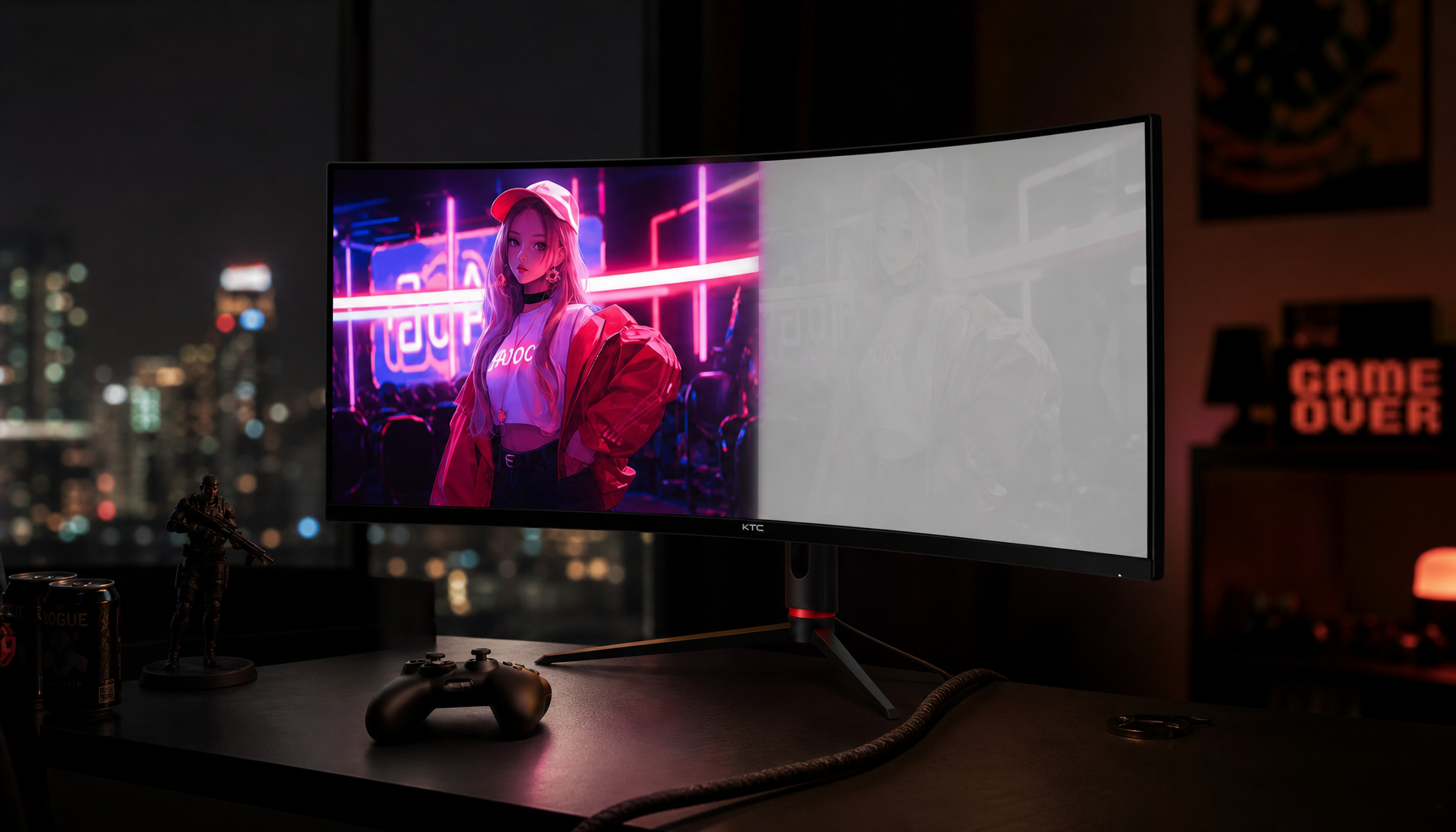
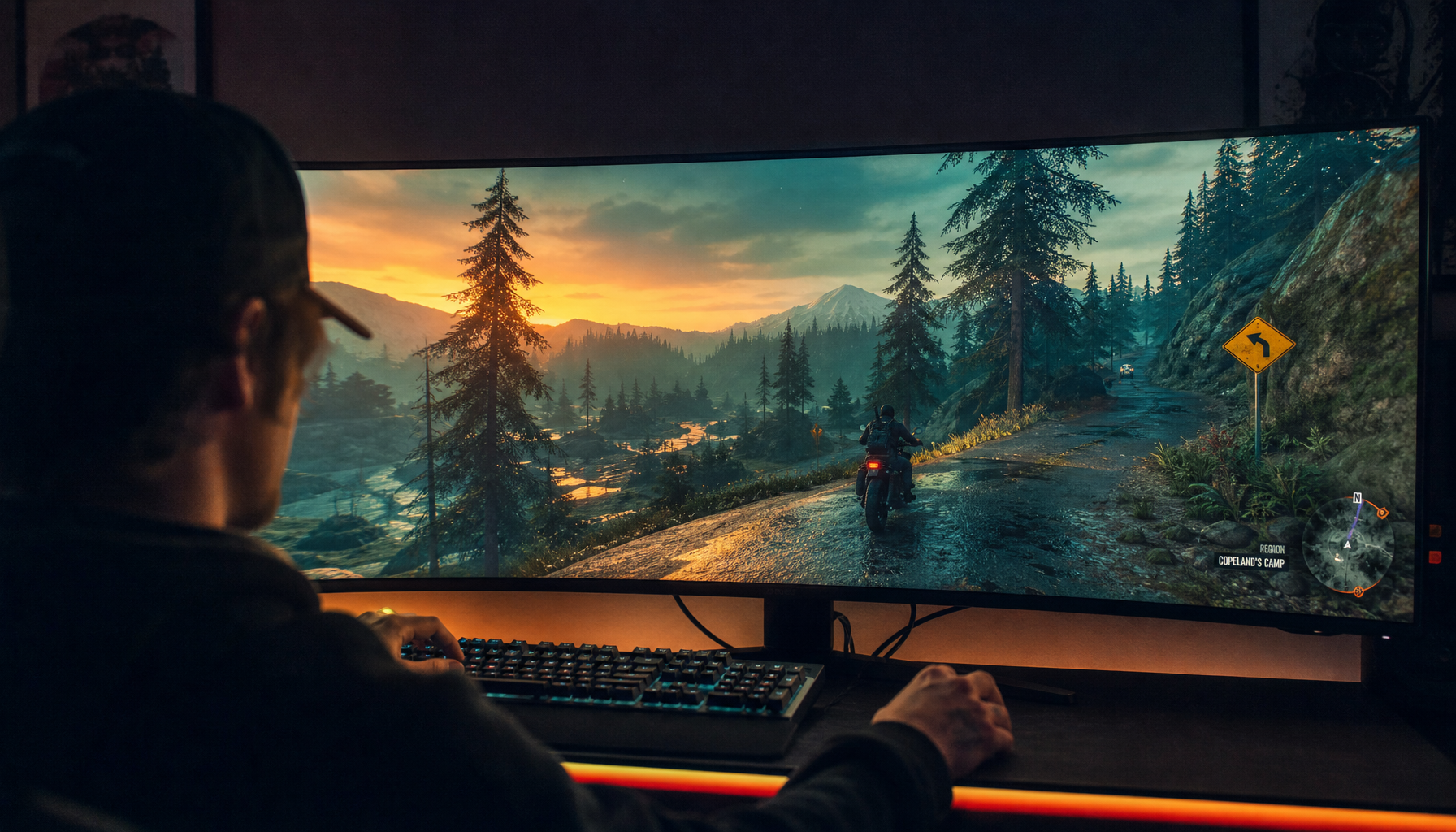
Dual mode monitors give hybrid gamers a single panel that switches between crisp 4K at 160Hz for immersive play and 1080p at 320Hz for fast-paced competitive sessions. This hardware-level toggle addresses the common desk-space and budget challenge of wanting both detail and speed without owning two separate displays.

What Is Dual Mode Display Tech?
A dual-mode monitor uses a hardware toggle to reconfigure the panel’s timing controller and scaling engine rather than relying on a simple Windows resolution change. The two built-in profiles are 3840x2160 at 160Hz for detail-heavy games and 1920x1080 at 320Hz for maximum motion clarity.
This approach solves the practical problem of limited desk space while letting players keep one display for both cinematic RPGs and twitch shooters. Because the switch happens inside the monitor, it avoids the latency and quality loss that often come with software-based downscaling.
The Engineering Behind the Switch: How It Works
When the monitor drops to 1080p, it applies 4:1 integer scaling so that every logical pixel maps exactly onto a 2x2 block of physical pixels. This method prevents the interpolation blur that normally appears when a 4K panel runs a lower resolution through standard scaling.
The trade-off is pixel density. A 27-inch 1080p image delivers roughly 81.5 pixels per inch, which is lower than a native 24-inch 1080p panel at about 91.8 PPI. Edges remain sharp thanks to integer scaling, yet the larger pixel size can make fine details appear chunkier at typical viewing distances.
Switching profiles requires a full hardware handshake that produces a 3-to-5-second black screen. During this cycle the monitor renegotiates timing, refresh rate, and scaling parameters, so the process is not instantaneous.
Why 320Hz Matters for Competitive Gaming
Higher refresh rates reduce the time each frame stays on screen. At 160Hz a frame persists for about 6.25 ms; at 320Hz that time drops to roughly 3.1 ms. The shorter persistence visibly reduces motion blur and improves the ability to track fast-moving targets.
In titles such as Valorant, CS2, and Apex Legends the difference helps players maintain aim during quick flicks and strafes. The same reduction in persistence also tightens the perceived input response because new frames reach the eye sooner.
Blur Busters persistence research shows why this step from 160Hz to 320Hz delivers measurable clarity gains in fast-motion scenarios even when absolute frame-rate ceilings are already high.
4K 160Hz vs. FHD 320Hz: Which Mode for Which Game?
Cinematic and story-driven titles benefit most from the 4K 160Hz profile. Games such as Cyberpunk 2077 or Elden Ring reward the extra pixel density and color depth that 4K provides on a 27-inch panel.
Competitive FPS players usually prefer the 320Hz profile because the motion-clarity advantage outweighs the loss of resolution during intense aiming sequences. Many users adopt a session-based approach: they stay in 4K for longer narrative sessions and switch to 1080p only when queuing ranked matches.
Navigating the Dual-Mode 'Toggle Tax'
The 3-to-5-second sync cycle and four-to-five joystick clicks required to reach the mode toggle make frequent per-game switching impractical. Most owners settle on a “session strategy” where they choose one profile for an entire play period rather than toggling between rounds.
Firmware behavior can also reset brightness or local-dimming settings after a switch, so users often re-check those values when changing modes. Planning ahead reduces the daily friction of the toggle process.
Setup and Compatibility: Is Your Rig Ready?
Running 4K at 160Hz demands HDMI 2.1 or DisplayPort 1.4 with Display Stream Compression. Without sufficient bandwidth the monitor cannot sustain the full resolution and refresh rate simultaneously.
High-end GPUs such as an RTX 4080 or newer comfortably drive 4K 160Hz, while the 320Hz 1080p mode is more CPU-limited. Current-generation consoles can output 4K 120Hz or 1440p 120Hz to these panels, but they do not yet support the 320Hz 1080p profile.
Choosing Your Dual-Mode Display: KTC H27P6 vs. M27P6
The H27P6 uses a Fast IPS panel and offers full ergonomic adjustment including height, swivel, and pivot. It delivers 400 nits typical brightness and wide color coverage suitable for mixed PC and console use.
The M27P6 steps up to Mini-LED backlighting with 1152 local dimming zones and up to 1400 nits peak HDR brightness. This model suits users who want stronger contrast in dark-room cinematic sessions while retaining the same dual-mode resolution and refresh options.
Consider your room lighting and budget first. The standard Fast IPS model meets most competitive-plus-casual needs, while the Mini-LED version justifies its higher price when HDR impact matters more than raw cost.
Common Questions About Dual Mode Monitors
How Long Does It Take to Switch Between Modes?
The hardware handshake lasts three to five seconds and produces a brief black screen while the panel reconfigures timing and scaling. Most users switch once per session rather than between individual matches.
Does 1080p on a 27-Inch Panel Look Blurry?
Integer scaling keeps edges sharp, yet the lower pixel density of roughly 81.5 PPI means fine details appear larger and less refined than on a native 24-inch 1080p display. Competitive players who sit close often accept the trade-off for the motion-clarity benefit.
Can I Use Dual Mode With a Console?
Current consoles support the 4K 160Hz profile through HDMI 2.1. They do not yet output the 320Hz 1080p mode, so console owners primarily benefit from the higher-resolution profile and VRR support.
Will Frequent Mode Switching Affect Panel Life?
The manufacturer has not published long-term endurance data specific to dual-mode toggling. Daily session-based use appears well within normal operating limits for current gaming panels.