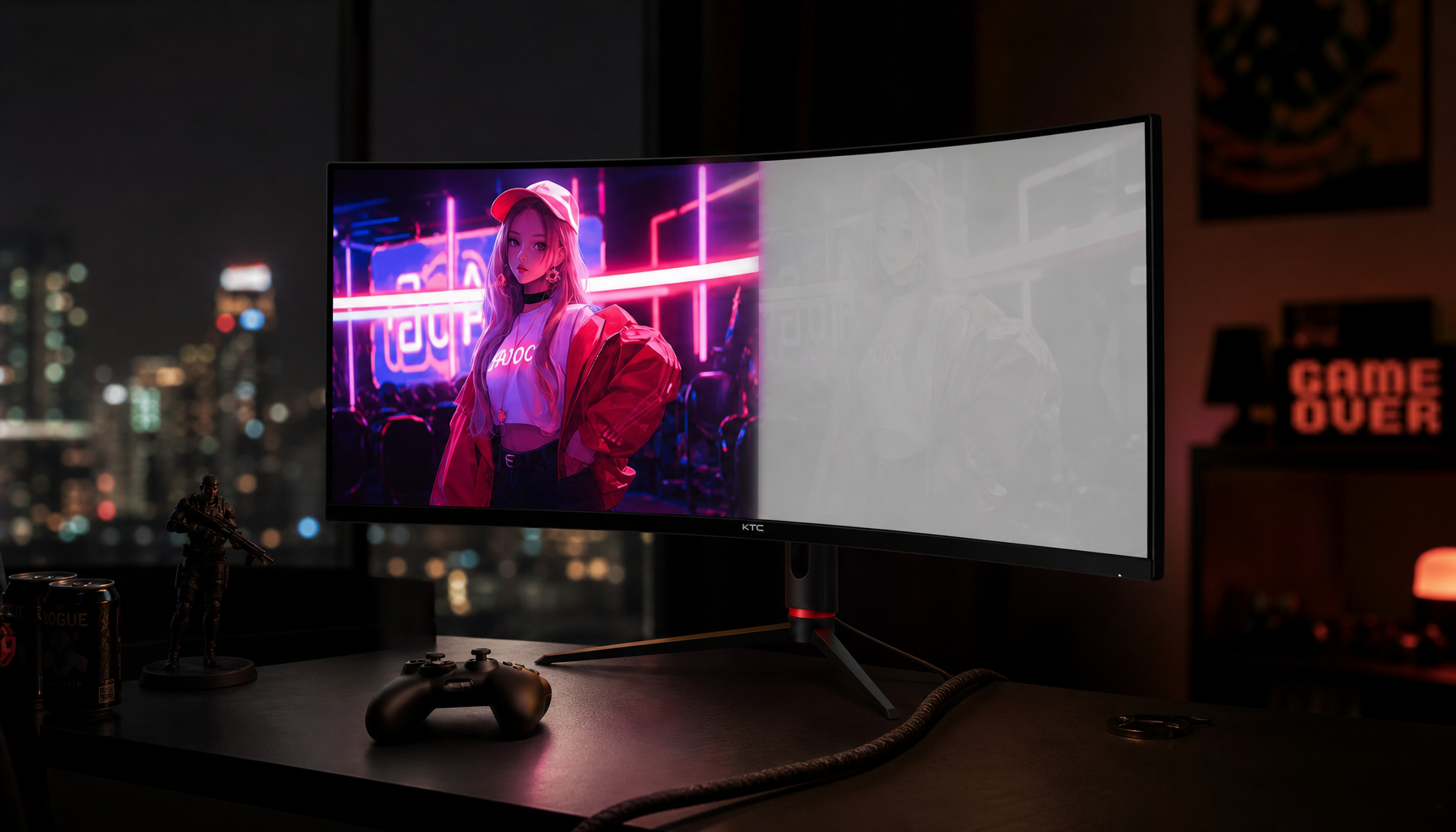
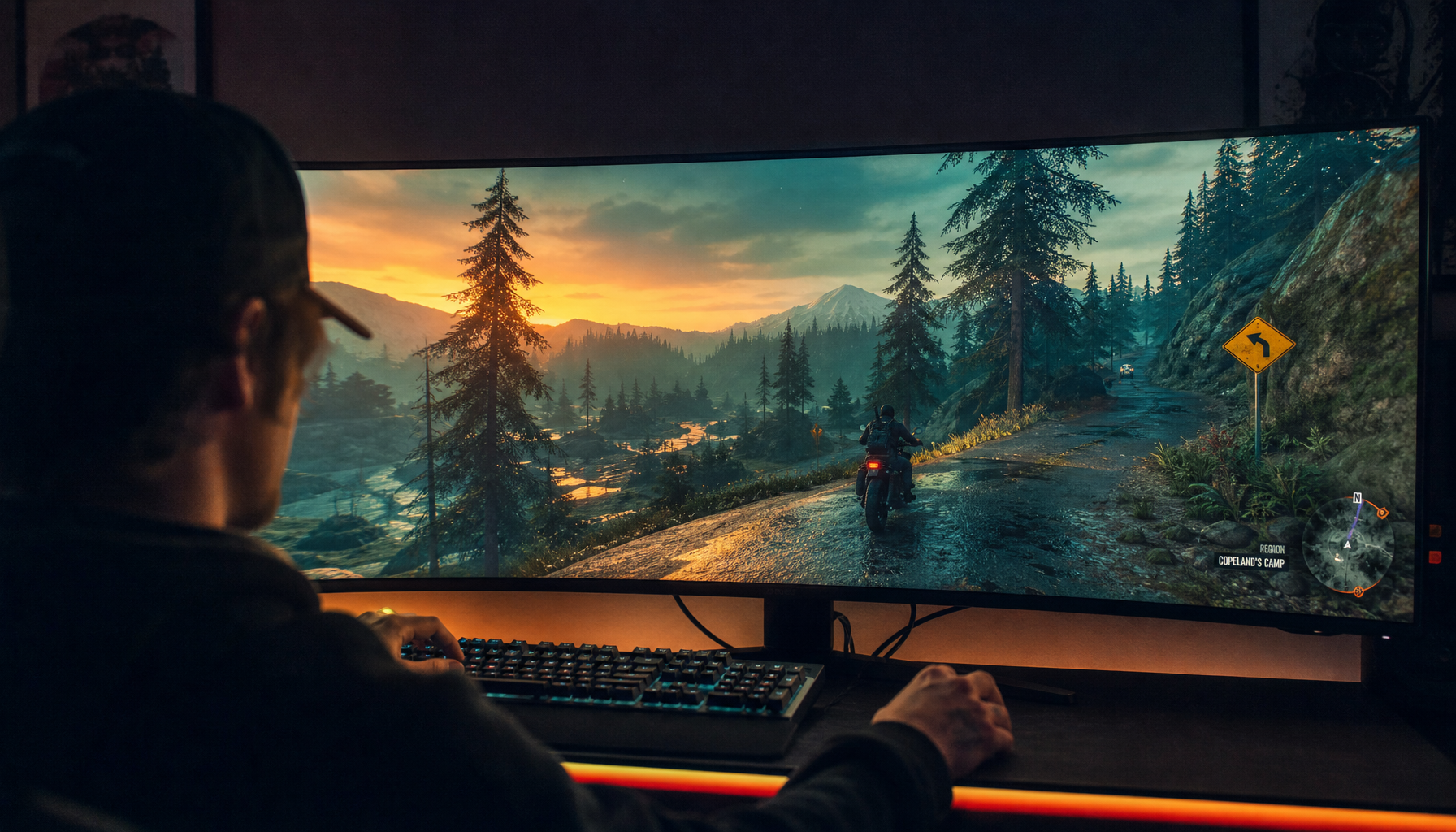
Contrast ratio does not add pixels, but it can make existing detail look cleaner, deeper, and easier to separate. A sharp panel with weak contrast can still look hazy; a well-tuned, high-contrast display often feels clearer because edges, shadows, text, and highlights stand apart.
Do dark game scenes look muddy, or does black text on a white document feel slightly gray after a long work session? In a practical monitor setup, improving contrast settings and matching brightness to room light can make text boundaries, shadow detail, and UI layers easier to read without buying a higher-resolution screen. This guide explains what contrast ratio actually changes, when it matters most, and how to choose or tune a display for clearer everyday viewing.
What Contrast Ratio Really Means
Display contrast ratio describes the luminance gap between the brightest white and darkest black a screen can produce. A 1000:1 ratio means the white level is 1,000 times brighter than the black level. That definition sounds simple, but it directly affects how your eyes separate objects, text strokes, shadows, and bright highlights on screen.
The key word is separation. Resolution controls how many pixels are available. Pixel density controls how tightly those pixels are packed. Contrast controls how strongly adjacent tones stand apart. A 27-inch QHD monitor can have excellent pixel density for office work, but if its black level is lifted by backlight bleed or glare, fine gray dividers, small text, and dark game textures can appear softer than the pixel count suggests.
Static contrast ratio is the number to respect first because it measures bright and dark output at the same time in a single image. Dynamic contrast ratio can produce giant marketing figures by changing backlight behavior across scenes, but it often says less about how a mixed webpage, spreadsheet, game HUD, or video frame will look in real use.
Why Higher Contrast Can Look Sharper Without More Pixels
Perceived sharpness is partly an edge-detection problem. When a black letter sits on a white document, stronger contrast makes the letter edge more obvious. When a dark enemy model moves through a shadowed corridor, better contrast helps the outline stand apart from the background. When a photo has both bright sky and shaded detail, higher contrast gives your eyes more tonal steps to work with.
That is why low contrast is often described as “blurry,” even when the panel is technically rendering the same pixel grid. The blur is perceptual. The eye sees weak boundaries, gray blacks, compressed shadows, and reduced depth. Higher contrast improves clarity, depth, vibrancy, and detail because it gives bright and dark areas more visual distance from each other.
Imagine two monitors showing the same 4K desktop. One has a native contrast ratio near 1000:1, and the other is closer to 3000:1. The pixel count is identical, but the 3000:1 display will usually show deeper blacks, more convincing shadow separation, and stronger window borders in dimmer viewing. That can make the image feel more precise before you ever change resolution.
Contrast vs. Resolution vs. Pixel Density
Contrast should not be treated as a replacement for resolution. It is a companion spec. Resolution determines detail capacity, while contrast determines how cleanly tonal differences are presented. For office work, a high-PPI display can make text finer, but contrast determines whether that text feels crisp against the page.
For productivity displays, pixel density is a major sharpness factor, with roughly 110 PPI or higher being a practical target. A 27-inch QHD monitor sits around that threshold, while a 27-inch 4K monitor looks finer but may require 125% or 150% operating system scaling. Contrast then decides whether that fine text has enough tonal authority to remain comfortable over long sessions.
Spec |
What It Changes |
How It Affects Clarity |
Resolution |
Total pixel count |
More detail potential, especially on larger screens |
Pixel density |
Pixels packed per inch |
Finer text and smaller visible pixel structure |
Contrast ratio |
Difference between black and white |
Stronger edges, depth, shadow detail, and readability |
Brightness |
Total light output |
Better visibility in bright rooms, but not automatically better depth |
A bright screen with poor contrast can look washed out. A high-resolution screen running outside its native resolution can look soft. A high-contrast screen with low pixel density can still show chunky text. The clearest result comes from balancing all three: native resolution, suitable PPI, and strong real-world contrast.
Static, Dynamic, and Ambient Contrast
Static contrast is the most useful buying number for normal monitor comparison. It tells you what the panel can do when bright and dark content appear together, which is exactly what happens in games, dashboards, documents, photos, and video timelines.
Dynamic contrast is less dependable because it depends on dimming algorithms, scene changes, and processing choices. Very large contrast claims are often dynamic figures, so a “1,000,000:1” label may not mean the display preserves that separation inside a single complex frame.
Ambient contrast is the overlooked real-world factor. Room light reflects off the screen surface and raises the apparent black level. Ambient light can reduce effective contrast dramatically, which is why a monitor that looks rich at night may look flat beside a sunny window. In a bright office, a matte coating, controlled reflections, and enough brightness can matter as much as the panel’s lab contrast number.
Panel Type: IPS, VA, OLED, and Mini-LED
Panel technology strongly shapes contrast behavior. IPS panels are popular for productivity because they usually offer stable viewing angles and strong color consistency, but many standard IPS displays sit around the 1000:1 class. VA panels often deliver deeper blacks, commonly making them attractive for cinematic games and mixed entertainment work. OLED goes further because individual pixels can turn off for black, creating extremely high perceived contrast.
For gaming buyers, panel type matters because IPS, VA, OLED, and QD-OLED balance speed, contrast, viewing angle, price, and motion quality differently. A VA monitor can look more immersive in dark RPGs but may show more motion smearing on weaker implementations. An IPS monitor can feel cleaner for competitive play and productivity but may look gray in a dark room. OLED can deliver elite contrast and response, but it costs more and may be less ideal for static office elements over long periods.
Mini-LED and full-array local dimming try to improve LCD contrast by dimming parts of the backlight. This can work well, especially for HDR, but it depends heavily on zone count and algorithm quality. Poor local dimming can create blooming around bright objects, crush shadow detail, or visibly shift brightness during motion.
What Contrast Ratio Should You Look For?
For general productivity, a stable static contrast ratio around 1000:1 is a reasonable floor. It supports clean black text on white backgrounds, clear app borders, and basic image depth. For gaming, movies, and immersive content, around 3000:1 is more satisfying because dark scenes gain weight and bright effects stand out with less gray haze.
A 3000:1 contrast ratio is commonly positioned as stronger than 1000:1 for gaming, movies, and richer image quality because it gives dark and bright areas more visible separation. For professional editing or HDR-minded work, contrast needs rise again, but the panel’s HDR hardware, local dimming, brightness, and color accuracy become just as important as the ratio itself.
Use Case |
Practical Contrast Target |
Why It Matters |
Email, documents, spreadsheets |
1000:1 or higher |
Clear text and comfortable UI separation |
Coding and office multitasking |
1000:1 to 2000:1 |
Better text edges, dividers, dark themes, and logs |
Story-driven gaming and movies |
Around 3000:1 or higher |
Deeper blacks and stronger shadow detail |
HDR, editing, premium immersion |
Higher-end VA, Mini-LED, or OLED class |
Better depth, highlights, and tonal control |
These targets are not absolute. A well-coated 1000:1 IPS monitor in a controlled office can feel clearer than a glossy higher-contrast panel facing a window. A 4K OLED can look spectacular for media, yet a 27-inch QHD IPS monitor with strong ergonomics and a modern single-cable connection may be the smarter value for daily work.
How Contrast Affects Text Clarity and Office Comfort
Text clarity is where contrast becomes quietly powerful. When black text is truly dark and the background is not glaring, your eyes spend less effort separating strokes from the page. This matters for spreadsheets, code editors, email, and long reading sessions where “sharp enough” can still become tiring after hours.

For work monitors, comfort features such as matte anti-glare surfaces, flicker-free backlighting, low-blue-light modes, and ergonomic stands should be evaluated alongside resolution and contrast. A high-contrast panel placed too high, too bright, or under a harsh reflection will not feel clear for long.
A practical setup test is to open a white document beside a gray UI panel. Lower brightness until the white area looks like lit paper instead of a light source, then adjust contrast only until text looks defined without crushing subtle gray elements. If thin borders disappear, contrast or gamma may be too aggressive. If black text looks charcoal and weak, the panel, settings, or room lighting is limiting perceived clarity.
How Contrast Changes Gaming and Video Immersion
In games, contrast affects both competitive visibility and emotional impact. High contrast makes object silhouettes, weapon edges, cave textures, and UI overlays easier to parse. In racing, flight, RPG, and horror titles, the sense of depth depends heavily on black levels and highlight separation.

For monitor shoppers, brightness and contrast become especially important for HDR because weak contrast can make HDR look like a brighter SDR mode rather than a deeper, more dimensional image. Entry-level HDR claims are often not enough by themselves; meaningful HDR usually needs OLED, QD-OLED, or Mini-LED hardware with strong dimming and real black-level control.
There is a tradeoff. Competitive esports players may prioritize refresh rate, response time, and low motion blur over cinematic contrast. Story-driven gamers, simulation players, and console users often gain more from deeper blacks and better HDR behavior. If you play both, a 1440p high-refresh IPS monitor may be the balanced value pick, while OLED or strong VA becomes more compelling when immersion is the priority.
How to Tune Contrast for Better Sharpness
Start with native resolution. A display running below native resolution can look soft no matter how good the contrast ratio is. Then set the correct refresh rate, choose the correct RGB range for the source, and use a neutral picture mode before making contrast judgments.
Next, match brightness to your room. Brightness and contrast are related but not the same; brightness changes overall light output, while contrast describes the range between dark and light. In a bright room, raising brightness can preserve visibility. In a dark room, excessive brightness can make blacks look lifted and cause fatigue.
Finally, use real content. Open a dark game scene, a text-heavy document, a high-contrast photo, and a gray UI screen. If shadow areas become solid black, reduce contrast or adjust gamma. If the whole image looks milky, reduce glare, check black-level settings, and consider whether the panel’s native contrast is the limitation. If white highlights lose texture, contrast may be clipping the top end.
Pros and Cons of Prioritizing High Contrast
High contrast improves perceived sharpness, depth, text separation, shadow detail, and image punch. It is especially valuable for dark-room entertainment, HDR, design review, coding in dark themes, and users who want a screen to feel more dimensional rather than merely brighter.
The tradeoff is that contrast cannot fix everything. It cannot replace pixel density, poor scaling, weak motion handling, bad calibration, or reflections. Some high-contrast VA panels may have slower dark transitions. OLED offers superb contrast but costs more and has static-image considerations. Dynamic contrast can also introduce brightness shifts that distract more than they help.
The best value decision is not “highest number wins.” It is choosing the right contrast behavior for the task, lighting, and panel type. For an office-first setup, balanced IPS clarity, 110 PPI or better, and good ergonomics may beat a higher-contrast panel with weaker text rendering or poor viewing angles. For immersion-first gaming, deeper blacks can matter more than a small bump in resolution.
FAQ
Does contrast ratio make a monitor physically sharper?
No. Physical sharpness comes mainly from resolution, pixel density, subpixel layout, scaling, and focus-like rendering quality. Contrast ratio affects perceived sharpness by making edges and tonal boundaries easier to distinguish.
Is 1000:1 contrast good enough?
Yes, for general office work and everyday use, 1000:1 can be enough when the monitor has good pixel density, a matte surface, and sensible brightness settings. For dark-room gaming, movies, and HDR, higher contrast is usually more satisfying.
Should I trust dynamic contrast numbers?
Treat them cautiously. Static contrast is more useful for comparing real panel performance because it reflects bright and dark content shown at the same time. Dynamic contrast can be useful when implemented well, but the advertised number alone is not a reliable clarity predictor.
What matters more for clarity: contrast or 4K?
For fine text and detailed images, 4K can be a major upgrade, especially at 27 inches and above. For perceived depth, dark-scene detail, and edge separation, contrast can be just as noticeable. The best result is high pixel density plus strong real-world contrast.
A clearer screen is rarely about one spec. Choose enough pixel density for the size, insist on honest static contrast, control glare, and tune brightness to the room. That combination makes images look sharper, text feel calmer, and games feel more immersive.