A curved monitor looks most natural from its intended center seat. Move too far left or right, and the edges can make straight lines, object sizes, and HUD elements look stretched, compressed, or slightly bowed.
If a minimap looks wider on one side of your ultrawide, or spreadsheet columns seem to lean when you slide your chair off center, you are seeing the geometry penalty of a curved screen from the wrong seat. One widely discussed 34-inch monitor example works out to a sweet spot measured from a circle radius of roughly 11.5 ft, which shows how quickly a real desk setup can drift away from the display’s design center. You will leave with a practical way to judge when curvature helps immersion, when it hurts accuracy, and how to buy around that tradeoff.
 Why Geometry Shifts When You Move Off Center
The center seat is part of the design
A company’s buying guidance describes curved monitors as intended for a direct front viewing position, which is why they tend to feel most balanced when one person sits squarely in the middle. In a typical gaming setup, that centered position keeps the left and right edges at more similar distances from your eyes, so menus, crosshairs, and map edges look more even.
 A company says off-center viewing can make straight lines appear curved or skewed, because the curved surface changes both reflection and the angle from which each part of the panel reaches your eye. In practice, the side closest to you can feel enlarged or more open, while the far edge can look pinched.
Why a flat screen behaves differently
A field-of-view modeling argument makes the core point clearly: a flat image already contains perspective stretching from the camera or game render, and a flat screen viewed from the intended position can partially cancel that effect. Once the panel itself is bent and the viewer slides away from the design center, that balance changes, so edge objects and straight borders can become easier to notice.
Which Specs Make Distortion Easier to Notice
Tighter curves increase the penalty
A company defines 1000R, 1800R, and gentler curves as different radii, with lower numbers creating a more aggressive wraparound shape. That usually improves immersion for one centered user, but it also means the picture changes faster when you lean left, lean right, or rotate your chair away from the centerline.
Wider panels magnify side-seat errors
A platform notes that curved ultrawides often use 1000R to 1800R shapes and depend heavily on viewing distance. That matters because a 34-inch 21:9 monitor or a 49-inch super-ultrawide pushes more content into your peripheral vision than a 27-inch or 32-inch screen, so any off-axis stretch is easier to spot at the far edges.
Where Curved Monitors Help Most, and Where They Do Not
Best case: centered solo gaming and ultrawide work
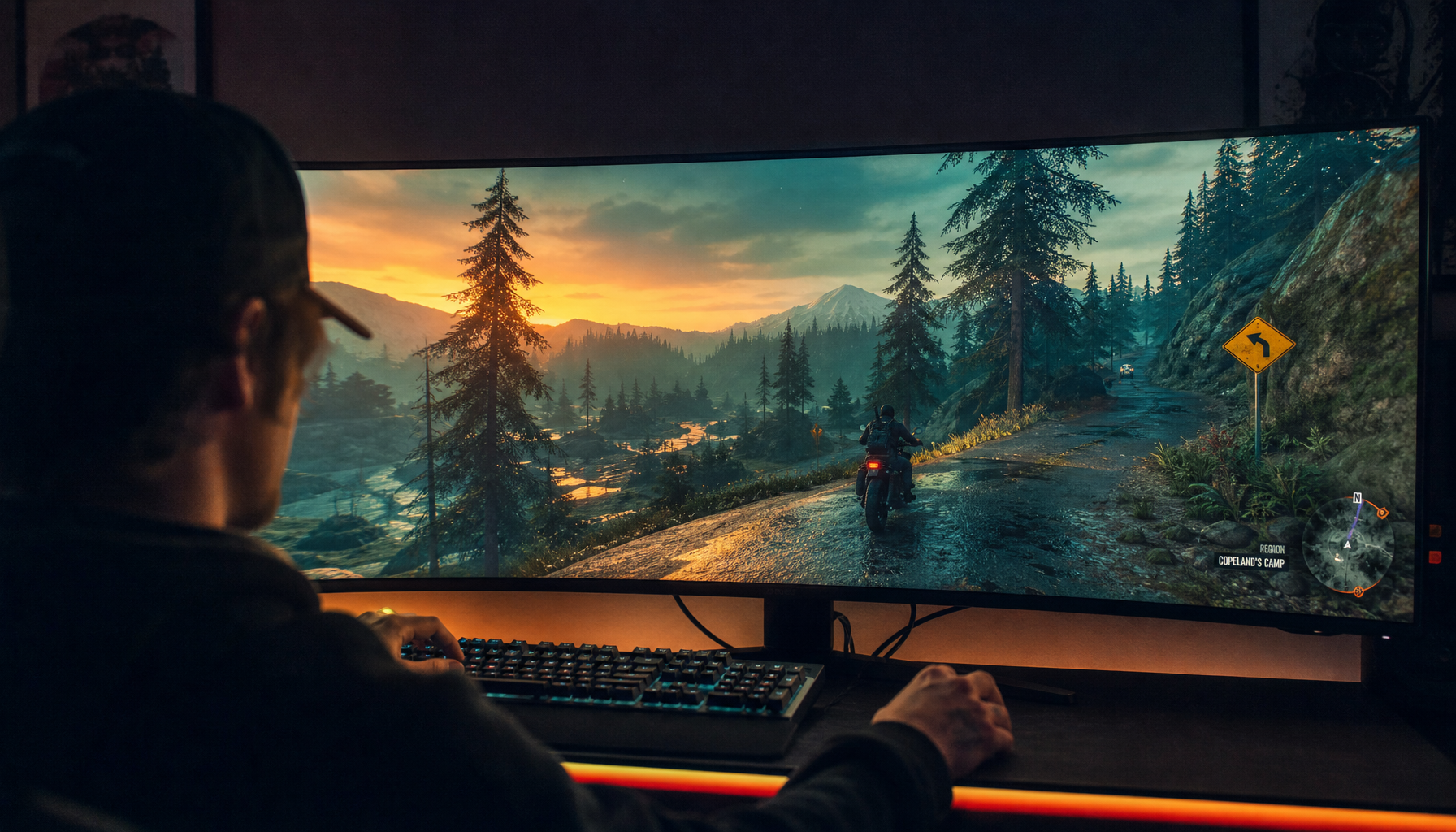
A company presents curved screens as reducing head and eye movement for one centered viewer, and that is the strongest case for them. A solo player on a high-refresh-rate 34-inch gaming monitor, or one desk user managing multiple windows on an ultrawide, can benefit from a shape that keeps the edges more inside the field of view.
A platform describes wide curved monitors as supporting more natural eye tracking across the display, which matches how many people use ultrawides in practice. The benefit is not that the curve makes geometry perfect; it is that a centered user often feels less edge fatigue during long sessions.
Weak case: shared viewing and line-critical work
A company also frames the optimal curved-monitor experience as a single-user setup, so a second viewer off to one side is automatically getting a worse seat. If you often review work with someone standing beside you, play from a couch, or turn the screen to show a client, flat panels are more predictable.
 A platform says precision line-based work can show mild image distortion on curved displays, and a company makes a similar point for editing and alignment work. In that context, a 27-inch QHD office monitor such as the a brand 27-inch 2K 100Hz/120Hz home and office monitor can be a safer baseline when people often sit off center. For CAD, architecture, image layout, finance dashboards, or any task where a straight grid needs to read as straight from more than one position, flat is still the lower-risk choice.
 How to Choose Curve Radius, Size, and Placement
Match the curve to your real desk, not the marketing image
A company explains that curvature ratings are radius measurements, so 1000R is roughly a 39-inch radius, 1800R is about 71 inches, and 4000R is about 13 ft. As a buying rule, tighter curves make the most sense when you sit close and centered; if you sit farther back, move around, or share the display, a gentler curve or flat screen is safer.
A 34-inch geometry example used a panel about 33 inches wide with only about 1 inch of center recession, yet still implied a sweet spot from a circle center around 11.5 ft away. The practical takeaway is not that curved monitors are useless, but that screen width, seat position, and actual desk depth matter more than the curve label by itself.
Choose by task first
A platform points out that flat monitors keep straight lines more predictable, while curved ultrawides can replace multiple displays. If your main use is one-player gaming or wraparound multitasking, a curved 34-inch ultrawide can be a smart buy; if your main use is shared viewing, portable use, or geometry-critical work, a flat monitor is usually the better tool.
Quick comparison table
Setup or use case |
Better fit |
Why it works |
Main risk if you view off center |
27-inch to 32-inch solo gaming monitor |
Mild curve or flat |
Easier to stay centered; less edge spread |
Small but noticeable HUD stretch at the near edge |
34-inch 21:9 high-refresh-rate ultrawide |
Curved, usually 1800R or tighter |
Strong immersion and easier edge scanning for one user |
Side-seat warping becomes more obvious |
49-inch super-ultrawide workstation |
Curved |
Can replace dual monitors for one fixed seat |
Highest sensitivity to chair position |
CAD, architecture, layout, finance grids |
Flat |
Straight lines stay more predictable |
Curved shape can make minor bowing easier to notice |
Shared desk, couch viewing, or client review |
Flat |
More consistent picture from multiple seats |
Curved screen favors only the center viewer |
Portable monitor |
Flat |
Small screen and frequent repositioning reduce the value of curvature |
Curve adds complexity without much seating control |
Practical Next Steps
Buy for your normal seat, not your ideal seat
A company’s guidance makes single-user centered seating the basic assumption of curved monitor design. If that matches how you actually use your desk, a curved gaming monitor or curved ultrawide can be a good fit; if your chair drifts, other people often look at the screen, or you depend on straight-line accuracy, flat is easier to live with.
A company notes that manufacturers often tune the image for the ideal centered position, which is why a display can look impressive in a demo but less convincing in day-to-day use. Test with your real desk depth, your real chair position, and the content that exposes distortion fastest, such as a game HUD, a spreadsheet grid, or a browser window with strong vertical lines.
Action checklist
- Measure your usual eye-to-screen distance before picking a curve.
- Decide whether the monitor is for one centered user or regular shared viewing.
- Treat tighter curves like 1000R as higher-commitment choices than gentler 1800R to 4000R options.
- Use a flat monitor if straight-line accuracy matters more than immersion.
- Favor curved ultrawides when you want one centered seat to replace a dual-monitor feel.
- Skip curvature on most portable monitors unless you have a very specific fixed-position use case.
FAQ
Q: Do curved gaming monitors always look more immersive?
A: No. They usually feel best when one person sits centered at the intended distance. Once you move off that center seat, the same curve that helps immersion can make edge geometry look less natural.
Q: Is 1000R worse than 1800R?
A: Not automatically. A 1000R screen is simply more aggressive, which can feel excellent up close for one user, but it is also less forgiving when your chair shifts or someone views the screen from the side.
Q: Does panel type fix off-center geometry distortion on a curved monitor?
A: Not really. Panel type can affect color and contrast behavior at angles, but the geometry issue discussed here comes mainly from screen shape, width, and where you sit relative to the center.