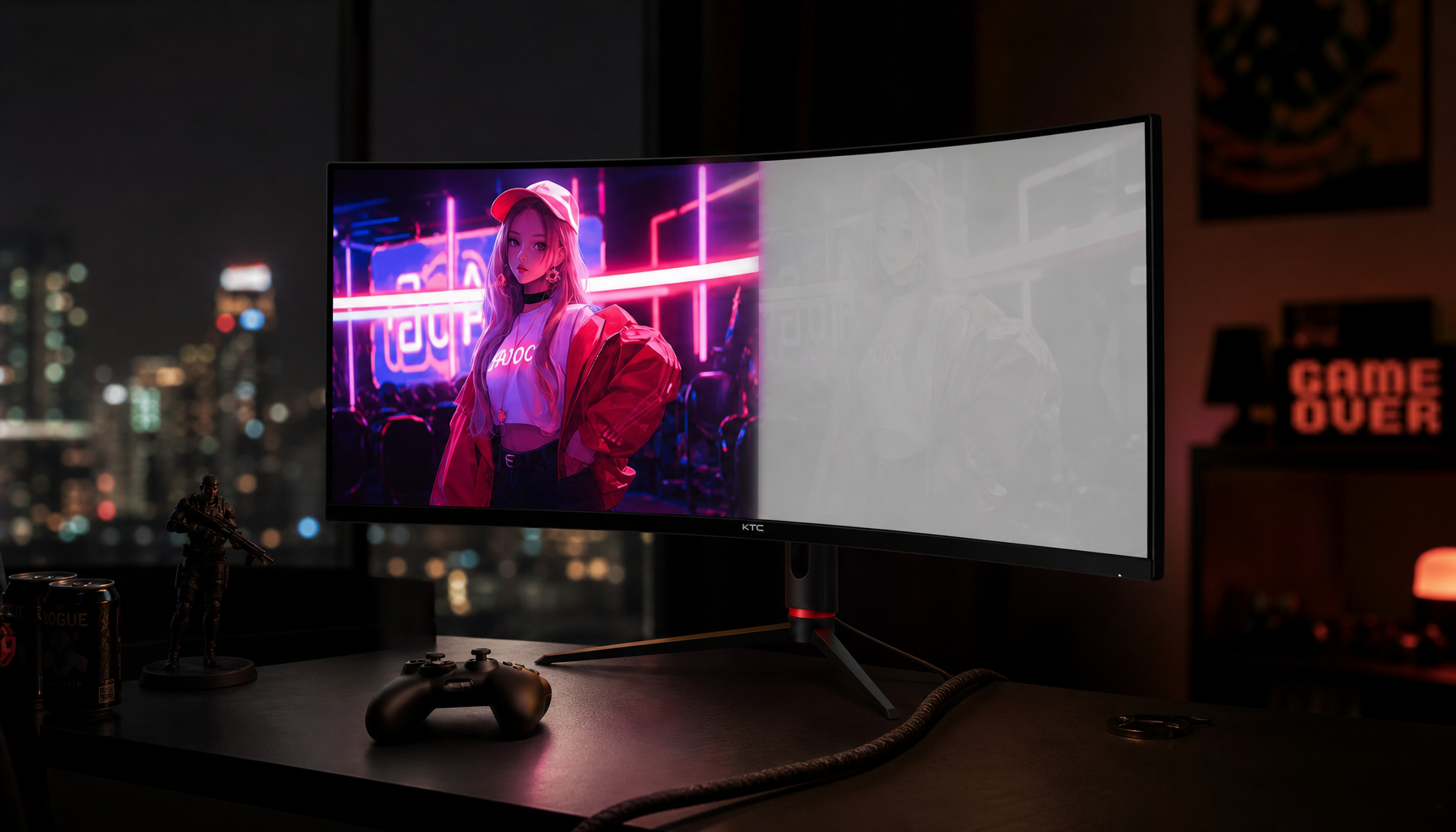
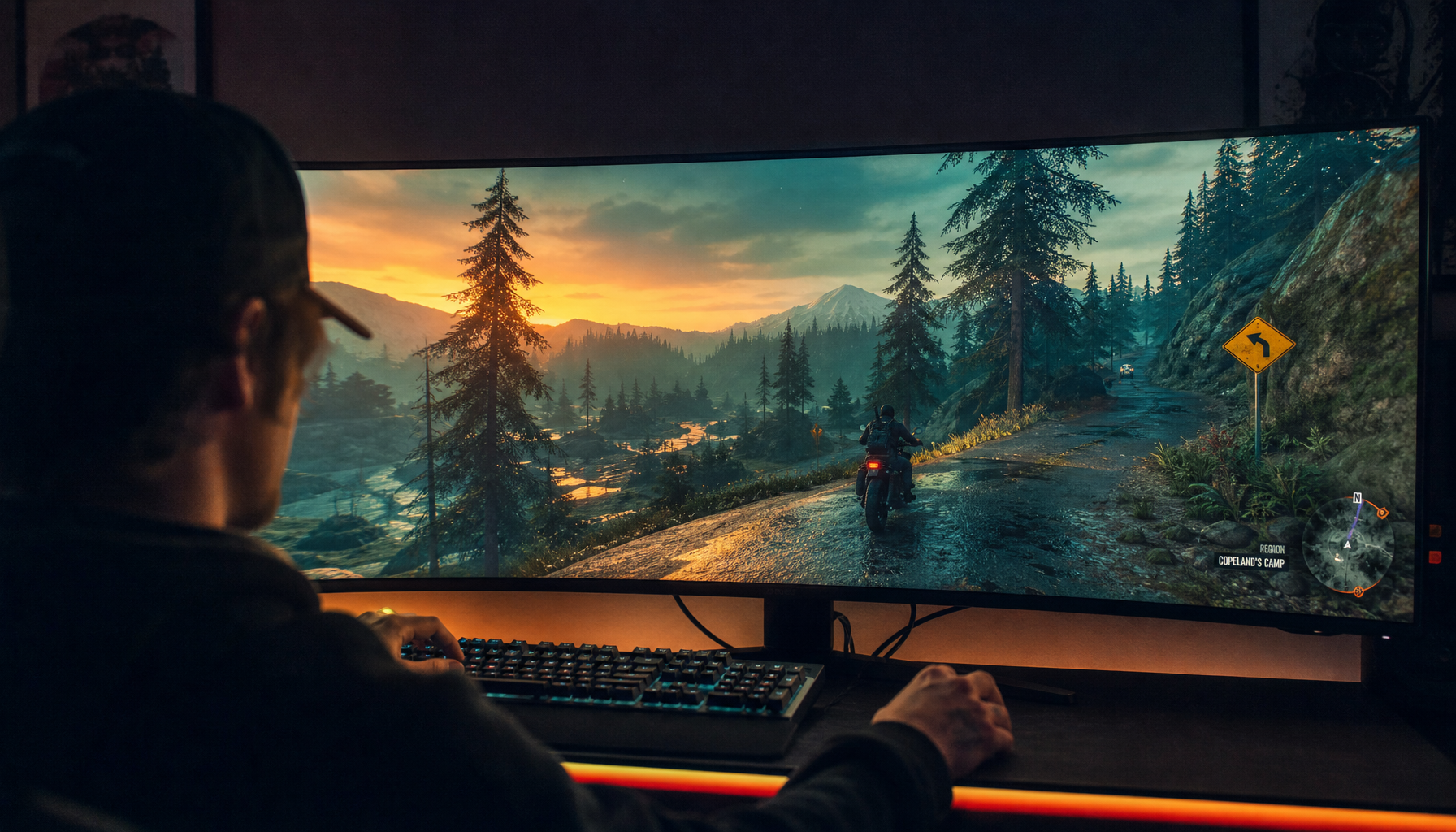
Monitor-side AI upscaling and GPU-based upscaling do different jobs in different parts of the signal chain. For most PC gamers, the GPU has more useful image data and more control, while the monitor has broader compatibility but less awareness of the game itself.
If you have ever dropped a game below native 4K on a fast gaming monitor and wondered why it looks different depending on one setting in the GPU driver and another in the monitor OSD, that confusion is normal. A practical test case from a 4K monitor running a GPU at 3200x1800 shows that the scaling choice can affect frame rate, responsiveness, and whether the monitor even accepts the signal. The goal here is to make those tradeoffs clear so you can choose the right path for gaming monitors, ultrawide displays, and portable screens.

Where Each Type of Upscaling Happens
GPU upscaling works before the signal reaches the monitor
A GPU scaling path happens on the graphics card before the final image is sent to the display. In practice, that means the GPU renders the game, applies the resize step, and outputs a finished frame to the monitor at the target timing. For PC gaming, this matters because the graphics card has direct access to the rendered frame and can make scaling decisions before video transmission.
That placement is the biggest difference between monitor AI processing and GPU-based upscaling. A monitor only sees the incoming video signal. It does not know the game engine, render resolution history, or frame-generation context behind that signal. A GPU does. For display buyers, that is why GPU-led methods usually fit better with high-refresh gaming monitors where sharpness, motion handling, and control over render resolution matter more than broad compatibility alone.

Monitor-side AI upscaling works after the monitor receives the signal
A TV AI upscaling example shows what display-side processing looks like: the display receives a lower-resolution signal such as 1440p and then upscales it internally to its 4K panel. Premium displays may market this with branded processors and AI language, but the core idea is the same for monitors with strong image processing: the panel electronics are enhancing an already-delivered signal.
For monitor shoppers, that means built-in processing can help with consoles, media boxes, laptops, or portable devices that cannot run advanced GPU features. The tradeoff is that the monitor is making a best-effort guess from the final signal it receives. That is useful for flexibility, but it is usually less game-aware than letting the GPU handle the upscale upstream.
Image Quality Is Not the Same Thing as Compatibility
GPU-based upscaling is usually the better choice when the content supports it
A discussion comparing GPU scaling and display scaling found that GPU scaling could look very good, even when the user still noticed small latency differences. That lines up with what many PC gamers see on modern gaming monitors: when the graphics card handles the resize, the image often looks more deliberate and less like a generic panel stretch, especially when you care about HUD sharpness, thin lines, and fine texture detail.
This is the practical buying point for 1440p and 4K high-refresh displays. If you are pairing a gaming monitor with a capable GPU, GPU-based upscaling usually gives you the better toolset for balancing image quality against performance. It is also easier to tune because you can combine render resolution, sharpening, and aspect-ratio behavior from the PC side instead of hoping the monitor’s internal scaler matches your preference.
Monitor-side upscaling wins on breadth, not usually on precision
A display scaling path can still be the right choice when the monitor must accept and process a wide range of signals. That is relevant for portable monitors, mixed-use office displays, and buyers who switch between a desktop PC, a handheld gaming device, and a console. In those setups, panel-side scaling is often the only universal option.

The limitation is precision. A monitor is scaling whatever arrives, whether that is a game, desktop text, streaming video, or a stretched custom resolution. That broad compatibility is valuable, but it also means the result is less tailored. If your priority is the cleanest gaming presentation on a premium ultrawide or 240 Hz monitor, broad support is not the same as best image reconstruction.
Latency Matters More on High-Refresh Monitors
Monitor processing can add delay before the frame appears
A scaling comparison on a 4K monitor notes that display-side scaling can add delay before frames are shown, which users may perceive as input lag. On a 60 Hz office panel, that may be acceptable. On a 144 Hz, 165 Hz, or 240 Hz gaming monitor, it matters much more because the whole point of the display is fast response to mouse movement and rapid scene changes.
That is why monitor buyers should treat AI processing claims carefully. A display processor may improve a lower-resolution signal, but every extra processing step competes with the low-latency promise that defines good gaming monitors. If you mainly play esports titles, the safer assumption is that less monitor-side processing is usually better.
GPU scaling can also have a cost, but the bottleneck is different
A forum test of GPU scaling versus display scaling reported that GPU scaling had small but noticeable input lag, while display scaling felt faster in that specific setup. That is a useful reminder that no scaling path is free. The GPU still spends time doing the resize, and when the card is already near full load, that extra work can affect performance or feel.
The decision point is simple: if your GPU has headroom, GPU-side scaling is often the better fit for competitive play because it avoids additional monitor processing and gives you more predictable control. If the GPU is already the hard limit, or if the display’s scaler is especially fast, monitor scaling can still be worth testing. The right answer depends on where the bottleneck lives in your setup, not on marketing language alone.
Resolution Flexibility, Aspect Ratio, and Real-World Setup Issues
Exact pixel mapping still matters on gaming and ultrawide monitors
A 1:1 scaling discussion found the cleanest result came from matching monitor OSD 1:1 with a GPU control panel No Scaling, which is effectively a pixel-for-pixel presentation. That is especially relevant for ultrawide monitors and specialty resolutions, where a poor scaling choice can blur the image or slightly distort the aspect ratio.
For buyers, this is the overlooked part of the decision. Not every lower-resolution mode should be upscaled to fill the whole screen. Sometimes the sharpest result is to avoid scaling entirely and preserve exact pixels. On a 27-inch 4K 160Hz display such as a 27” 4K 160Hz/1ms HDR400 gaming monitor, the difference between GPU scaling, monitor-side processing, and true 1:1 mapping is often easier to notice because fine detail and UI edges are packed into a relatively dense screen.

Some monitors simply handle odd resolutions better than others
A real-world custom-resolution case using 3200x1800 on a 4K monitor highlights another buyer issue: some monitors may not accept every resolution because of internal limits. That matters if you like custom timings, uncommon aspect ratios, or portable monitors that are often less flexible than full desktop gaming displays.
This is where monitor quality shows up in everyday ownership, not just spec sheets. A display with a better scaler and broader timing support is easier to live with across a desktop PC, laptop dock, and handheld gaming source. A cheaper panel may still look fine at native resolution but become frustrating when you start experimenting with lower render targets or nonstandard inputs.
Which Approach Fits Your Monitor Type?
Use case |
Better default choice |
Why it usually wins |
Main risk |
4K gaming monitor with a strong GPU |
GPU-based upscaling |
Better game-aware control and sharper results |
Can cost performance if the GPU is already maxed out |
GPU scaling or no scaling |
Keeps monitor processing minimal |
Needs testing if GPU load is already high |
|
Ultrawide gaming monitor |
GPU scaling plus aspect-ratio control |
Better handling of non-native game resolutions |
Poor setup can stretch or soften the image |
Monitor-side scaling |
Works across many input sources |
Image quality is less content-specific |
|
Monitor-side scaling by necessity |
Simple compatibility with laptops and handhelds |
Internal scaler quality varies widely |
|
Retro or fixed-resolution content |
1:1 or no scaling |
Preserves exact pixels |
Smaller displayed image |
A monitor-versus-GPU scaling tradeoff is easiest to understand when you match it to the display category you are buying. A fast 27-inch 1440p gaming monitor and a slim portable monitor may both advertise scaling support, but they are solving different problems. One is trying to preserve speed and clarity during play. The other is trying to stay compatible with as many devices as possible.
A high-refresh display example from premium panels also shows why buyers should separate panel specs from processing claims. A display can support 144 Hz, VRR, or adaptive sync and still not be the best place to do the upscale for PC gaming. Refresh rate tells you how often the panel can update. It does not prove that the panel’s internal upscaling is the smartest or lowest-latency option.
FAQ
Q: Does AI upscaling built into a monitor improve games the same way GPU upscaling does?
A: No. Monitor-side processing happens after the video signal reaches the display, so it works from a finished image. GPU upscaling happens earlier in the chain and usually has more useful rendering context, which is why it is generally the better fit for PC gaming.
Q: Which is better for a high-refresh-rate gaming monitor?
A: In most cases, GPU-based upscaling or no scaling is the safer default because it avoids extra monitor processing. If your GPU is already fully loaded, though, testing display scaling can still make sense because the performance and feel can vary by monitor and game.
Q: When should I rely on monitor scaling instead of GPU scaling?
A: Use monitor scaling when you need broad compatibility across consoles, laptops, handhelds, or portable monitors, or when the display handles a specific input mode better than the GPU path. It is also useful when you are not using a supported GPU-side feature and just need the screen to accept and resize the signal cleanly.
Final Takeaway
A side-by-side scaling decision comes down to your display type and your bottleneck. For a desktop gaming monitor, especially a high-refresh or ultrawide model, GPU-based upscaling is usually the better default because it is more game-aware and easier to tune for image quality. For portable monitors and mixed-device setups, monitor-side scaling is more universal but less specialized.
If you are buying a monitor, do not treat “AI upscaling” as an automatic upgrade. Check whether your real priority is lower latency, cleaner non-native gaming, better aspect-ratio control, or easier compatibility with multiple devices. Those answers will tell you whether the smarter place to scale is the GPU or the display.