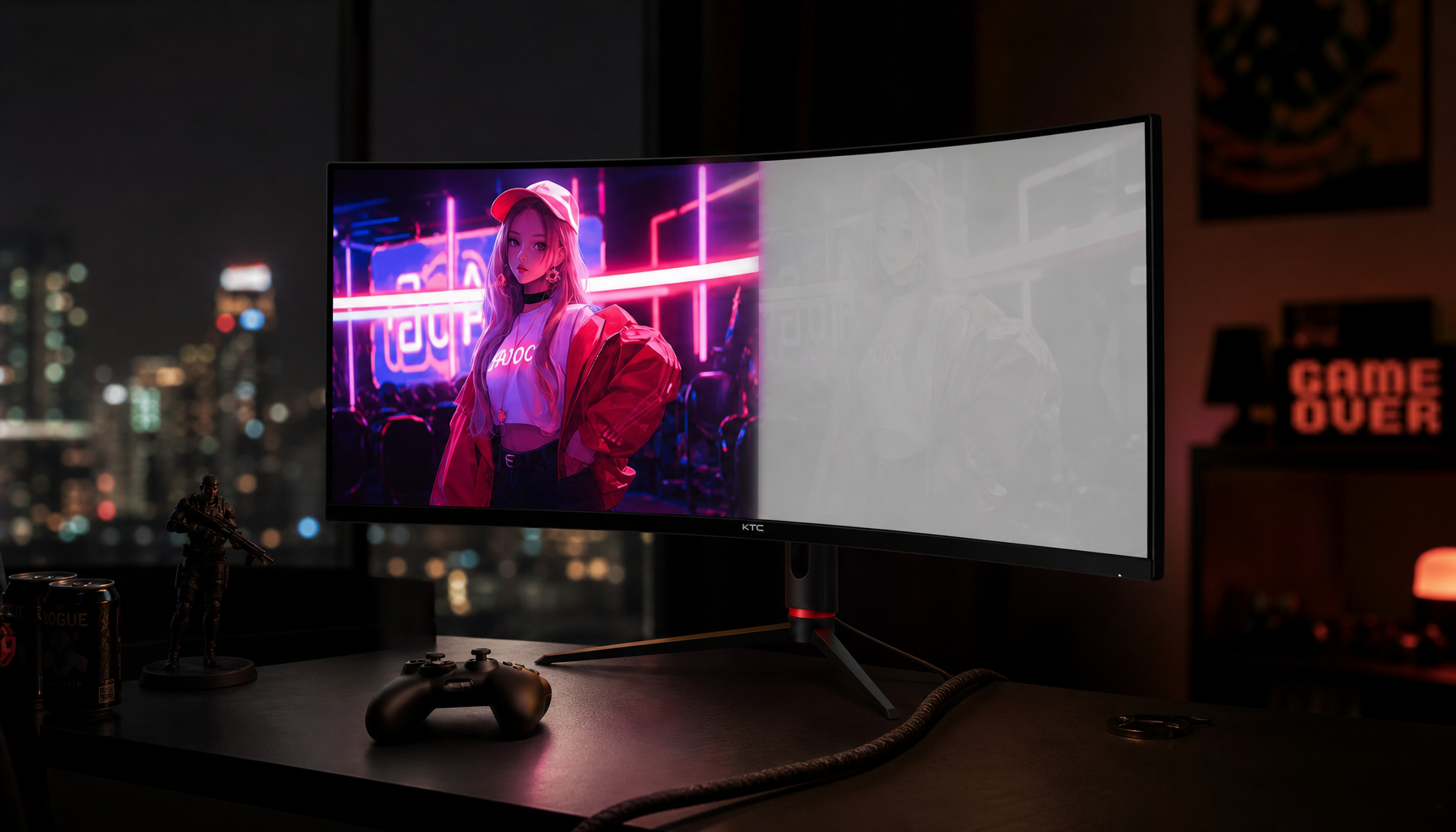
AI image processing can make games look smoother, sharper, or brighter, but it often adds processing time between your input and the image you see. For competitive gaming, low-lag modes and minimal processing usually matter more than AI-enhanced picture features.
Ever flick a mouse in a shooter and feel like the screen is just a fraction behind your hand? On a 240 Hz monitor, each refresh takes about 4.17 ms, but one extra buffered frame or heavy processing step can still be enough to change how aiming feels. This guide explains when AI image processing is worth using, when to disable it, and how to set up a gaming display without sacrificing the responsiveness you bought it for.
Why AI Image Processing Can Add Latency
AI image processing on gaming displays usually means the monitor is doing more than simply accepting a frame and lighting pixels. Features such as motion smoothing, frame interpolation, super-resolution, automated detail enhancement, dynamic contrast, HDR tone mapping, and scene-aware brightness control may require the display to analyze, alter, buffer, scale, or remap each frame before showing it, and that added work can increase input lag.
That does not mean every picture setting is dangerous. Basic brightness and simple contrast adjustments are usually low-risk because they often behave like direct output changes. The latency concern grows when the monitor needs to compare frames, create new frames, detect scene content, upscale the image, change brightness zones dynamically, or route the signal through a more complex scaler path.
Input Lag Is Not Pixel Response Time

A “1 ms” gaming monitor claim usually refers to pixel transition behavior, not the whole delay from a mouse click to the visible result. Full click-to-screen latency includes the mouse, USB path, operating system, game engine, CPU, GPU queue, sync mode, display processing, refresh timing, and pixel behavior, so response time and input lag should be treated as different specs.
For monitor buyers, this distinction matters because AI image features usually sit in the display-processing part of the chain. A panel can have fast pixel transitions and still feel delayed if motion interpolation, non-native scaling, dynamic contrast, or other processing-heavy features are active.
The Frame Timing Math Behind the Trade-Off

High refresh rate helps, but it does not erase added processing delay. A 60 Hz display refreshes about every 16.67 ms, 144 Hz about every 6.94 ms, 240 Hz about every 4.17 ms, and 360 Hz about every 2.78 ms, so faster monitors reduce display wait time but do not remove total input lag.
The same logic applies to frame rate. If a game renders at 60 FPS, a new frame arrives about every 16.6 ms even if the monitor can refresh at 240 Hz. AI motion smoothing may make that 60 FPS feed appear closer to 120 FPS, but it does not make the original game simulation, input sampling, or GPU render cadence twice as responsive.
One Buffered Frame Can Be Noticeable
At 60 Hz, one extra buffered frame is roughly 16.7 ms. At 144 Hz, it is roughly 6.9 ms. At 240 Hz, it is roughly 4.2 ms. Those numbers sound small, but they stack with existing game, GPU, sync, and display latency.
That is why competitive players often notice image-processing delay before casual players do. In one cited FPS aiming test, an 8 ms latency reduction improved median aiming completion time from 1.530 seconds to 1.348 seconds, which shows how small latency changes can affect fast correction-based play where every adjustment depends on immediate visual feedback.
Which AI Features Are Worth the Latency?

Not all AI or automated image features create the same trade-off. The key question is whether the feature changes the current frame directly, analyzes multiple frames, or generates new frames. The more the display has to predict, buffer, or synthesize, the higher the latency and artifact risk.
Motion smoothing is the clearest example. AI motion smoothing can make a low-FPS game look more fluid by generating intermediate frames, but the monitor must buffer and analyze frames before display; in a 240 Hz example, a motion-smoothing mode made a 60 FPS game present like 120 FPS, while adding lag and showing more artifacts when base FPS dropped below roughly 40 to 60 FPS due to synthetic frames.
Feature or Setting |
Latency Risk |
Visual Benefit |
Best Use |
Competitive Recommendation |
Basic brightness |
Low |
Makes the image easier to see |
Any game, any refresh rate |
Safe to adjust |
Basic contrast |
Low |
Improves light/dark balance |
General gaming |
Safe if it is not dynamic contrast |
Sharpness |
Low to medium |
Adds edge definition |
Soft-looking games or console input |
Use lightly; avoid detail boost modes |
Super-resolution/detail boost |
Medium to high |
Makes lower-resolution content appear sharper |
Single-player games, older titles, portable monitor use |
Usually disable |
Dynamic contrast/black equalizer |
Medium |
Improves visibility in dark scenes |
Casual play or games with poor shadow detail |
Test carefully; avoid aggressive modes |
HDR tone mapping/local dimming |
Medium |
Improves highlight and shadow range |
HDR single-player games and media |
Avoid if it adds delay or locks low-lag settings |
AI motion smoothing/frame interpolation |
High |
Makes low-FPS motion look smoother |
Slow-paced games, controller play, video |
Disable for competitive play |
Monitor scaling |
Medium |
Fits non-native resolutions |
Consoles or legacy sources |
Prefer native resolution when possible |
Backlight strobing |
Low to medium |
Reduces perceived motion blur |
High-FPS play with stable frame rate |
Useful, but test brightness and comfort |
Motion Clarity Is Not Always Low Latency
Backlight strobing is often confused with motion smoothing, but it works differently. Instead of generating frames, it flashes the backlight to reduce perceived blur; the trade-off is that it can reduce brightness by about 30% to 50%, may cause flicker discomfort, and is often incompatible with Adaptive Sync.
For a fast shooter on a high-refresh-rate display, strobing can be useful if your frame rate is stable and you are comfortable with the brightness drop. For open-world games with variable frame rates, VRR usually feels better because it reduces tearing and pacing issues without creating synthetic frames.
Competitive Gaming: When to Disable AI Processing
For competitive shooters, fighting games, racing sims, and rhythm games, the safest setup is simple: native resolution, highest stable refresh rate, low-lag or Instant mode, and minimal post-processing. Heavy display processing such as motion enhancement, smoothing, super-resolution, dynamic contrast, and monitor-side scaling can add delay, while Game Mode or low-lag mode usually reduces latency by bypassing extra image work.
The practical target is not just a prettier picture. It is a shorter control loop: move, see, correct, repeat. If your monitor is adding processing delay, your aim adjustment, counter-steer, parry timing, or crosshair tracking can feel slightly disconnected even when the image looks smooth.
The Best Low-Lag Baseline
Start with the monitor’s Game, FPS, Instant, or Low Input Lag mode. Set the display to its native resolution, use the highest refresh rate that remains stable, turn off AI motion smoothing, disable dynamic contrast, and avoid monitor-side super-resolution unless the image is unusably soft.
For PC gaming, an FPS cap slightly below the monitor’s maximum refresh can help when using VRR; for example, 237 FPS on a 240 Hz display is a common style of cap. Traditional V-Sync can add significant latency in some setups, with cited testing showing V-Sync-off latency around 59 to 61 ms versus in-game V-Sync around 102 to 103 ms, so competitive players should test sync behavior rather than assuming refresh rate alone solves the problem.
When AI Image Processing Makes Sense
AI image processing is not useless. It can be worthwhile when visual comfort, smoothness, or perceived detail matters more than the fastest possible input response. Slow-paced RPGs, cinematic adventure games, strategy games, cloud gaming, console titles locked to 30 or 60 FPS, and couch-style controller play are better candidates than mouse-driven esports.
A portable monitor used with a handheld gaming PC is a good example. If the game is running at 45 to 60 FPS and you are playing a single-player RPG, a mild sharpening or smoothing feature may make the experience feel cleaner. On the same portable monitor, that setting would be a poor fit for a twitch shooter where every frame of delay affects correction timing.
HDR and Local Dimming Need Separate Testing
HDR can complicate the decision because it often locks brightness, contrast, saturation, color temperature, and picture presets to maintain a fixed tone-mapping path. Modern gaming monitors may also gray out settings when HDR, Adaptive Sync, factory presets, or low-latency modes force a specific display pipeline.
For HDR single-player games, the extra processing may be acceptable if highlights look better and controls still feel direct. For competitive HDR gaming, compare HDR on versus off in the same match or training range, because tone mapping and local dimming behavior can vary widely by monitor. On a Mini LED HDR display such as a Mini LED 27” 4K 160Hz HDR1400 gaming monitor, compare SDR low-lag mode against HDR and local-dimming modes before deciding which settings to keep.

How to Test a Gaming Monitor Without Lab Gear
You do not need a professional test bench to make better settings decisions. The goal is to isolate one feature at a time and judge both visual benefit and control feel. Use a familiar game scene where you can repeat the same movement: a training range, time trial, rhythm chart, aim trainer, or a camera pan across high-contrast objects.
Keep a simple baseline: native resolution, highest stable refresh rate, low-lag mode enabled, VRR configured if you normally use it, and all extra image processing off. Then enable one feature, play for five to ten minutes, and look for three things: delayed aim correction, artifacting around moving objects, and whether the visual gain is large enough to justify the feel.
Action Checklist

- Set the monitor to native resolution and the highest stable refresh rate.
- Enable Game, FPS, Instant, or Low Input Lag mode.
- Turn off AI motion smoothing, frame interpolation, super-resolution, noise reduction, and dynamic contrast for competitive games.
- Use VRR or Adaptive Sync when it improves frame pacing, but check whether it disables picture controls.
- Test HDR separately from SDR because HDR may lock the monitor into a fixed processing path.
- Change one setting at a time and test it in the same game scene.
- Save separate monitor presets for competitive play, cinematic games, and console or handheld use.
FAQ
Q: Do AI image processing features always increase input lag?
A: No. Simple settings such as brightness or basic contrast are usually low-risk, while features that analyze frames, scale the image, adjust scenes dynamically, or generate synthetic frames are more likely to add delay. The safest approach is to treat AI motion smoothing, super-resolution, dynamic contrast, and monitor-side scaling as features that need testing before use.
Q: Should I disable AI image enhancement on a 240 Hz or 360 Hz gaming monitor?
A: For competitive gaming, yes in most cases. A high-refresh-rate monitor reduces refresh interval, but it cannot cancel out processing delay added before the image reaches the panel. At 240 Hz, each refresh is about 4.17 ms, so even a small extra buffer can erase part of the benefit you paid for.
Q: Is VRR better than AI motion smoothing?
A: For gaming responsiveness, VRR is usually the better first choice because it improves frame pacing without creating synthetic frames. AI motion smoothing can make low-FPS content look smoother, but it does not improve the original game loop and can add input lag or visible artifacts.
Practical Next Steps
If you play competitive games, build your monitor setup around latency first: native resolution, highest stable refresh rate, low-lag mode, minimal processing, and carefully tested sync settings. Save AI motion smoothing, super-resolution, dynamic contrast, and heavier HDR processing for games where visual presentation matters more than immediate input feedback.
For display buyers, the best question is not “Does this gaming monitor have AI features?” but “Can I control them separately from low-lag mode, HDR, VRR, and high-refresh operation?” A monitor that lets you save separate presets for esports, HDR single-player games, console play, and everyday use will be more practical than one that forces every feature into the same fixed picture mode.
References
- Why Monitor Settings Are Grayed Out & How to Fix It
- AI Motion Smoothing & Monitor Latency: The Tradeoff
- Zone Control Latency: Your Guide to a Competitive Edge
- Why Monitor Picture Settings Increase Input Lag
- High Refresh Rate & Low Latency: A Gaming Settings Guide
- Input Lag vs. Refresh Rate: What Matters for Gaming