Adaptive Sync flicker is usually more visible in dark scenes because small brightness or gamma shifts stand out more against near-black content, especially on OLED and VA panels. The trigger is often unstable frame pacing, rapid refresh-rate changes, or Low Framerate Compensation near the bottom of the monitor’s VRR range.
Does your game look smooth in daylight scenes, then suddenly pulse in caves, loading screens, menus, or night missions? A practical test can separate VRR behavior from a failing monitor in about 10 minutes: turn Adaptive Sync off, replay the same dark scene, and watch whether the brightness pulsing stops. That result helps you decide when to tolerate the issue and how to reduce it without giving up the performance you paid for.
What Adaptive Sync Is Actually Doing
Adaptive Sync is the broad display behavior behind common variable-refresh technologies. Instead of forcing the monitor to refresh at a fixed 60 Hz, 144 Hz, 240 Hz, or 360 Hz, VRR lets the display adjust its refresh timing to match the GPU’s frame output. That is why variable refresh rate can reduce tearing, judder, and stutter when your frame rate moves around during gameplay.
The benefit is real. A 165 Hz monitor running a game between 92 FPS and 141 FPS can feel far cleaner with Adaptive Sync than with V-Sync off, because the monitor is no longer drawing a new scan at the wrong moment. The tradeoff is that many panels do not maintain perfectly identical brightness, gamma, or pixel behavior at every refresh interval.
That tradeoff becomes visible as VRR flicker. It usually looks like a subtle brightness pulse, gray-level shimmer, or background flashing rather than a full power blink. It often appears in game menus, loading screens, dark rooms, inventory screens, cutscenes, or poorly optimized areas where the frame rate jumps around.
Why Dark Scenes Reveal Flicker First
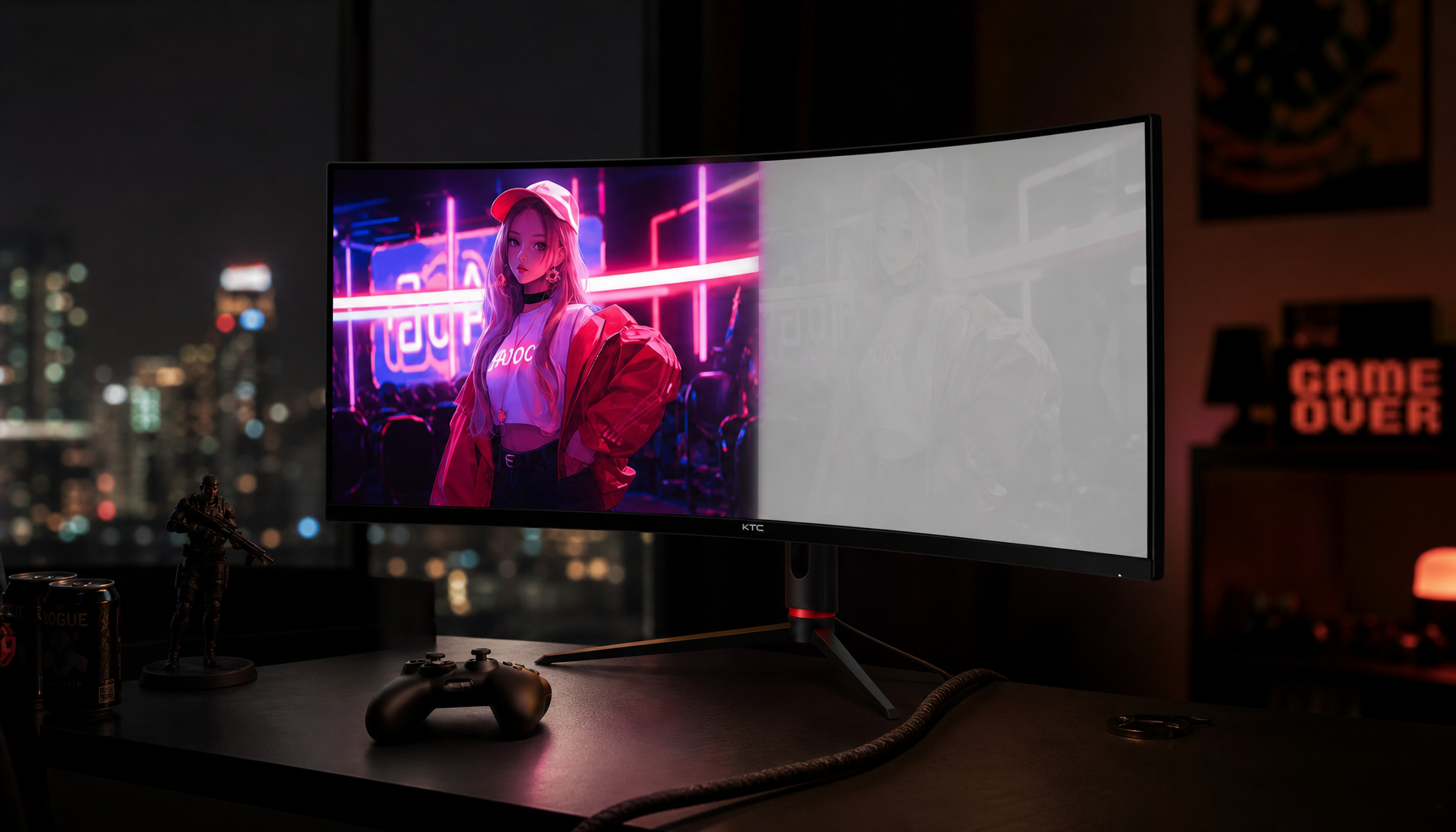
Dark scenes are unforgiving because the eye notices small changes in black level and shadow gamma more easily when most of the screen is already dim. A tiny lift from near-black to dark gray may be invisible in a bright skybox, but obvious in a horror-game corridor. Hands-on testing has found that VRR flicker is especially noticeable in darker scenes, menus, and moments with inconsistent frame pacing.

Panel type matters. OLED pixels emit their own light, so near-black transitions can expose small luminance changes. VA panels typically have high native contrast, which makes shadow instability easier to see. IPS and TN panels can still flicker, but lower contrast often masks the same shift. That does not make OLED or VA panels bad; it means their strengths can also make VRR brightness shifts more visible.
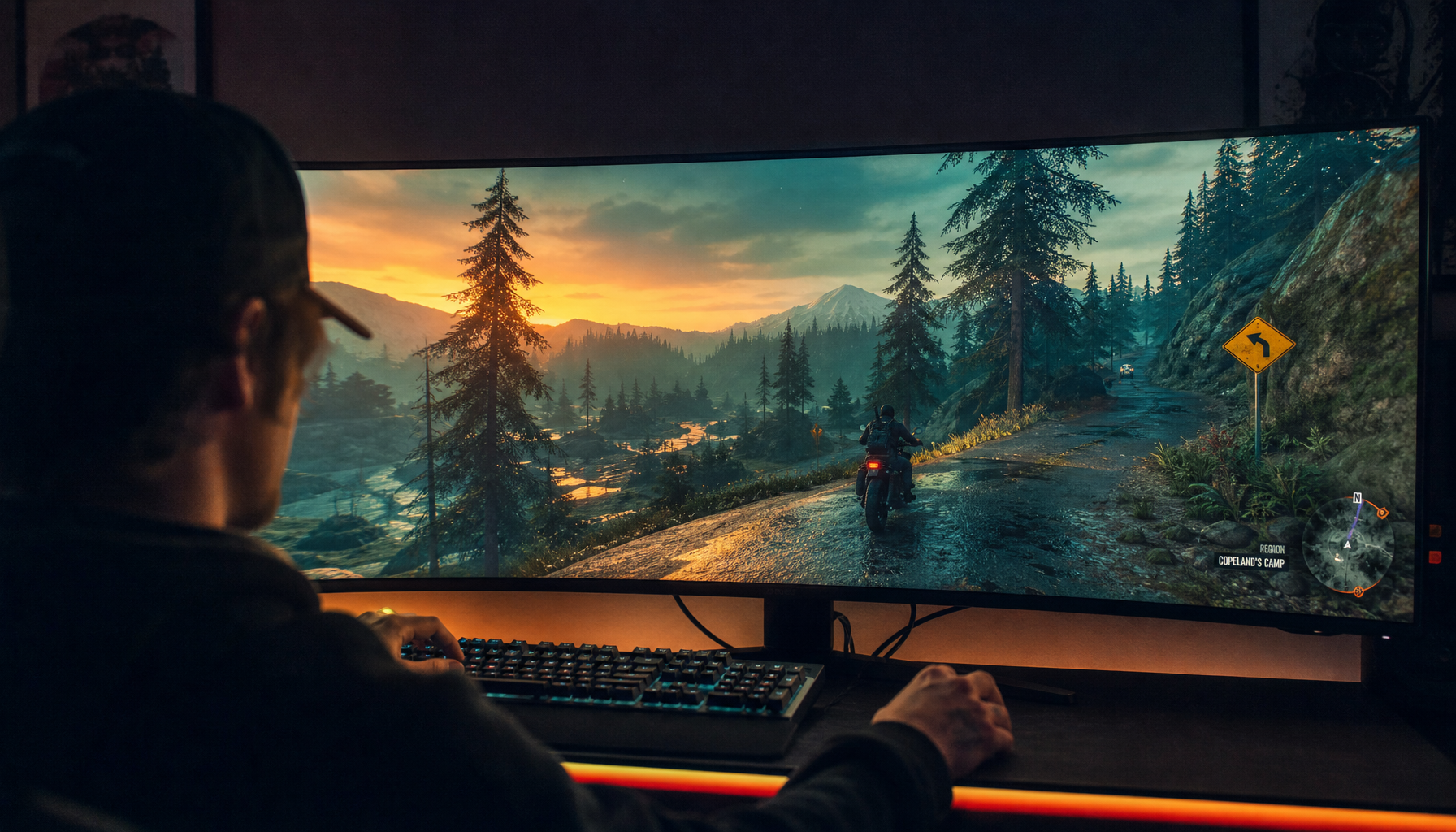
Here is the practical viewing example: if a game alternates between 55 FPS and 85 FPS during a dark pause menu, the monitor may keep changing refresh timing while most pixels sit near black. Your eyes are not distracted by bright motion, so the brightness fluctuation becomes the main thing you see. In a bright outdoor firefight, the same refresh variation may still be present, but motion, color, and highlights hide it.
The Low-Framerate Compensation Problem
Low Framerate Compensation, or LFC, is designed to keep VRR active when FPS drops below the monitor’s supported VRR floor. On many 144 Hz VRR displays, a common range is 48–144 Hz. When FPS falls below that floor, the system may multiply frames to stay inside the supported refresh range.
That sounds clean, but the transition can be visually harsh. One 48–144 Hz monitor example shows how a frame-rate drop near the bottom of the range can cause a large refresh-rate jump, and VRR monitors often depend on range behavior, LFC support, and GPU compatibility to deliver the best result.
Situation |
What the Monitor May Do |
Why Flicker Gets Worse |
Game holds 90–120 FPS |
Refresh varies inside the VRR range |
Usually smooth with little brightness shift |
Game bounces around 48 FPS |
VRR may cross the lower limit repeatedly |
LFC can create larger refresh jumps |
Loading screen runs uncapped |
FPS and GPU load may swing sharply |
Brightness pulses can appear on static backgrounds |
Dark menu at unstable FPS |
Frame pacing changes while shadows dominate |
Gamma shifts become easy to see |
A simple calculation shows why this matters. If your monitor’s VRR floor is 48 Hz and your game keeps hovering between 47 FPS and 51 FPS, the display may repeatedly switch between normal VRR operation and compensated behavior. That repeated transition is exactly the kind of instability that turns a small panel characteristic into visible flicker.
It Is Not Always a Defective Monitor
A defective panel can flicker, but Adaptive Sync flicker has a pattern. It appears with VRR enabled, changes by game or scene, often gets worse in dark content, and may disappear at a fixed refresh rate. KTC’s troubleshooting guidance treats high-refresh flicker as a mix of VRR behavior, signal-path limits, and timing sensitivity, and recommends disabling Adaptive Sync briefly because monitor flickering at high refresh rate that stops during that test points toward a VRR interaction.
Driver behavior can also matter. In a developer-forum report, a user described light flickering after moving beyond a known driver version, with the issue appearing when applications activated VRR and during loading screens; the reported light flickering looked like backlight flicker on solid-color backgrounds. That does not prove every driver update is risky, but it does show why rollback testing is reasonable after a sudden change.
Apps can contribute too. One community case found that an Adaptive Sync-related blackout or flicker symptom appeared to improve when launching the app with a -nodeepcolor flag, which suggests display flickering can sometimes involve color-depth handling rather than the panel alone.
Practical Fixes That Preserve Smoothness
Start by reproducing the problem in one controlled scene. Pick a dark game area, menu, or loading screen where flicker is obvious. Turn Adaptive Sync off in the monitor OSD or GPU control panel, then run the same scene for 5 to 10 minutes. If the flicker disappears, your monitor is probably reacting to VRR behavior rather than failing outright.

Next, cap the game’s FPS to a number it can hold consistently. If your game swings between 80 FPS and 135 FPS, try a cap around 90 or 100 FPS instead of chasing the maximum refresh rate. The goal is not to make the monitor slower; it is to reduce refresh-rate volatility. For competitive play, a stable 141 FPS cap on a 144 Hz display or a stable 237 FPS cap on a 240 Hz display can also keep VRR away from the ceiling while preserving low latency.
If the flicker happens near the lower VRR range, reduce graphics settings enough to stay above the floor. On a 48–144 Hz display, keeping the game above 55 FPS is often more stable than letting it wander through the high 40s. If the game is mostly a 60 FPS title, testing a fixed 60 Hz, 90 Hz, or 120 Hz mode may look calmer than forcing a high-refresh VRR mode that the content cannot feed consistently.
Cable and port quality still matter. Monitor troubleshooting resources note that flicker can come from loose cables, refresh-rate mismatches, outdated drivers, unstable power, or Adaptive Sync conflicts, while high refresh rates require compatible HDMI or DisplayPort bandwidth; a disciplined one variable at a time process isolates the cause. For a 1440p high-refresh display, test a certified DisplayPort cable, avoid adapters, try another GPU output, and verify that HDR or 10-bit color is not pushing the link into a marginal mode.
Driver rollback is worth testing when flicker starts after an update. Operating-system guidance treats screen flickering as commonly tied to display driver issues after updates, and external-display troubleshooting emphasizes checking adapter limits and connection paths when external monitor connections behave unpredictably. For laptops with hybrid graphics, use the laptop maker’s validated display driver first, then test the latest GPU vendor driver if needed.
Pros and Cons of Leaving Adaptive Sync On
Choice |
Upside |
Downside |
Adaptive Sync on |
Smoother motion, less tearing, better feel when FPS varies |
Possible flicker in dark scenes, menus, or unstable games |
Adaptive Sync off |
Flicker often disappears immediately |
Tearing or stutter may return |
V-Sync on instead |
Can reduce tearing at fixed refresh |
May add input lag and can feel less responsive |
Often the best balance of smoothness and stability |
Requires per-game tuning |
For most gaming monitors, Adaptive Sync is still worth using. The value proposition is strongest when your frame rate stays inside a stable VRR range and your panel handles refresh changes cleanly. The case for turning it off gets stronger if you play dark, cinematic games, are sensitive to luminance shifts, or own an OLED or VA monitor where the flicker breaks immersion.
When to Return, Replace, or Stop Troubleshooting
If flicker remains severe after testing VRR off, lowering refresh rate, swapping cable and port, updating or rolling back drivers, testing another PC, and resetting the monitor OSD, the monitor may have a timing, firmware, power, or panel issue. OLED troubleshooting literature also points to power stability, driver circuits, firmware, and electromagnetic interference as possible causes of OLED display flickering, so persistent flicker outside VRR deserves broader diagnosis.
During a return window, test the display as you will actually use it. Run 60 Hz, 120 Hz, and maximum refresh. Test VRR on and off. Try the darkest game you play, a static menu, a browser video, HDR if you use it, and every input you plan to rely on. A premium monitor should not require excessive workarounds for your main workflow.
Adaptive Sync flicker in dark scenes is usually the visible cost of dynamic refresh behavior meeting high-contrast panel physics. Keep VRR when it improves control and immersion, tame it with stable frame caps and clean signal paths, and return a display that cannot stay composed in the games and work modes you bought it for.