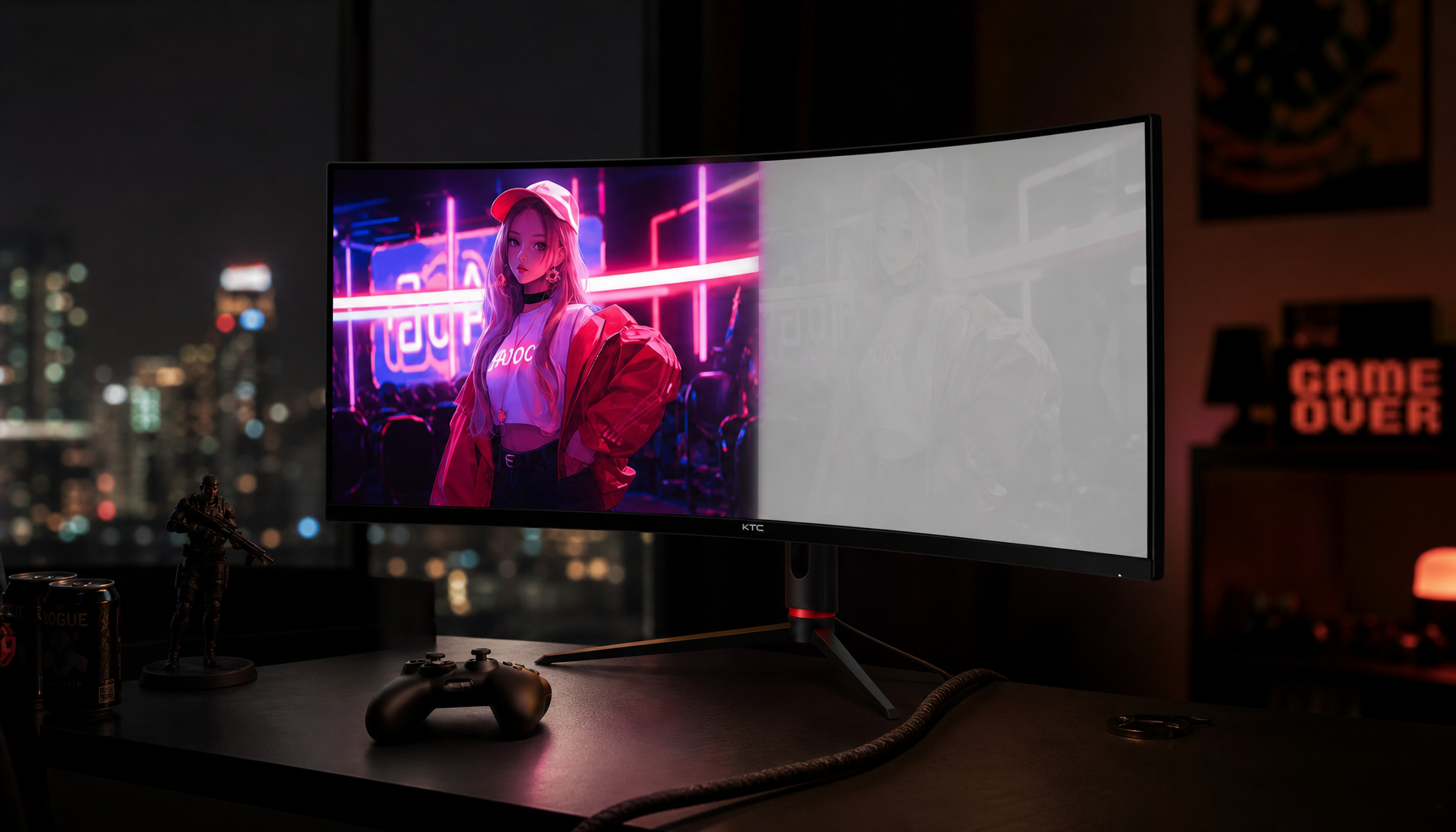
6500K usually looks cooler and slightly bluer, while 5000K looks warmer and more yellow. For most gaming monitors and everyday displays, 6500K is the safer default because it lines up better with common screen standards.
If your new gaming monitor makes white menus look icy while your older ultrawide looks creamy, the mismatch is usually the white point, not a bad panel. Side-by-side calibration comparisons have shown that moving a display from 6500K to 5000K can make cool colors look flatter and skin tones more yellow on screen. You will leave with a practical way to pick the right setting for gaming, productivity, and color-sensitive monitor use.

What Color Temperature Means on a Monitor
White point is the target hue your monitor uses for “white,” and that single choice shifts the look of every gray, highlight, and skin tone on the panel. On a gaming monitor, portable monitor, or ultrawide, it affects whether menus, webpages, and bright scenes look neutral, warm, or slightly blue.
Color temperature is the shorthand used for that white point, expressed in kelvin. In display buying terms, it is not about how hot the panel gets; it is a reference to the color of light, with lower values looking warmer and higher values looking cooler on screen.
A display’s white point and brightness are separate controls, which is why two monitors can be equally bright but still look different. That is a common reason a high-refresh-rate gaming monitor can look “cleaner” or “bluer” than a creator display sitting right beside it.
Why 6500K Looks Cooler Than 5000K
5000K corresponds to a warmer white and 6500K to a cooler daylight-like white, so the difference is easy to spot on white browser tabs, gray UI panels, and snowy game scenes. On most monitors, 5000K adds a cream or yellow cast, while 6500K pushes white closer to neutral daylight.

Higher Kelvin settings look cooler on displays, even though the number is larger. That is why a monitor set to 6500K often looks bluer than the same screen at 5000K, and why “Cool” presets on gaming monitors can look punchy at first but less natural over time.
Kelvin alone does not fully describe white color, which matters when comparing monitor specs. Two screens can both claim a 6500K target yet still look different if their actual white point does not land in the same place, so the preset label is useful but not perfect.
Which White Point Makes Sense for Gaming Monitors and Everyday Displays
6500K is a common display target for accurate screen viewing, and it is the most practical default for gaming monitors, office displays, and most portable monitors. It aligns better with sRGB-style screen content, so games, video, and web graphics are less likely to look overly warm.
Many gamers start with D65, or roughly 6500K, because that is closer to how digital content is commonly viewed. User measurements in gaming setups also show that some uncalibrated displays land much cooler, around the low-to-mid 7000K range, which can make a new monitor look sharp at first but less neutral once you compare it against a properly set screen.
Setting |
How it looks on a monitor |
Best fit |
Common downside |
5000K |
Warm, creamy, slightly yellow |
Print-oriented viewing, soft-proofing |
Whites can look dull for games and web content |
6500K |
Neutral to slightly cool |
Gaming, general use, most digital media |
Can look a bit cool if you are used to warmer screens |
7500K and up |
Noticeably cool, blue-leaning |
Preference-driven use only |
Whites and grays can look harsh or artificial |
Native white |
Whatever the panel naturally produces |
Maximum contrast when calibration options are limited |
May not match other screens or standards |
Factory picture modes often exaggerate color and brightness, so “Vivid” or “Cool” is rarely the best choice when you are judging a monitor in a review or on your desk. For buying guidance, a strong starting point is User, Custom, or Normal, then adjust temperature before touching advanced color sliders.

When 5000K Is the Better Choice
5000K is commonly used for print-oriented viewing conditions, so it still has a real place if your monitor doubles as a proofing screen. If you are using a wide-gamut monitor to compare on-screen work against printed material under print-style viewing light, 5000K can be the better match.
A real-world LCD comparison between 6500K, 6000K, and 5000K found that 5000K made cool colors look less vibrant and skin tones look duller and more yellow. That is exactly why 5000K often feels wrong on a gaming monitor, even if it is technically useful for a print workflow.
Moving far away from a display’s native white can reduce contrast and available gray detail, especially if the panel has limited hardware controls and the correction is done in software. On a portable monitor or budget ultrawide, that tradeoff can matter more than it does on a higher-end panel with better RGB adjustment.
How to Adjust Color Temperature Without Making the Screen Worse
The safest first move is to change only color temperature or white balance and leave the rest alone until you see the result. On many gaming monitors, that means trying Normal, Warm, or User first instead of stacking changes to contrast, black equalizer, sharpness, and saturation all at once.

White-point changes can also affect luminance, so brightness often needs a second pass after you settle on 5000K or 6500K. That matches real desk use: a screen that looks neutral at 6500K may still feel too intense in a bright apartment office or too dim after shifting to a warmer target.
If your monitor cannot adjust hardware RGB channels, software correction may be the fallback, but native white usually preserves the most contrast. In practical buying terms, monitors with useful RGB controls are easier to tune well than models that only offer vague presets like Cool, Normal, and Warm.
A simple setup order
- Reset the monitor to User or Custom.
- Turn off extra processing such as Vivid, artificial sharpness, or image enhancement.
- Set color temperature to 6500K, D65, Normal, or the closest warm-neutral preset for general use.
- Match all screens in a multi-monitor setup to the same white point before adjusting brightness.
- Recheck brightness after the white point is set.
- Use RGB controls only if you know the screen still has a visible red, green, or blue cast.
FAQ
Q: Is 6500K always better for a gaming monitor?
A: Not always, but it is the best default for most gaming and everyday use because it matches common digital display standards more closely than 5000K.
Q: Why does my portable monitor look bluer than my desktop monitor even when both say 6500K?
A: The preset label is only a target. Real panel behavior, factory tuning, and limited hardware controls can make two “6500K” displays look different.
Q: Should I use 5000K at night to reduce eye strain?
A: A warmer screen may feel more comfortable to some people, but 5000K is mainly useful when you want a print-style white point. For most users, lowering brightness and avoiding overly cool presets is a more practical first fix.
Final Takeaway
For monitor buyers, the simplest rule is this: use 6500K for gaming, general productivity, ultrawide setups, and most digital content, then fine-tune brightness to your room. Use 5000K only when you have a specific reason, such as print matching or a workflow built around warmer viewing conditions.
If two displays on your desk do not match, fix white point before you blame panel quality. A well-set 6500K target usually delivers the most natural compromise between neutral whites, believable skin tones, and screen-to-screen consistency.
References
- White point - a platform
- 5 display calibration settings that will level up your game for free
- Measure and set the white point
- Why it’s not a good idea to calibrate a display to a 5000K color temperature
- White Point and Its Effect on Image Quality
- White point for video games
- White Point Settings
- Color temperature - a platform
- What is a display’s white point and why should you care about it?
- Huge difference in measured vs assumed white point