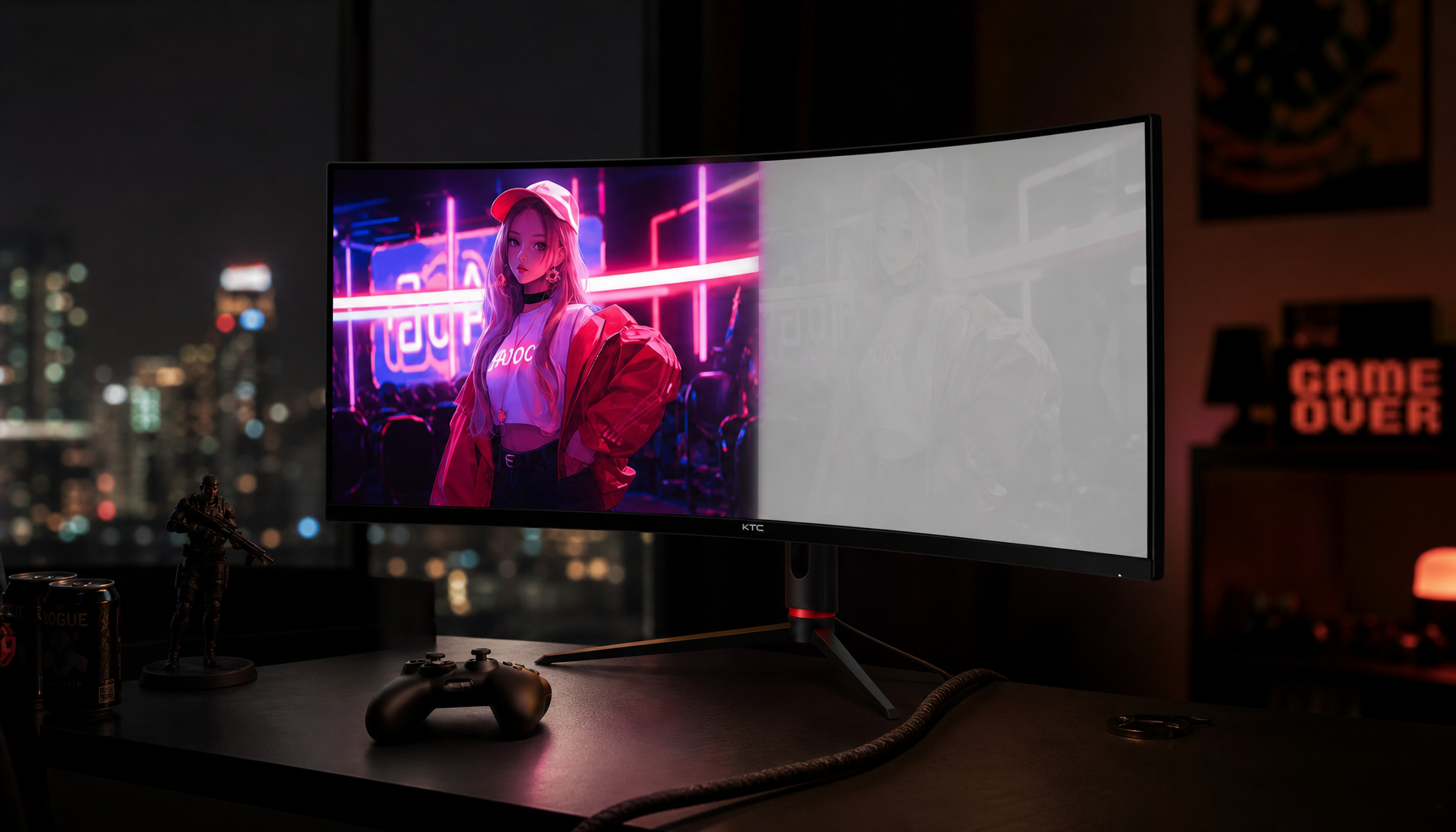
Choosing between a 1000R and 1500R curved monitor comes down to matching the curve's radius to your desk depth, screen size, and primary tasks. The tighter 1000R curve delivers stronger wrap-around immersion for gaming on large ultrawides when you sit close, while the gentler 1500R curve generally offers better straight-line accuracy and comfort for mixed productivity and gaming at typical desk distances.

What Does the 'R' in Curved Monitors Actually Mean?
The "R" stands for radius and is measured in millimeters. It tells you the radius of the imaginary circle that the screen's curve would form if completed into a full circle. A 1000R monitor therefore curves along a 1-meter (about 39-inch) radius, while a 1500R monitor follows a gentler 1.5-meter (about 59-inch) radius.
As explained in this curved vs flat monitor guide from RTINGS, a smaller R number creates a more aggressive curve. This directly affects how much the screen wraps around your field of view and how uniform the distance is from your eyes to every part of the display.
For most users, this is not just an aesthetic choice. The radius determines whether the edges of the screen stay comfortably in your peripheral vision without forcing your eyes or neck to compensate. Understanding this physics helps you avoid buying a curve that feels either too flat for your setup or uncomfortably tight.
1000R: The 'Aggressive' Curve for Maximum Immersion
1000R is widely considered the most immersive curvature because it closely aligns with the natural 1000 mm focal radius of the human field of view. This match lets the screen edges fall more naturally into your peripheral vision, creating a wrap-around effect that heightens presence in games.
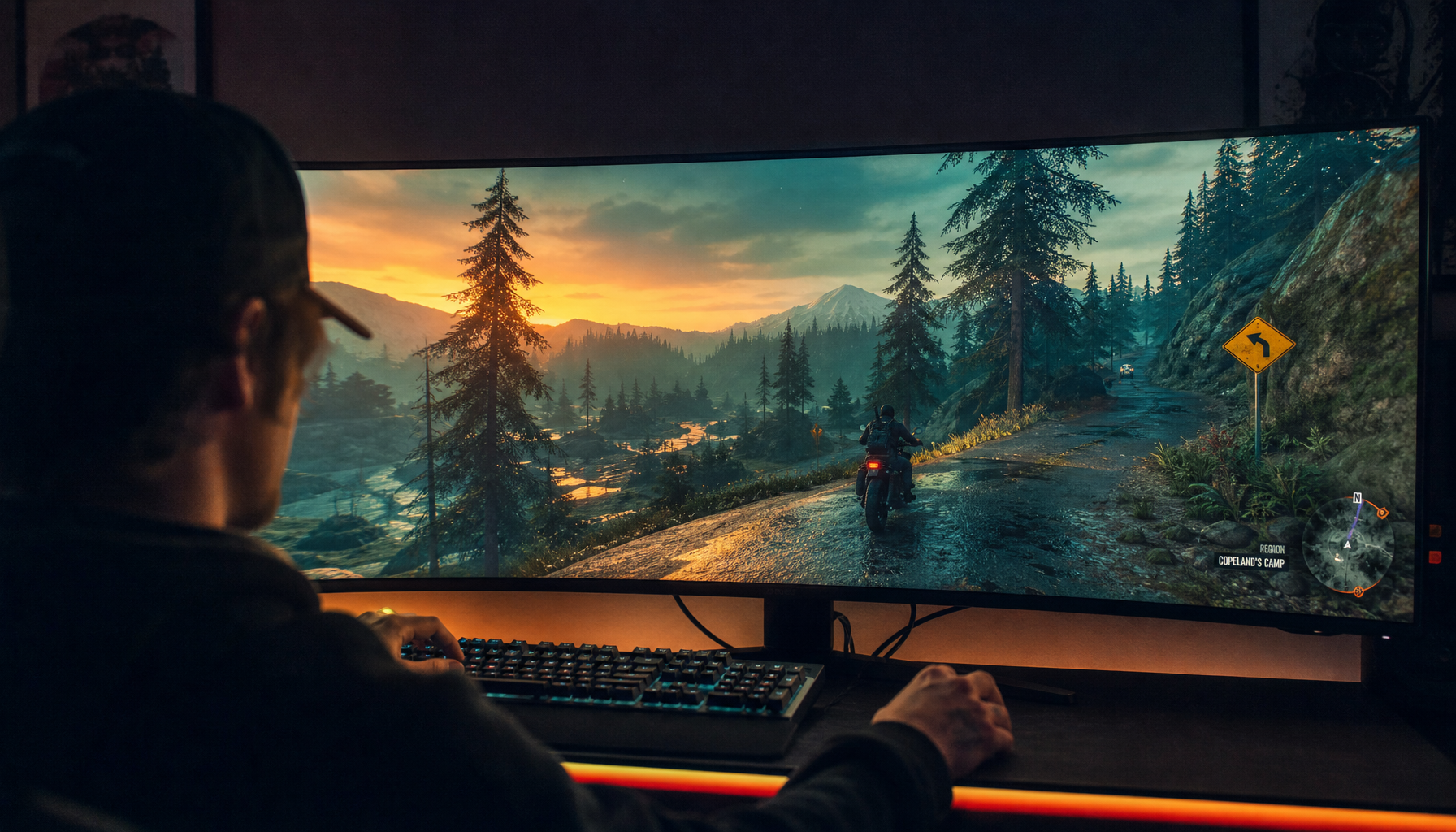
The benefit is most pronounced on large super-ultrawide panels (49 inches and up). At these sizes, a 1000R curve brings the far edges closer to your eyes, reducing the need to turn your head and making flight simulators, racing games, and open-world titles feel more enveloping.
This curvature also pairs particularly well with VA panels. VA technology often suffers from washed-out colors at off-angles; the tighter curve keeps more pixels aimed directly at you, improving perceived contrast and color uniformity across the screen. For gamers building a compact combat station on a shallower desk, 1000R frequently becomes the preferred technical choice rather than a pure aesthetic upgrade.
If you prioritize immersion above all else and your setup allows sitting roughly one meter from the screen, a 1000R monitor such as the KTC 49" DQHD 180Hz 1000R Curved Gaming monitor or the KTC 32" 2K 240Hz 1000R Curved Gaming Monitor can deliver noticeable presence gains. However, the tighter arc can introduce a learning curve for users transitioning from flat panels.
1500R: The 'Gentle' Curve for Hybrid Work and Gaming
1500R offers a more subtle curve that serves as a gentler transition from traditional flat monitors. It strikes a practical balance for users who split time between immersive gaming and productivity work on 27- to 34-inch screens.
At these sizes, a 1000R curve can sometimes feel overly aggressive and create a slight "tunnel" sensation. The milder 1500R arc reduces that effect while still providing some peripheral enhancement and improved edge visibility compared with flat displays. This makes 1500R especially popular in hybrid setups where users switch between creative software, spreadsheets, and gaming.
You can see practical examples in monitors like the KTC 34" 2K 180Hz/1ms 1500R Curved Gaming Monitor or the KTC 27" 2K 180Hz/1ms 1500R Curved Gaming Monitor. These models let you enjoy smoother gaming without the stronger geometric changes that tighter curves sometimes introduce during office tasks.
Science-Backed Comfort: How Curvature Fights Eye Strain
Curved monitors can reduce symptoms of visual fatigue for many users. A clinical study published in PubMed Central found that participants reported significantly less eyestrain, blurred vision, and difficulty focusing when using curved displays during intensive visual tasks compared with flat ones.
The mechanism is called focal uniformity. On a flat screen, the distance from your eyes to the center versus the corners differs noticeably. Your ciliary muscles (the tiny muscles that adjust lens focus) must constantly refocus as your gaze moves. A curved screen keeps that distance more consistent, so your eyes perform less work when scanning across the panel.
This benefit matters most during long sessions—exactly the scenario many gamers and productivity users face. However, curvature does not eliminate eye strain entirely. Proper lighting, regular breaks, and correct sitting posture remain essential. The curve simply removes one common source of refocusing effort.
Gaming vs. Productivity: Which Curve Fits Your Workflow?
Your main activities should heavily influence the curvature decision. For pure immersion-focused gaming—especially on large ultrawides—1000R generally provides the stronger sense of presence. The tighter wrap helps edges stay in your peripheral vision, enhancing spatial awareness in simulators and RPGs.
For productivity work involving straight lines, such as CAD, spreadsheets, or photo editing, 1500R is often the safer choice. The gentler curve introduces less perceptible geometric distortion, so horizontal and vertical lines appear straighter. Many users notice a slight "bowing" effect on 1000R panels during precision tasks, which can become distracting over hours.
Panel type adds another layer. VA panels benefit significantly from 1000R curvature because it mitigates their narrower effective viewing angles and helps maintain edge contrast. IPS panels, with inherently better off-angle performance, gain less from the tightest curves and often perform well with 1500R.
This creates a clear scenario split: choose 1000R when immersion on large VA ultrawides is the priority and your desk supports closer seating. Choose 1500R when you need balanced performance across gaming and accuracy-focused work, or when your desk depth pushes you farther from the screen. As this analysis of curved monitors for work notes, the productivity advantage of milder curves often outweighs marginal immersion gains for mixed-use buyers.

The Setup Factor: Viewing Distance and Desk Depth
Viewing distance is the single most practical variable when choosing curvature. The optimal sweet spot for any curved monitor roughly matches its radius: about 1 meter (3.3 feet) for 1000R and 1.5 meters (4.9 feet) for 1500R.
This curved monitor radius guide from Tom's Hardware confirms that matching distance to radius maximizes the ergonomic benefits while minimizing distortion. On a typical 60–80 cm deep desk, accounting for monitor stand depth and your seated position, you often end up around 70–90 cm from the screen—close enough for 1000R to shine on larger panels.
Deeper desks or setups where the monitor sits farther back favor 1500R. Screen size also matters: 1000R works best on 34-inch and larger ultrawides, while 27- to 32-inch monitors often feel more natural with 1500R unless you sit unusually close.
A quick self-check: measure from your eyes to the center of where the monitor will sit. If that distance is closer to one meter and your main goal is gaming immersion, lean toward 1000R. If it is closer to 1.5 meters or you value straight-line accuracy, 1500R is usually the lower-risk pick.
Making the Choice: 1000R vs. 1500R Comparison Chart
1000R vs 1500R: Best-Fit Curvature by Desk Depth and Use Case
Use the chart to match monitor curvature to your desk depth, screen size, and primary task. Stronger curve tends to fit closer seating and immersion-focused setups; milder curve is the safer all-round choice as distance and productivity needs rise.
View chart data
| Category | 1000R sweet spot | 1500R sweet spot |
|---|---|---|
| Shallow desk (<80 cm) | 3.0 | 1.0 |
| Standard desk (80–120 cm) | 2.0 | 3.0 |
| Deep desk (>120 cm) | 1.0 | 2.0 |
The chart above visualizes fit strength across common desk depths using the physics of each radius. Higher bars indicate stronger expected comfort and performance alignment based on typical ergonomic data. Remember these are directional guides, not absolute scores—your exact seating posture and content type can shift the ideal choice.
Final recommendation: Go with 1000R for ultrawide or super-ultrawide gaming on shallower desks where maximum immersion matters most. Choose 1500R for 27- to 34-inch hybrid setups, deeper desks, or when straight-line accuracy during productivity work is a priority. Measure your actual viewing distance first, then let that data drive the decision rather than marketing claims alone.
For more context on related decisions, see our guides on Curved vs. Flat Monitors: Which Is Better for Gaming Immersion?, Should Your Next Gaming Monitor Be an Ultrawide? A Gamer's Guide, and The Secret Productivity Issue: How to Remedy Digital Eye Strain. You may also want to explore the full Curved Monitors or Gaming Monitor collections to match these curvature insights to specific models.
Frequently Asked Questions
Is 1000R curvature bad for productivity?
It can introduce slight geometric bowing on straight lines in apps like CAD or Excel, which some users find distracting during precision work. For mixed use, 1500R is usually the lower-risk option unless your desk is very shallow and your workflow is heavily gaming-oriented.
How does 1500R compare to 1800R?
1500R provides noticeably more wrap-around immersion than 1800R while remaining comfortable for most desk setups. 1800R is closer to flat and is typically chosen only when maximum desk depth or extreme straight-line accuracy is required. The jump from 1800R to 1500R is often more perceptible than the jump from 1500R to 1000R.
Does monitor curvature really reduce eye strain?
Clinical evidence shows curved monitors can lower reported symptoms of visual fatigue by keeping focal distance more uniform across the screen. The benefit is most noticeable during long sessions, but it works best alongside good room lighting, proper posture, and the 20-20-20 rule.
What screen size works best with 1000R?
1000R performs best on 34-inch and larger ultrawide or super-ultrawide panels. On smaller 27-inch screens the curve can feel overly aggressive for many users unless they sit unusually close (under 70 cm).
How far should I sit from a 1000R vs 1500R monitor?
Aim for roughly 1 meter (about 3.3 feet) from a 1000R display and 1.5 meters (about 4.9 feet) from a 1500R display to experience their respective sweet spots. Measure your actual eye-to-screen distance with your normal seating position before deciding.
Is 1000R only for gaming?
No, but it is most advantageous there. Creative professionals who value peripheral awareness (video editors working with timelines, for example) can also benefit if their desk depth and posture support the tighter curve. Precision design work remains the main scenario where 1500R is typically preferred.