

A calibrated monitor is only one part of print accuracy; brightness, room lighting, printer profiling, paper choice, and panel limitations still decide whether your print actually matches your screen.
You make careful edits on a crisp 27-inch 4K display or a fast gaming monitor, hit print, and the image comes back darker, flatter, or slightly off in skin tones. That happens even in setups where calibration itself was done correctly, because monitor calibration usually takes only about 6 to 30 minutes while the rest of the print chain can still be misaligned. This guide shows what calibration really fixes, which monitor specs matter for print-focused buyers, and how to get closer screen-to-paper matches on standard, ultrawide, gaming, and portable displays.
Calibration Fixes the Screen, Not the Whole Print Workflow
A calibrated display is a baseline, not a guarantee
A calibrated display is not the same as a print-matched workflow. It helps your monitor hit a known target for brightness, gamma, and color, but it does not automatically correct the printer, the paper, or the software settings used during output.
That distinction matters for monitor buyers. A gaming monitor with excellent refresh rate and contrast can still miss print targets if its color modes are unstable, while a portable monitor with decent factory tuning can still fail if the print side is unmanaged. Calibration improves consistency on the display side; it does not remove the need for ICC profiles, controlled lighting, and printer-specific setup.
Prints and screens are different by design
A screen uses RGB light while printing uses ink on paper. That means you are comparing an emissive image to a reflective one. Even when both are well-managed, the match is approximate, not magical.
This is why experienced print workflows focus on “nearly identical” rather than “identical.” Wide-gamut monitors can show more of what your file contains, but the final print still depends on the printer’s gamut, the paper white, and the way your room light changes how the print is perceived.
Why Prints Still Look Too Dark or Slightly Wrong
Monitor brightness is usually the first culprit
A too-bright monitor often makes prints look dark. That is one of the most common causes of frustration after calibration, especially on modern high-refresh-rate displays that ship with vivid, high-output default modes.

In practice, many users edit on brightness levels that feel great for gaming or everyday desktop use but are too intense for print judgment. A company community guidance suggests starting around 50% brightness and contrast, then evaluating under controlled room light. On a 240Hz gaming monitor or a bright HDR-capable panel, that often means turning off the punchy preset you like for games and creating a separate print-editing mode.
Room light and reflections change your judgment
A stable viewing environment matters as much as calibration. Overhead light, sunlight from a window, colored walls, and even bright clothing can shift how your eyes read contrast and color on screen.

This matters even more on glossy portable monitors and curved ultrawides, where reflections and angle changes are harder to ignore. If your display is calibrated in one lighting condition and you edit in another, the profile is still technically valid, but your visual judgment is not. For print work, clean the panel, block glare, and let the monitor warm up for 15 to 30 minutes before critical edits.
Paper and printer settings can defeat a good monitor
A printer profile should match the specific paper and output setup. Change the paper type, switch ink, or use the wrong profile in the print dialog, and your calibrated monitor will no longer predict the result well.
This is why a print can be wrong without the printer being broken. Some a company support discussions describe printers that produced dim or uneven output during setup, while a company’s own manual separates color mismatch correction, density control, and full calibration on the printer side. In other words, you may have a display problem, a print density problem, or both.
Which Monitor Specs Actually Matter for Print Matching
Gamut, accuracy, and uniformity matter more than refresh rate
For print-focused work, wide-gamut color space coverage and low Delta E matter more than raw speed. A monitor aimed at gaming can still work, but only if it also delivers predictable color, good uniformity, and a usable sRGB or wide-gamut mode.
A practical target is at least full sRGB for general creative work, with 98% or better wide-gamut color space coverage preferred for serious print work. Delta E under 2 is a strong baseline, and under 1 is better for critical edits. Uniformity is the hidden spec many buyers miss: if the left side of the screen is darker or warmer than the center, calibration cannot fully rescue the experience.
IPS and 4K remain the safer default for print buyers
An IPS panel with stable viewing angles is still the safer choice for color work. High resolution also helps because it makes it easier to judge fine detail, sharpening, and local contrast before printing.
That does not mean every VA, OLED, or high-refresh panel is disqualified. It means those panels need extra scrutiny for white balance stability, uniformity, and color-mode behavior. Some fast OLED and advanced OLED monitors now have surprisingly accurate sRGB modes, but speed alone should never be treated as proof of print suitability.
Monitor feature priorities for print-focused buyers
Feature |
Why it matters for print matching |
Good baseline |
Better target |
Color gamut |
Determines how much of the file’s printable color you can preview |
100% sRGB |
98%+ wide-gamut color space |
Color accuracy |
Reduces visible color error before printing |
Delta E < 2 |
Delta E < 1.5 |
Prevents corner-to-corner shifts that distort edits |
Acceptable factory uniformity |
Uniformity compensation or strong lab results |
|
Brightness control |
Helps align screen luminance with paper output |
Stable manual brightness |
Hardware calibration support |
Resolution |
Improves fine-detail review and retouching |
QHD |
4K or higher |
Panel type |
Affects angle stability and consistency |
IPS |
Higher-end IPS or pro-grade IPS/OLED with proven color modes |
Calibration support |
Makes long-term accuracy easier to maintain |
Factory calibration |
Hardware LUT calibration |
Can Gaming, Ultrawide, and Portable Monitors Work for Print?
Gaming monitors can work if color mode quality is real
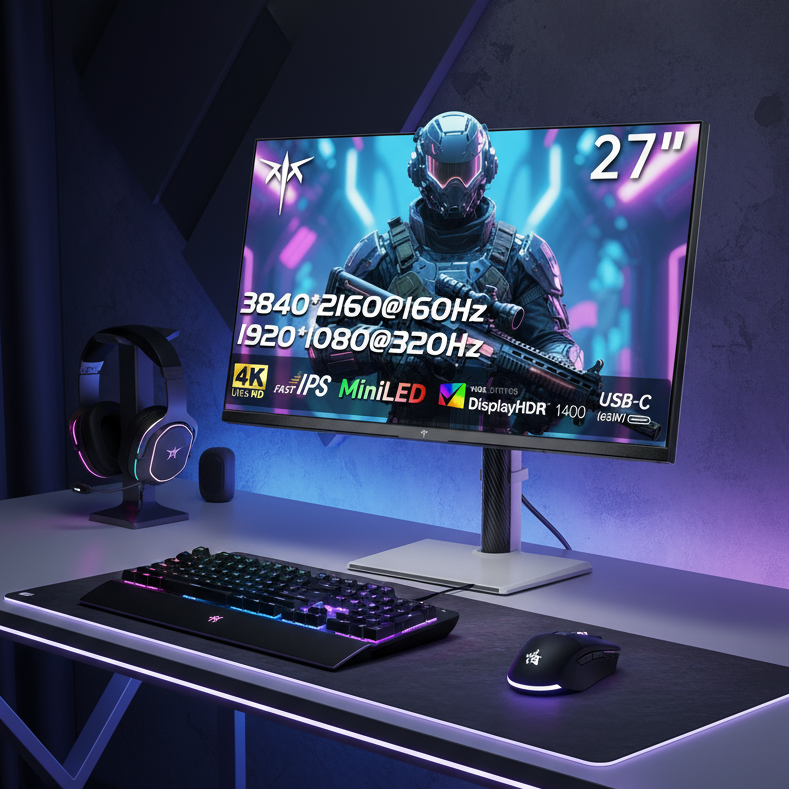
Some modern gaming-oriented displays now ship with accurate sRGB modes and wide gamut support. That makes them more viable for mixed-use buyers who want one monitor for both high refresh and print-aware editing.
The catch is that refresh rate does not improve print matching. A 240Hz panel is helpful for motion, not paper output. If you buy a gaming monitor for print-related work, prioritize the panel’s measured accuracy, gamut coverage, and uniformity before caring about 1 ms response time or flashy HDR claims.
Ultrawides are useful, but shape and uniformity change the tradeoff
A 34-inch ultrawide with 3440 x 1440 resolution or better gives more editing space. Side-by-side soft proofing, palettes, and full-size previews are easier on a wide canvas, which is a real productivity advantage.

Still, ultrawides introduce their own risks. Curvature can make straight-line judgment feel less natural for some print users, and larger panels make brightness uniformity more important. If you choose an ultrawide, do not assume “bigger” means “better matched.” Check whether the panel is consistent from center to edges.
Portable monitors are usable, but only the best ones belong in a print workflow
A portable monitor can be viable when it offers wide gamut coverage, low Delta E, and hardware calibration support. That makes high-end portable displays useful for tethered shoots, travel edits, and on-site proofing.
But this is also the category where buyers should be most skeptical. Many portable screens are bright, thin, and convenient, yet lack the uniformity and long-term stability needed for serious print matching. For critical work, treat a portable monitor as a secondary validation tool unless it has proven wide-gamut color space coverage, strong calibration results, and a controlled viewing setup.
A Practical Workflow That Gets Closer Matches
Use a repeatable screen setup before touching the printer
A repeatable calibration routine starts with warm-up time and stable ambient light. Let the monitor warm up for 15 to 30 minutes, clean the screen, use native resolution, and recalibrate every 2 to 4 weeks, or more often in critical environments.
For mixed-use displays, save separate presets. One can be optimized for games or video, and one for print editing with lower brightness and a disciplined color mode. This is especially important on high-refresh monitors, where factory defaults are often tuned to look exciting rather than neutral.
Validate the printer before blaming the monitor
A known-good test print can show whether the printer is actually the problem. If a standard image prints correctly without your custom edits, the printer may be fine and the mismatch may be happening earlier in the workflow.

That also applies to printer-side maintenance. A company documents multiple calibration modes for color mismatch correction and density control, and notes that full calibration takes about 100 seconds. If prints are faint, uneven, or misaligned, the fix may be on the printer side rather than the monitor side.
Action checklist
- Let the monitor warm up for 15 to 30 minutes before critical edits.
- Edit in stable light with no glare or direct light hitting the panel.
- Lower monitor brightness from showroom levels and keep a dedicated print-editing preset.
- Use the correct ICC profile for the monitor, printer, and exact paper type.
- Print a known-good test image before changing your monitor profile again.
- Recalibrate the display every 2 to 4 weeks, or more often if the workflow is color-critical.
- Recheck printer maintenance if you see faint output, density shifts, or color misalignment.
FAQ
Q: If my monitor is calibrated, should my prints match exactly?
A: No. Calibration improves display consistency, but prints are still limited by printer gamut, paper white, lighting, and ICC profile accuracy. The goal is a close, predictable match, not a perfect one.
Q: Is a gaming monitor automatically bad for print work?
A: No. A gaming monitor can work if it has strong color accuracy, stable brightness, usable color modes, and good uniformity. High refresh rate helps motion, but it does not help print matching by itself.
Q: Is sRGB enough, or do I need a wide-gamut color space?
A: For general screen-first creative work, full sRGB is a solid baseline. For print-focused work, a wide-gamut color space is more useful because it covers more printable cyan and green tones, especially on better photo printers.
Final Takeaway
Monitor calibration is necessary, but it is not the whole answer. If your prints still look dark or shifted, the usual causes are excessive screen brightness, unstable room light, missing printer or paper profiles, or a display that was never a strong print monitor to begin with.
For buyers, the safest path is simple: choose a monitor with proven color accuracy, wide gamut coverage, stable uniformity, and reliable calibration support. Whether it is a standard 4K IPS display, a high-refresh gaming monitor, a 34-inch ultrawide, or a portable panel, the best print results come from a managed workflow, not from calibration alone.