

CAD dimension labels usually become unreadable at certain zoom levels because the software, operating system scaling, and your monitor’s native pixel grid stop lining up cleanly.
You zoom out to review a drawing, and suddenly the dimensions that looked fine a moment ago turn soft, thin, or oddly jagged. A real-world pattern behind that complaint shows up when users move from older 27-inch 1080p screens to larger 31.5-inch 4K displays and then fight blur at 175% or 200% scaling. The fix is usually more practical than mysterious: match monitor resolution, screen size, and scaling so small text has enough pixels to render cleanly.

Why Zoom Level Changes Text Clarity
Screen Pixels and CAD Text Do Not Scale the Same Way
On-screen CAD text is only as sharp as the pixels available to draw each character, and fractional scaling can soften text. That is why 150% or 175% scaling often looks worse than 200% on a 4K display: a full 200% step maps one interface pixel to a clean 2x2 block of panel pixels, while fractional scaling has to interpolate.
Running away from a monitor’s native resolution adds another layer of blur because the image must be resized before it reaches your eyes, and 1080p on a 4K screen can look soft. This matters in CAD more than in casual office work because dimension labels, leaders, and fine linework expose soft scaling immediately.

Annotation Scale and Display Scale Are Different Problems
Some “zoom blur” complaints are really drawing-scale issues rather than monitor failures, and annotative text follows paper height rules. In one CAD application, for example, 0.1000" text at 1" = 50' becomes 5' model-space text, while paper-space output stays at the same plotted height. If the plotted result is correct but the screen view looks inconsistent, the display pipeline is usually the first place to investigate.
A second clue is whether the problem affects only text. In one user case, lines and geometry looked normal while text quality collapsed, and another case tied the issue to DPI handling rather than geometry itself. That distinction matters when shopping for monitors, because buying a sharper panel will not fix a broken annotation setup, but it will make correctly scaled labels easier to read at normal zoom levels.
Which Monitor Specs Matter Most for Small CAD Labels
Resolution and Pixel Density Do Most of the Work
For static drafting readability, higher pixel density generally improves text sharpness. A 4K panel packs more pixels into the same space than QHD or Full HD, so small dimension text gets more edge detail and less visible stair-stepping at the same viewing distance.
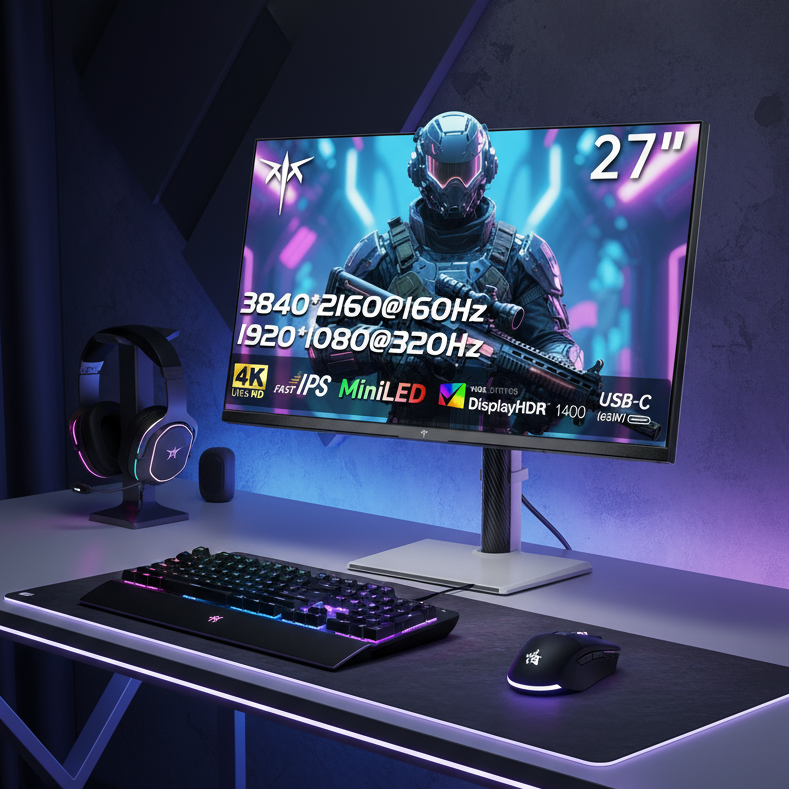
That does not mean “buy the biggest screen” is the right answer. CAD monitor guidance consistently points to 27-inch to 32-inch displays because they balance workspace and clarity better than oversized low-density panels. In practical terms, a 27-inch QHD display is often the easiest upgrade for readable text, while 27-inch to 32-inch 4K makes the most sense if your software and scaling behave properly. A neutral example is a 27-inch 4K IPS 60Hz low blue light monitor, a 27-inch 4K IPS setup that gives small CAD labels more pixels to render cleanly at native resolution.

Size Without Enough Pixels Can Hurt Readability
A useful real-world example comes from a 31.5-inch 4K upgrade that still produced disappointing text and CAD line quality after operating system scaling changes. That experience does not prove 4K is worse; it shows that resolution alone is not enough if the GPU, connection path, scaling mode, or application DPI behavior is off.
Use this quick comparison when choosing a drafting display:
Monitor setup |
Small CAD text clarity |
Scaling behavior |
Best fit |
Main tradeoff |
27-inch 1080p |
Fair |
Usually simple |
Legacy setups, light drafting |
Lowest pixel density |
27-inch QHD |
Very good |
Often usable with little scaling |
Best balance for daily drafting |
Less workspace than 4K |
27-inch 4K |
Excellent |
Usually needs scaling |
Dense drawings, sharp text |
More DPI sensitivity |
32-inch 4K |
Very good to excellent |
Often easier to size than 27-inch 4K |
Large workspace with strong detail |
Slightly lower density than 27-inch 4K |
30-inch ultrawide 2560x1080 |
Moderate |
Simple |
Side-by-side palettes and references |
Coarser text than QHD or 4K |
15-inch portable 4K |
Excellent density, tiny UI |
Highly scaling-dependent |
Travel, review, secondary use |
Not ideal as a primary CAD screen |
How Scaling Settings Create Blur Even on a Good Monitor
Operating System DPI Settings Can Help or Harm
Many CAD text complaints start when operating system scaling is raised above 100%. Some CAD-related tools render sharply only at 100%, then become blurry or incorrectly sized when the platform enlarges text and interface elements. That is why one troubleshooting path is still to test 100% scaling first and then adjust screen resolution only if items are too small.

Older or partially updated CAD interfaces are especially vulnerable, and high-resolution display issues in a CAD application have long included tiny icons, overlapping labels, and palette problems once text-size scaling is increased. If you work across a monitor wall with different sizes or resolutions, these inconsistencies become more obvious because each screen may apply DPI rules differently.
Native Resolution Matters More Than Raw Speed
If the goal is sharper dimensions, keep the monitor at native resolution first, then tune the software. Native resolution, correct refresh rate, font smoothing, and sharpness tuning are the basic checks before you decide a panel is unsuitable.
Performance settings still matter, just for a different reason. Hardware acceleration improves zooming, panning, and redraw speed, and lowering resolution can make heavy drawings feel much smoother on mid-range hardware. The tradeoff is simple: faster motion at lower resolution often comes with softer text and less precise-looking linework.
Are Gaming Monitors, Ultrawides, and Portable Displays Good for CAD Text?
High Refresh Helps Motion More Than Static Labels
A common buying mistake is assuming a gaming monitor will fix drafting text because the refresh rate is high. The better rule is that higher refresh rates help smoother panning and model rotation, but static text clarity still depends far more on resolution, pixel density, and scaling quality.
That is why the 4K-versus-1440p debate for text work is not really a 60 Hz versus 120 Hz debate. In text-heavy workflows, the sharper option usually wins if your system handles DPI properly. A high-refresh display is worthwhile for hybrid users who also game, rotate 3D assemblies, or want smoother cursor and viewport motion, but it is not the main answer to unreadable dimensions.
Ultrawide and Portable Monitors Need More Careful Picking
Ultrawide displays can improve multitasking because you can keep the drawing, palettes, specs, and a browser open at once. The catch is that some ultrawide panels spread modest resolution across a lot of horizontal space, which can make dense dimensions look coarser than they do on a 27-inch QHD or 4K screen.
A portable monitor can be useful, but CAD display buying factors still apply: high resolution, IPS viewing angles, anti-glare, and practical connectivity matter. For field markup, a portable screen works well as a second display for palettes or PDFs; for all-day dimension review, most users will be better served by a full-size 27-inch or 32-inch primary monitor.
Practical Next Steps
A Reliable Troubleshooting Order
Start by treating unreadable labels as a display-chain problem, not just a CAD problem. Test the monitor at native resolution, confirm the cable path, set operating system scaling to a clean value such as 100% or 200%, and only then decide whether the issue is the panel, the GPU, or the application’s DPI behavior.
Use this checklist before replacing hardware:
- Keep the monitor at its native resolution.
- Test operating system scaling at 100%, then 200% on 4K if 100% is unusably small.
- Tune font smoothing and check monitor sharpness settings.
- Verify the CAD app’s DPI or compatibility options.
- Turn on hardware acceleration for smoother navigation, but do not expect it to sharpen text.
- Check annotative text and dimension-style settings so the drawing itself is not the real problem.
- If you are buying new, prioritize 27-inch QHD or 27-inch to 32-inch 4K IPS over large low-resolution panels.
What to Buy if You Work With Dense Dimensions
If your current setup is an older 1080p office screen, the safest upgrade for readable CAD text is usually a 27-inch QHD IPS display. If you want the sharpest label edges and also use your screen for spreadsheets, browser research, or monitor-buying work across multiple windows, 27-inch or 32-inch 4K is the stronger long-term choice, provided your CAD software behaves well with scaling.
The practical takeaway is straightforward: for dimension-heavy drafting, buy for pixel density first, physical size second, and refresh rate third. That order gives the best chance that the text you see at review zoom will still look clean when the drawing gets crowded.
FAQ
Q: Why do dimension labels look sharp when I zoom in but blurry when I zoom out?
A: The text is being redrawn with fewer visible pixels as it gets smaller on screen, and blur gets worse when the operating system or the GPU uses fractional scaling instead of clean pixel mapping.
Q: Is 4K always better than 1440p for CAD text?
A: Usually yes for static text, because 4K gives more pixels for letter edges and fine linework. The exception is when the software handles DPI badly enough that scaling blur cancels out the sharpness gain.
Q: Will a high-refresh gaming monitor make dimension text easier to read?
A: Not by itself. Higher refresh improves motion smoothness during panning, zooming, and 3D rotation, but readability of small labels mostly comes from resolution, pixel density, and correct scaling.