Your PC usually forgets custom scaling because it detects the monitor as a changed or merged display setup after reconnecting. The most reliable fix is to keep each screen as a separate extended display, select the exact monitor before changing scale, use native resolution, and update display drivers if the layout keeps changing.
Does your 4K monitor look perfect at 125% or 150%, then suddenly turn tiny or oversized after you unplug your laptop? A stable display setup can save you from redoing scale, window size, and readability settings every time you dock again. Here is how to make your monitor layout stick with fewer surprises.

Why Custom Scaling Keeps Resetting
Display scaling controls the size of text, apps, menus, and interface elements. At 100%, the interface uses its baseline size; at 125%, 150%, or higher, those elements become larger and easier to read on high-density displays. That matters because a 27-inch 4K monitor can make text physically much smaller than a 24-inch 1080p monitor at the same 100% scale, which is why practical 4K setups often need scaling.
The main problem is that scaling is stored in relation to detected displays and layouts. When you disconnect a monitor, switch docks, close a laptop lid, mirror screens, or connect through a different USB-C hub, the system may detect a new arrangement instead of restoring the old one. The display settings workflow starts with selecting the specific external display before changing scale, resolution, or orientation, and that detail is crucial because users with external displays need to modify the intended screen rather than the whole desktop.
In practical terms, a laptop plus a 32-inch 4K monitor is a high-risk setup for scale resets. The laptop panel may prefer 150% or 200%, while the external monitor may feel best at 125%. If the system briefly treats them as duplicated displays during reconnect, it can collapse those preferences into one shared behavior.

Start With the Correct Display Mode
Use Extend, Not Duplicate
The strongest first move is to keep your monitors in extended mode instead of duplicate mode. Duplicate mode mirrors the same desktop on more than one screen, which limits the system’s ability to preserve separate scale choices. Extended mode treats each monitor as its own workspace, which is what you want for a productivity display, gaming monitor, or portable smart screen.
Open Settings, go to System, then Display. Use the display diagram at the top to identify each screen, select the external monitor, and set the layout to extend the desktop. After that, change scale for the selected display only. Per-display scaling works best when each panel is treated independently, not as a replicated view.
For a real-world example, a 14-inch laptop at 200% and a 27-inch QHD monitor at 100% can coexist cleanly in extended mode. In duplicate mode, one desktop image has to serve two very different pixel densities, so one screen usually loses.
Select the Monitor Before Changing Scale
Do not open Display settings and immediately change the scale dropdown. First, click the monitor tile that represents the screen you want to control. Then adjust Scale under Scale & layout. Settings marked Recommended are generally the safest baseline for scale and resolution.
This matters because the laptop panel may remain selected by default. If you change scaling while the laptop screen is selected, your external display may not get the setting you think you applied. This happens most often on USB-C docked desks where the external monitor wakes a second after the laptop panel, so the internal display gets focus first.
Use Native Resolution Before Blaming Scaling
Scaling and resolution are different controls. Resolution decides how many pixels the monitor uses; scaling decides how large text and interface elements are drawn on those pixels. If you lower resolution to make text bigger, the display can look soft, stretched, bordered, or less precise. That is a bad trade on a sharp office display and an even worse trade on a fast gaming monitor where clarity and responsiveness matter.
Display resolution controls how sharply and completely content appears. For most modern monitors, the right move is to keep the native or recommended resolution, then adjust scale.
A simple example shows why. A 27-inch 4K monitor at 100% can make text feel too small for long document work. Dropping it to 1440p may enlarge things, but it sacrifices pixel clarity. Keeping 4K and using 150% scaling usually gives a cleaner result because the interface still renders against the full pixel grid.

Pick a Scaling Value That Matches the Screen
The best scaling value depends on screen size, resolution, viewing distance, and eyesight. A 24-inch 1080p office display often works well at 100%. A 27-inch QHD display is also commonly comfortable at 100%, which is why it remains a strong value-performance choice for productivity. A 27-inch 4K monitor often feels better at 150%, while a 32-inch 4K display often lands around 125% for users who want more workspace without tiny text.
A practical pixel-density discussion compares 24-inch 1080p at about 91.79 DPI with 27-inch 4K at about 163.18 DPI, meaning the same interface at 100% appears much smaller on the 4K screen; that DPI ratio helps explain why display scaling is ergonomic, not cosmetic.
Display Type |
Practical Starting Scale |
Best Fit |
24-inch 1080p |
100% |
Standard office work |
27-inch QHD |
100% |
Productivity, coding, general multitasking |
27-inch 4K |
150% |
Sharp text, design, mixed work and media |
32-inch 4K |
125% |
Large spreadsheets, dashboards, heavy multitasking |
These are starting points, not laws. If you sit farther back, use a deep desk, or run a monitor arm, you may need larger scaling. Home-office guidance consistently emphasizes matching size, resolution, and desk distance instead of buying the biggest panel and forcing your eyes to adapt; a 24- to 27-inch monitor is often recommended for balanced office use, while larger displays need more room and viewing distance for comfort.
Stabilize the Reconnect Routine
Reconnect the Same Way Every Time
The system is more likely to remember a setup when the signal path stays consistent. Use the same monitor input, the same dock port, and the same cable whenever possible. If your monitor supports multiple video inputs, avoid switching between them casually because the same physical monitor may be treated as a changed display path.
For gaming monitors, one connection type may expose better resolution and refresh-rate combinations than another, depending on the monitor and graphics hardware. That is not just a speed issue. If reconnecting through a different port changes the monitor’s reported capabilities, the system may rebuild the display profile and disturb scale.
Update Display Drivers When Resolution or Layout Changes Unexpectedly
If the system keeps changing resolution, layout, or scale after reconnecting, update the graphics driver. The practical first step is to check for operating system and driver updates through Settings.
This is especially important on laptop docking setups. The graphics driver, USB-C controller, dock firmware, and monitor identification handshake all influence how the display is detected. You do not need to diagnose every layer first; driver updates are a practical first pass because they often fix detection and compatibility behavior.
It is also worth noting that support for one widely used older operating system ended on October 14, 2025. If you are still using it on a work machine, scaling glitches are only one part of the risk picture; long-term reliability and security favor moving to a supported system where hardware support allows it.
Avoid Risky Registry and Security Tweaks
You may find forum advice recommending registry edits, policy changes, or disabling User Account Control behavior to preserve display settings. Treat that advice carefully. Some anecdotal guidance suggests changing security policies or hibernating instead of closing the lid, but weakening User Account Control can reduce system security and is not a display-quality fix.
A safer performance-driven approach is to exhaust supported controls first: extended mode, correct monitor selection, native resolution, consistent cabling, and updated display drivers. If you manage a fleet of office displays, this also makes the setup repeatable. A workaround that depends on weakening security or pinning an old operating system build is hard to defend in a professional workspace.
Improve Readability Beyond Display Scaling
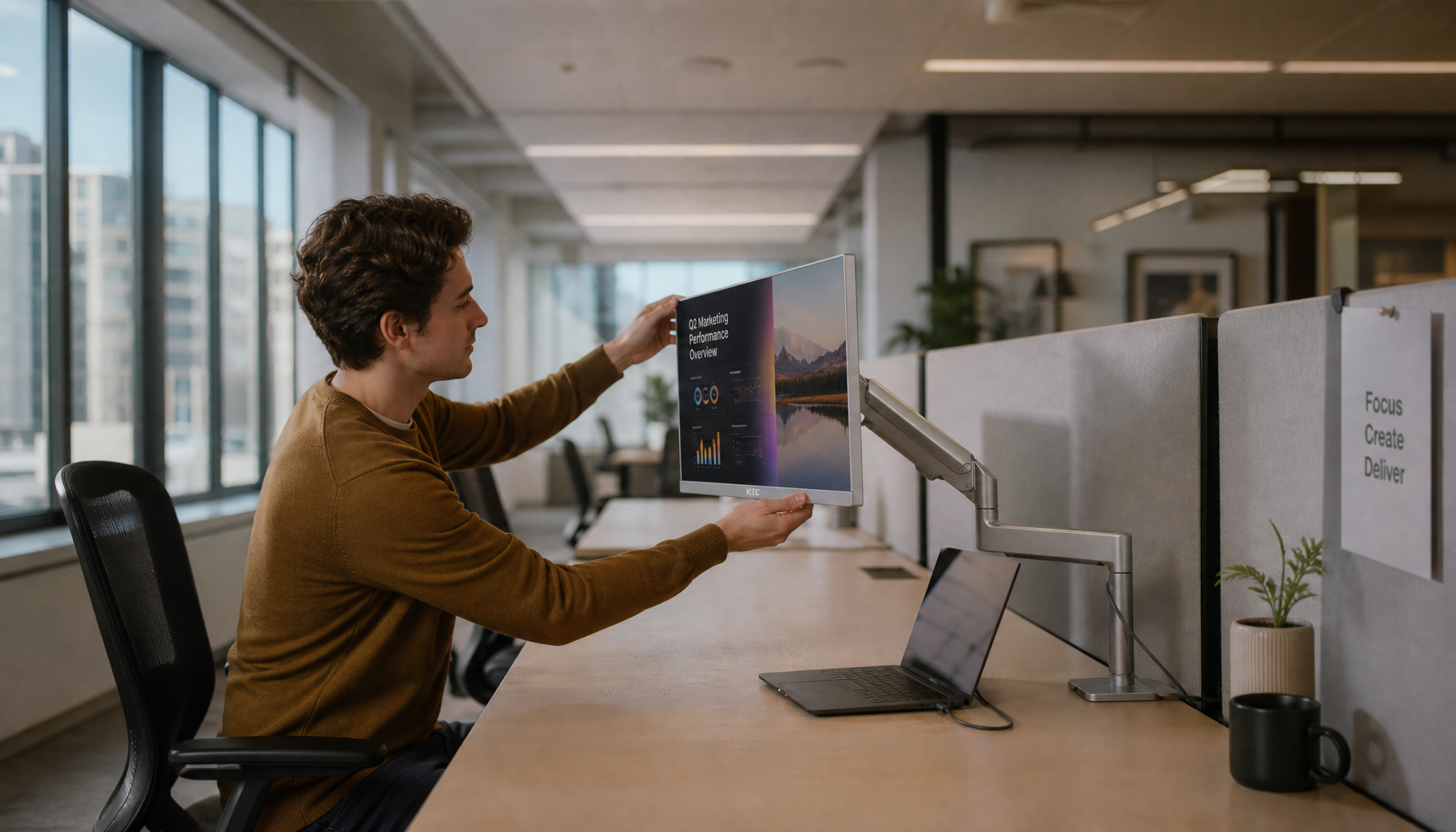
Scaling fixes interface size, but it does not solve every comfort problem. A productivity display should also be positioned and tuned correctly. Put the top edge of the monitor near eye level, sit roughly an arm’s length away, and avoid direct glare. Home-office monitor guidance emphasizes that screen size should match work tasks, viewing distance, and desk space, while visual comfort and focus depend on more than resolution alone.
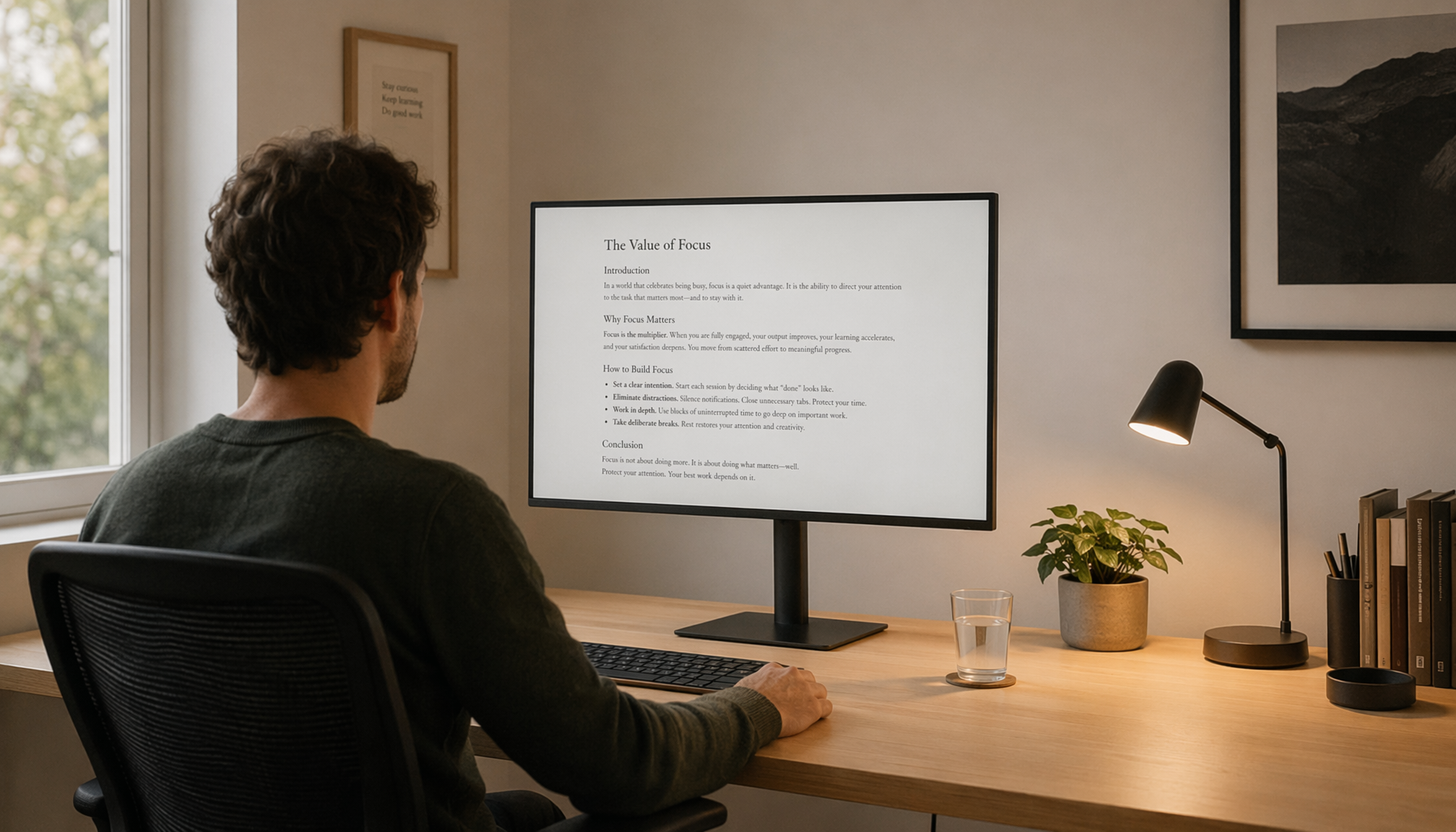
For text-heavy work, keep the monitor at native resolution, use font smoothing if available, and match brightness to the room. For color-sensitive work, use sRGB or Rec. 709 modes when you do not have calibration hardware. Hardware calibration is the more accurate path for professional color work, but for everyday productivity, stable brightness, neutral room lighting, and a readable scale setting matter more than chasing extreme specs.
Contrast also plays a role in perceived sharpness. A display’s contrast ratio compares its brightest white with its darkest black, and higher contrast can improve readability and image depth. For office productivity, that means spreadsheets, dashboards, and code panes feel cleaner when text has enough separation from the background.
Quick FAQ
Can Display Scaling Go Below 100%?
Most systems do not provide a supported way to set display scaling below 100%. If everything looks too large at 100%, the better supported option is to use the monitor’s native or recommended resolution and choose a display with a size and pixel density that fits your workflow.
Should I Use Custom Scaling or Preset Scaling?
Use preset scaling first, such as 100%, 125%, or 150%. Custom scaling can help in edge cases, but it is more likely to behave inconsistently across mixed monitors. For a reliable desk setup, preset values are easier for the system, apps, and support teams to handle.
Why Does My Laptop Screen Keep the Right Scale but My External Monitor Does Not?
The laptop panel is always present, so the system can identify it consistently. An external monitor depends on the cable, dock, input, driver, and wake timing. If any of those change, the monitor configuration may be treated as new and given a fallback scale.
Final Calibration
A stable scaling setup starts with discipline: extend displays, select the exact monitor, keep native resolution, choose a sensible scale, and reconnect through the same path. Once the system stops fighting the layout, your monitor can do its real job: give you sharp text, efficient workspace, and an immersive screen experience that stays ready when you plug back in.