A portable smart display vs tablet choice comes down to how you plan to use the screen. Pick the portable smart display when you want a larger, movable screen for shared use around the home. Pick a tablet when handheld carry, travel, and one-handed use matter more. Pick a small TV or wall-mounted display when the screen will mostly stay in one place.

When a Portable Smart Display Makes Sense
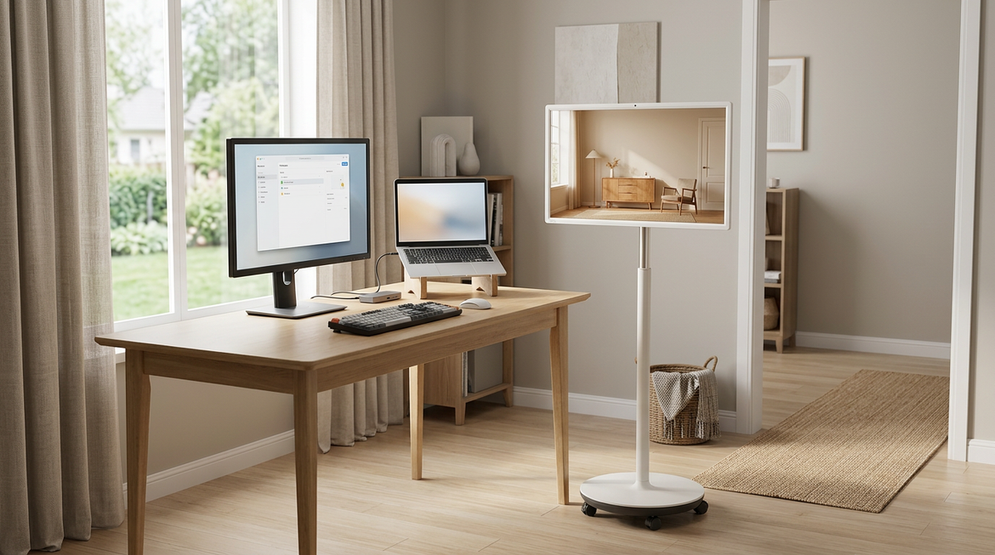
Think of a portable smart display as a category bridge, not a tablet replacement. It sits between fixed TVs and handheld tablets, which is why it is most useful when the screen needs to stay upright, move from room to room, and remain easy for more than one person to use. That framing matches how portable smart screens are described in category guides and helps prevent the biggest mistake: confusing mobility with pocket-friendly portability.Types of Smart Screens
In real homes, this category usually makes sense for kitchen streaming, workout videos, casual movie nights, shared dashboards, or a bedroom screen you roll away later. If the job is mostly "set it down and watch," a portable smart display can be more practical than a tablet because the larger screen is easier to see from across a room.
If the job is "carry it everywhere," the answer flips. That is where a tablet stays the safer fit. A portable smart display is about room-to-room convenience, not bag-friendly portability.
How the Categories Differ at a Glance
| Category | Best Fit | Common Tradeoff | What Usually Decides The Sale |
|---|---|---|---|
| Portable smart display | Shared viewing, casual control, room-to-room movement | Bigger and less personal than a tablet, less fixed than a TV | Whether the buyer wants a movable screen that still feels like a shared household display |
| Tablet | Handheld use, travel, couch reading, private browsing | Smaller screen and less comfortable for group viewing | Whether true portability matters more than screen size |
| Small TV | Casual entertainment in one room | Not meant for touch-first use or frequent moving | Whether the screen stays in one place and app convenience matters more than touch control |
| Wall-mounted display | Permanent room setup, cleaner installation | Least flexible once installed | Whether the buyer values a fixed installation over movement |
Large portable displays can also be harder to live with in bright rooms. CNET notes that many smart-display-style screens sit below premium tablets on brightness, which can make glare more noticeable near windows or under strong overhead lighting.CNET
The practical takeaway is simple: if you need a screen that moves but does not need to disappear into a bag, the portable smart display category is worth a look. If your room is bright and you sit close to the screen, a tablet may still feel easier to read.

App Ecosystem and Input Feel
App access is one of the biggest reasons the portable smart display vs tablet decision should stay model-specific. On some large Android displays, Google EDLA certification provides native Google Play access and a more controlled app environment, which can make app selection feel closer to a mainstream Android device.Google EDLA Certified Displays
That still does not mean every portable smart display has the same app support. Buyers should check the exact model they are considering, especially if they need streaming apps, smart-home dashboards, or a particular conferencing app. The category name alone does not guarantee the experience.
Input feel matters too. Latency is just the delay between touch and on-screen response, and in this category it is mostly a comfort issue. If taps, scrolling, or swipes feel slow, the screen becomes annoying for casual browsing and daily control. That is why the touch experience should be treated as a real buying check, not a spec detail to skim past.
For shared use, a larger touch surface can be easier than a small tablet. For example, a kitchen dashboard or living-room control screen often benefits from bigger targets and less cramped navigation. But if the buyer wants a device for typing-heavy work, note-taking, or lots of private app switching, a tablet usually feels more natural.
The short version: if app access and touch feel are central to your use, verify the exact model before buying. A portable smart display can be a good fit, but only when its software behavior matches the way you actually plan to use it.
Portability, Power, and Room-To-Room Use
Portable in this category usually means "easy to move around the home," not "easy to carry all day." That difference matters. A tablet wins for bag carry, one-handed use, and spontaneous travel. A rolling display wins when the screen needs to move from the kitchen to the living room without being lifted constantly.
Battery power helps, but it should not be treated as a universal all-day promise. Ars Technica's reporting on giant displays on wheels points out that active streaming can cut real runtime well below headline battery claims, especially on larger screens.Ars Technica
That is why battery runtime should be checked against the buyer's actual routine. If the screen will mostly stream video at high brightness, or if it will sit near a power outlet anyway, battery convenience matters less than the marketing language suggests. If the screen will truly move between rooms, battery life can still be useful, but only if it covers the way you use the device.
Wall-mounted displays solve a different problem altogether. They trade flexibility for a cleaner fixed setup. If you already know the screen will stay in one room, fixed installation usually makes more sense than paying for mobility you will not use.
See real battery behavior before assuming a large mobile screen will stay unplugged all evening.
Which Buyer Profile Fits Best
Choose a tablet when you need true handheld use, travel convenience, or a better fit for couch reading and private browsing. Tablets are still the safer baseline when the screen lives in your hands more than in the room. If your use is mostly personal and mobile, the portable smart display vs tablet question usually resolves in favor of the tablet.
Choose a portable smart display when you want a larger screen that can move between rooms, support casual touch control, and work well for shared household use. This is where the category feels strongest: kitchen streaming, workouts, family viewing, smart-home dashboards, and casual entertainment in a shared space.
Choose a wall-mounted display or small TV when the screen will stay put. That option is cleaner for a permanent entertainment zone and avoids paying for mobility you do not need. If you want the most fixed-room simplicity, the rolling display is often the wrong purchase.
For readers who want a more screen-first category path, browse the broader Smart Monitor selection. If your priority is a movable touch screen, the Mobile Touch Screen collection is the more relevant place to compare options.
A natural product example is the KTC MEGAPAD 32" 4K Android 14 Google EDLA Smart Touch Monitor with 8550mAh Battery. Its product facts fit the category discussion because it combines a 31.5-inch 4K touch display, Android 14 with Google EDLA, built-in battery, and a stand that adjusts for different viewing positions. It is still a better check-for-fit choice than a blanket recommendation.
Fit Test Before You Buy
- Decide where the screen will live most of the time. If it stays in one room, a small TV or wall-mounted display may be the better buy.
- Decide whether you need handheld portability or room-to-room movement. If you mean "carry it," choose a tablet.
- Verify the exact app behavior you need. Do not assume every portable smart display has the same app access.
- Check whether touch response really matters for your use. If you will tap and scroll often, responsiveness should be part of the decision.
- Confirm support, warranty, and return comfort before checkout. That is especially useful with a category that sits between a tablet and a TV.
If you are still torn after the checklist, use this rule: choose the device class that matches your most common routine, not the one that sounds most flexible on paper. For many shoppers, that means the tablet is the better mobile device, while the portable smart display is the better shared screen.
Related Resources
FAQs
How Do I Know If a Portable Smart Display Is Better Than a Tablet?
If you want a screen that stays visible in a room and gets shared more than it gets carried, the portable smart display is the better fit. If you need to hold it, travel with it, or use it one-handed, a tablet is still the better choice.
What Matters More: App Support or Screen Size?
It depends on the job. App support matters more if you need specific streaming or conferencing apps. Screen size matters more if you want a shared screen for casual control, dashboards, or group viewing. In many homes, app access is the first check and size is the second.
Can a Rolling Smart Display Replace a Small TV?
Sometimes, yes, if you want a casual entertainment screen that can move around the home. But a small TV or wall-mounted display still makes more sense when the screen stays in one place and you want a fixed setup with no movement to manage.
Why Does Input Latency Matter on a Smart Display?
Because it changes how the screen feels during everyday touch use. If there is too much delay between tap and response, scrolling and casual browsing feel less natural. That matters most when you plan to use the screen directly instead of casting everything to it.
Can I Use a Portable Smart Display for Streaming and Light Work?
Yes, for casual streaming, dashboards, video calls, and light touch-driven tasks. For typing-heavy work, long editing sessions, or travel-first use, a tablet or laptop-style setup usually makes more sense.
Final Takeaway
A portable smart display vs tablet decision is really a choice between room-to-room convenience and true handheld portability. Choose the portable smart display when the bigger movable screen solves a shared-use problem. Choose the tablet when personal carry and app familiarity matter more. Choose a fixed display when mobility is not part of the job.