For home fitness enthusiasts who do yoga, Pilates, or trainer-led workouts on the floor, a 32-inch rolling smart display like the MegPad typically wins over a tablet on a stand. The larger screen reduces neck strain at mat distances, the weighted rolling base stays stable during movement, and native Google EDLA-certified Android delivers more reliable app performance than mirroring or generic tablet setups.
This comparison focuses on real daily friction in apartment living rooms or multi-use spaces rather than marketing claims. A tablet-plus-stand setup can work for occasional sessions, but it often creates posture problems, wobble hazards, and workflow interruptions that a purpose-built mobile fitness display avoids.

The Home Fitness Display Dilemma: Size vs. Versatility
Most home gyms sit in the awkward middle ground sometimes called the lifestyle display wedge. A 10- or 12-inch tablet feels personal but forces you to crane your neck or squint from a yoga-mat distance. A living-room TV offers size but stays fixed to one wall, making it impractical for floor work or quick room-to-room shifts.
Standard yoga mats run roughly 68 to 72 inches long, so users often end up viewing from 5–6 feet away. At that range a small tablet requires significantly more visual effort and forward head tilt. The result is the familiar “yoga neck” that builds fatigue and can reduce workout quality. A 32-inch integrated battery display bridges the gap: large enough for clear cues at typical mat distances, yet mobile enough to follow you from standing cardio to floor stretching without permanent installation.
Virtual training apps have grown rapidly, and users want a screen that moves with their routine rather than forcing the routine to fit the screen. This decision matters most for apartment dwellers, shared-space families, and anyone who switches between HIIT, cycling, and restorative yoga in the same room.
Solving 'Yoga Neck': Why 32 Inches is the Ergonomic Threshold
Floor-based workouts change the viewing geometry. A tablet on a low stand or the floor usually sits at a steep downward angle. At a 60-degree neck tilt—the position many people adopt when following a small screen on the mat—the head can exert around 60 pounds of effective pressure on the cervical spine. Shifting to a 32-inch screen positioned at eye level or slightly below brings the posture closer to neutral, reducing that load to roughly 12 pounds according to cervical-spine load models.
As this yoga mat size guide confirms, the typical 6-foot mat length places users well outside the comfortable close-range zone for 10-inch tablets. A 32-inch display at 3–6 feet lets you see instructor form cues in your peripheral vision while keeping your gaze roughly horizontal. That difference helps maintain spinal alignment during long holds or repetitive movements.
The practical test is simple: during your next floor session, notice how often you round your shoulders or jut your chin forward to see details. If that happens within the first 15 minutes, screen size is likely the limiting factor. A larger mobile display often eliminates that adjustment, which can improve both comfort and exercise effectiveness.
See our related guide on Large Touchscreen for Home Gym: Best Workout Screen Guide for more on posture-friendly setups.
Stability on the Mat: Rolling Bases vs. Wobbly Tripods
Rubber gym mats and soft rugs create a classic stability problem for lightweight tripod stands. Vibrations from jumping, treadmill footfalls, or even enthusiastic cycling can cause the stand to wobble or tip. Many users end up wedging books or taping the base—temporary fixes that still require frequent readjustment.
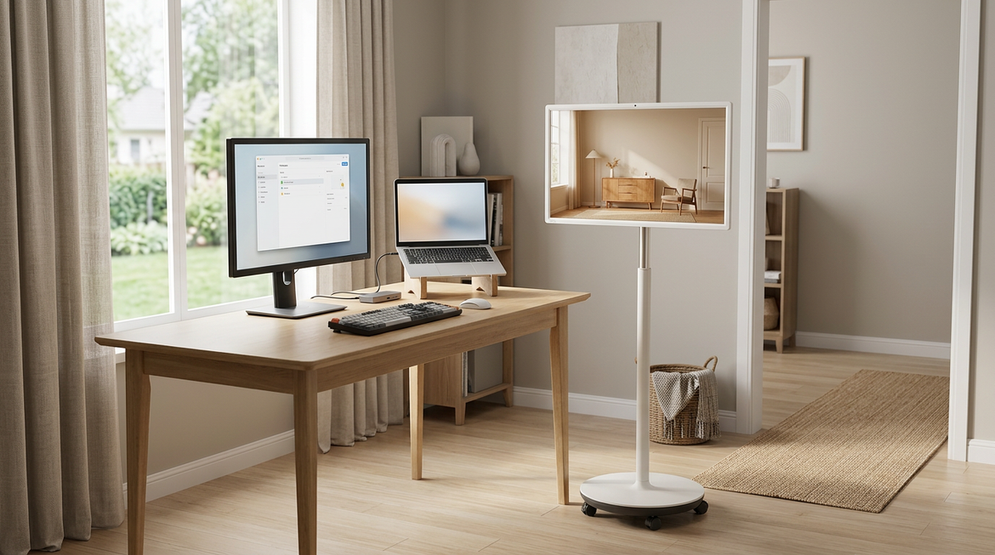
A rolling display with a 5-wheel weighted base spreads mass over a wider footprint and lowers the center of gravity. The added mass dampens vibration, and the wheels allow one-handed repositioning in seconds when you switch from standing to floor positions. This removes the repeated bending and fiddling that interrupts flow during trainer-led classes.
In high-intensity sessions the difference is noticeable: a stable large screen keeps the instructor visible without blur or sudden shifts. For shared family workouts the quick height and tilt adjustment also lets multiple users find a comfortable viewing angle without resetting a fragile stand each time.
The Software Advantage: Why Google EDLA Matters for Peloton and Zwift
Many tablets run consumer Android or iOS, but fitness apps often behave differently on uncertified devices. Google’s Enterprise Devices Licensing Agreement (EDLA) certification gives the display native, full Play Store access and system-level stability that generic Android overlays or screen-mirroring setups frequently lack.
Native apps for Peloton, Zwift, Kinomap, and similar platforms tend to launch faster, maintain connection during live classes, and receive updates without the compatibility breaks that can occur when mirroring from a phone over Wi-Fi. This matters during longer sessions where a dropped stream or frozen interface can ruin momentum.
As explained in our comparison of giant tablet vs smart monitor, EDLA-certified devices provide better long-term app reliability for performance-intensive fitness software. Future updates are also more predictable, reducing the chance that a system change will suddenly break your favorite training app.
MegPad vs. Tablet Setup: Who Wins for Your Workout Style?
The choice ultimately depends on how you train and the constraints of your space. Here is a practical side-by-side view of the main trade-offs.
| Factor | Tablet + Stand | 32-inch Rolling Smart Display (MegPad) | Winner for Most Users |
|---|---|---|---|
| Ergonomics | Often forces downward neck tilt | Neutral spine at mat distance | Rolling display |
| Stability on mats | Prone to wobble or tip on soft surfaces | Weighted 5-wheel base absorbs vibration | Rolling display |
| App experience | Mirroring or limited native support | Native EDLA Android with direct Play Store access | Rolling display |
| Repositioning | Manual adjustment, often two-handed | One-handed rolling and quick height/tilt changes | Rolling display |
| Battery & mobility | Good for short sessions, lighter | 3–5 hours typical at high brightness for 4K models; wheels enable room-to-room movement | Depends on session length (see below) |
| Upfront cost | Lower | Higher but replaces stand, extra charger, and possibly a second device | Tablet for very light use |
The Apartment Yogi who does mostly floor work in a small space benefits most from the 32-inch option. The larger screen corrects posture and the stable base removes daily frustration.
The Multi-Room Athlete who moves between living-room yoga, bedroom stretching, and garage cycling finds the rolling design and built-in battery a clear time-saver.
When a tablet setup still makes sense: If you only do short guided sessions once or twice a week, already own a high-quality tablet and stand, and rarely need to move the screen, the added cost of a dedicated display may not be justified. In bright sunlit rooms or for very long unplugged sessions, the lower-power 27-inch FHD MegPad model can offer longer runtime than the 32-inch 4K version.
The 4K vs runtime paradox is real. Higher resolution and brightness cut battery life noticeably—often to 3–5 hours at peak settings for HDR content versus the longer lab ratings measured at moderate brightness. Choose the 32-inch 4K model (such as the KTC MEGAPAD 32" 4K Android 13 Google EDLA Smart Touch Monitor with 9500mAh Battery) for shorter, visually rich sessions in varied lighting. Opt for the KTC MEGAPAD 27" FHD Android 14 Google EDLA Smart Touch Monitor with 9500mAh Battery when maximum unplugged time matters more than pixel density.

Which Setup Should You Choose for Home Fitness?
Start by checking your two highest-friction points. If neck discomfort or constant screen readjustment already interrupts your workouts, a 32-inch rolling smart display is usually the upgrade that pays for itself in daily convenience and better form. If your routine is short, infrequent, and you already have a stable tablet stand you like, you can comfortably stay with that simpler setup.
The integrated battery display wins for most people who treat fitness as a daily habit rather than an occasional add-on. It removes the ergonomic, stability, and software compromises that turn a tablet-plus-stand combination into a part-time solution. Test the decision by timing how many minutes of your current workout are lost to positioning, squinting, or technical hiccups. That number often clarifies whether the investment in a purpose-built mobile fitness screen is worthwhile.
FAQs
How long does the MegPad battery really last during workouts?
Runtime depends heavily on brightness, resolution, and content. At moderate settings many users see 7–9 hours; 4K HDR fitness videos at full brightness often drop to 3–5 hours. Plan to charge after intense morning sessions if you also want evening use. Lowering brightness to 50–60% extends time significantly without hurting visibility in typical indoor lighting.
Can a good tablet stand really match the stability of a rolling display?
In most cases no. Tripod or lightweight stands tend to sink into or wobble on rubber mats during dynamic movements. A weighted rolling base with wide wheel spacing resists tipping and vibration far better. If your workouts stay very gentle and the stand sits on hard flooring, a premium tablet stand can be adequate, but it still lacks the one-handed mobility of wheels.
Is native app support on the MegPad noticeably better than screen mirroring from an iPad?
Yes for most fitness platforms. Native EDLA Android apps launch without the latency or occasional disconnects common in mirroring, especially on busy home networks. Live Peloton classes and Zwift rides maintain smoother performance and avoid the extra battery drain mirroring causes on the source device.
How far away should I place a 32-inch fitness screen for yoga?
Three to six feet is the typical sweet spot. This distance lets you see full-body instructor cues while keeping your neck in a neutral position. Closer than two feet the screen can feel overwhelming; farther than seven feet small text and fine form details become harder to read.
Does the higher price of an integrated rolling display justify itself for occasional users?
For light use—once or twice a week for 30 minutes—a tablet you already own is usually sufficient. The dedicated display becomes the better value when workouts happen most days, involve frequent position changes, or when poor ergonomics already causes discomfort. Calculate your weekly frustration time; many users find the convenience pays back within a few months of regular use.
Will a 27-inch FHD model work as well as 32-inch 4K for home workouts?
For most fitness content the 27-inch FHD version performs very well and offers longer battery life. The 32-inch 4K model shines when you want sharper detail for form-heavy classes or when the screen will also be used for entertainment from farther away. If your primary goal is workout guidance rather than cinematic quality, the smaller model is often the smarter practical choice.