









For sim racers chasing every edge in iRacing or Assetto Corsa Competizione, Fast VA (also called HVA) panels now deliver a compelling middle ground between the deep blacks needed for night racing immersion and the motion clarity required at 200 mph. Prioritize Fast VA for single-screen or ultrawide cockpits focused on endurance and low-light sessions where contrast sharpens braking markers. Choose Fast IPS instead for triple-screen rigs or bright daylight sprints where perfect side-angle consistency and minimal residual blur matter most. The real decision starts with your cockpit geometry and primary racing discipline rather than raw millisecond specs.

The Great Sim Racing Debate: Contrast Immersion vs. Motion Precision
Sim racing stands apart from other genres because it demands both blistering motion at triple-digit speeds and precise depth perception in low-light conditions such as night endurance events. Traditional VA panels were long avoided in competitive setups because of noticeable black smearing during rapid dark-to-light transitions, such as headlights against asphalt. HVA technology changes that equation by redesigning the panel microstructure to accelerate those exact transitions, making Fast VA viable for high-refresh racing displays.
Fast IPS panels continue to serve as the benchmark for color uniformity and raw pixel speed across wide viewing angles. The practical trade-off therefore comes down to choosing inkier blacks and better shadow separation on Fast VA versus cleaner motion and consistent off-angle performance on Fast IPS. As this HVA technology overview explains, the new micro-structure design specifically targets the slow dark-pixel behavior that once made standard VA unsuitable for simulators.
This choice matters most in cockpit-mounted or ultrawide setups where your eyes stay relatively centered versus triple-screen rigs where peripheral monitors sit at 45-degree angles. Check your typical session type first: if most of your hours involve night racing or endurance stints with low room lighting, Fast VA deserves strong consideration. If you run bright daylight sprints or heavily angled triples, Fast IPS is usually the safer starting point. For a broader look at how panel types align with different play styles, see our guide to IPS vs VA Panels: Which is Right for Your Playing Style?.
Analyzing Motion Clarity: Why 1ms GtG Isn't the Full Story
Marketing often highlights 1 ms GtG response times, yet that single number fails to capture what drivers actually see when bright track markers flash against dark asphalt at high speed. Gray-to-gray testing measures average transitions but under-represents the slow dark-level shifts that create visible trailing in racing scenes. VESA’s ClearMR standard offers a more useful metric by measuring the ratio of clear pixels to blurry ones during real motion, shifting the focus from lab specs to perceived blur in motion.

HVA technology directly improves the slowest transitions that plagued older VA panels. At refresh rates of 165 Hz and above, the remaining difference in motion clarity between well-tuned Fast VA and Fast IPS becomes difficult for most users to notice during typical simulator speeds. Overdrive settings, frame pacing from the game engine, and your specific refresh rate all influence the final result more than the panel label alone. This VESA ClearMR explanation shows why modern standards like ClearMR provide a better guide for high-speed applications than traditional GtG numbers.
Fast VA vs Fast IPS Motion and Contrast Performance by Racing Scenario
Tiered comparison showing where each panel type typically excels based on common sim racing setups. Higher tiers indicate better suitability for the listed criteria in typical cockpit conditions.
Show Data Table
| Criterion | Fast VA (HVA) | Fast IPS |
|---|---|---|
| Night Racing Contrast | Excellent | Good |
| Motion Clarity (High Speed) | Good | Excellent |
| Triple Screen Angles | Fair | Excellent |
| Endurance Eye Comfort | Excellent | Good |
| Daylight Sprint Consistency | Good | Excellent |
For deeper understanding of related motion artifacts, review our explanations of What Is Monitor Ghosting and How Do You Eliminate It?, What Is Pixel Overdrive, and When Does It Create Inverse Ghosting?, and What Is Sample-and-Hold Blur and Why Higher Refresh Rates Don't Eliminate It?.
The Night Racing Advantage: How Contrast Sharpens Your Braking Points
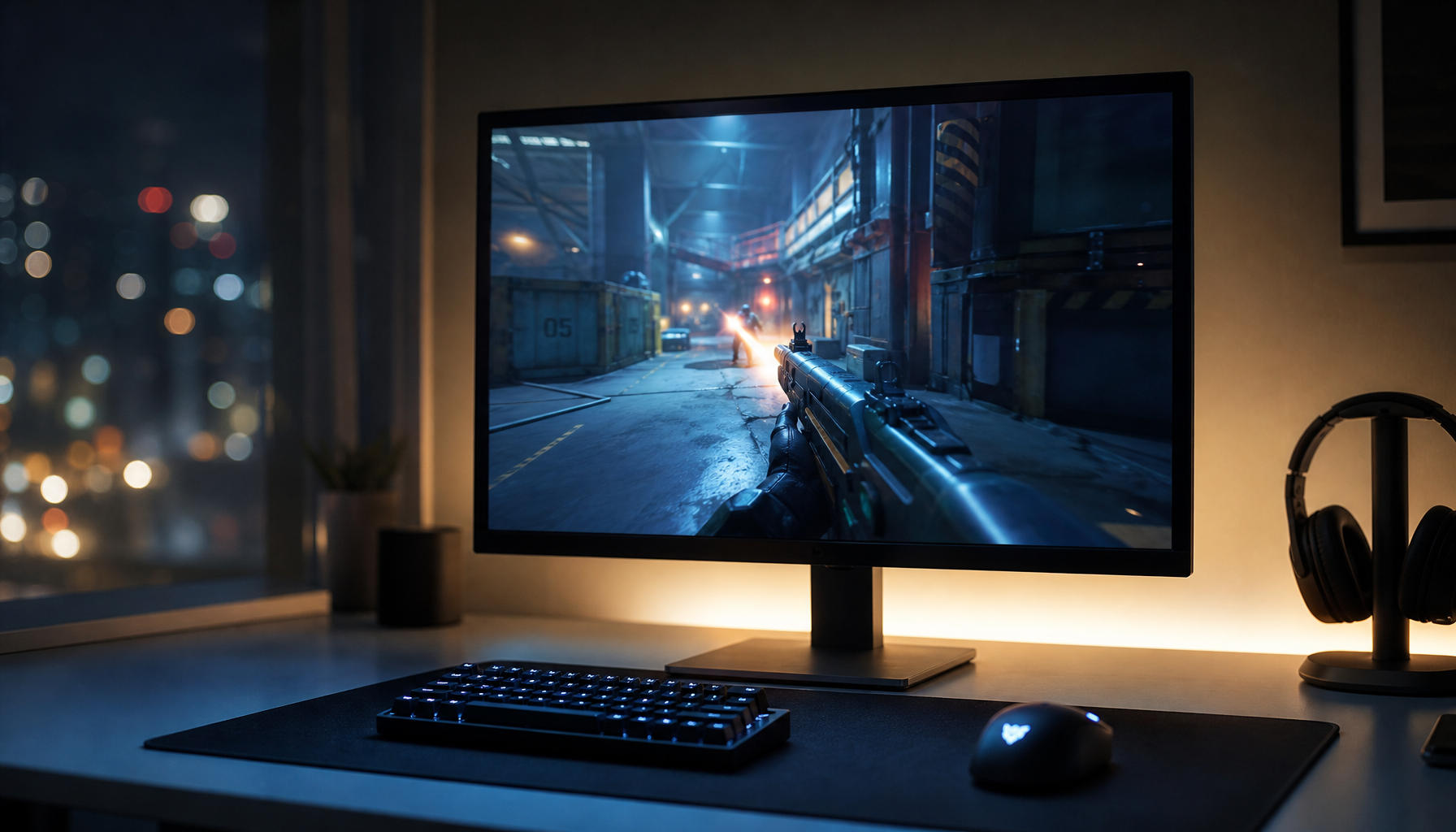
Night sessions in titles like Assetto Corsa Competizione turn subtle shadow gradients and braking markers into performance cues. VA panels, including HVA variants, typically deliver contrast ratios of 3000:1 to 5000:1 compared with roughly 1000:1 on most IPS panels. That difference produces deeper blacks and better separation of dark track edges from surrounding grass or barriers, helping drivers recognize limits faster in low ambient light.
IPS glow can introduce a hazy gray veil across dark scenes that flattens perceived depth and occasionally masks distant markers. Many sim racers report reduced eye strain during long night stints on higher-contrast displays because shadow transitions feel more natural. These advantages appear most clearly in dark-room cockpit environments; bright bias lighting reduces the gap. Community discussions on night-racing setups often highlight this preference, as captured in sim racing forum threads.
The tactical value here is cognitive speed: clearer shadow detail lets you maintain consistent lines without over-braking. Fast VA therefore becomes a strong option for drivers whose calendar centers on IMSA night races or 24-hour endurance events. If your racing stays mostly in bright daylight or you accept some shadow compression for flawless motion, Fast IPS remains perfectly capable.
The Cockpit Geometry Factor: Triple Screens and Ultrawides
Your physical layout often decides the panel verdict more than any single spec. Triple-screen rigs commonly angle side monitors 45–60 degrees from center, pushing the limits of off-angle performance. Fast IPS maintains color and gamma accuracy across those wide angles, preventing the gamma shift or “apex washout” that can make inner edges of side screens look crushed or desaturated on VA panels.
Fast VA performs best when the entire screen stays relatively perpendicular to your line of sight. Large curved ultrawides (34-inch 1500R or 49-inch 1000R) keep the panel surface closer to that ideal across the driver’s natural head position, preserving contrast uniformity without extreme side viewing. Our guide to Curved vs. Flat Monitors: Which Is Better for Gaming Immersion? explores how curvature interacts with panel strengths in simulator environments.
If your current or planned rig uses tight-wrap triples, start with Fast IPS to avoid peripheral inconsistencies that hurt apex judgment. For single-monitor or gently curved ultrawide cockpits, Fast VA often delivers the immersion advantage without meaningful drawbacks at high refresh rates.
Choosing Your Display: Matching Panel Tech to Your Racing Discipline Lights Out
Translate the trade-offs into a concrete buying filter. For single-screen or ultrawide immersion, night racing, and endurance events where shadow detail and reduced eye strain matter, select a Fast VA model such as the KTC H27E22P. Pair it with at least 165 Hz refresh to keep any residual smearing below noticeable thresholds. These displays also suit budget-conscious builders who want strong native contrast without Mini-LED pricing.
For triple-screen cockpits, competitive sprint racing, or setups where flawless side-angle consistency and absolute motion clarity take priority, choose a Fast IPS option like the KTC H27T6 or KTC H27E6. The wider viewing angles and typically superior ClearMR performance help maintain precision across angled monitors or in variable lighting.
KTC offers both technologies at overlapping price and size points, allowing racers to match the panel to their exact cockpit and schedule rather than compromise on one universal “best.” Always verify that your chosen refresh rate and overdrive settings align with the game engine’s output; a 240 Hz Fast VA tuned properly can outperform an untuned 144 Hz Fast IPS in many real sessions. For overall monitor selection advice, consult The Ultimate Guide to Choosing a Gaming Monitor for Peak Performance.
What Refresh Rate Makes the Motion Difference Between Fast VA and Fast IPS Negligible?
At 165 Hz and above, most sim racers report that the remaining motion clarity gap narrows dramatically when both panels use appropriate overdrive. Below 144 Hz the advantage of Fast IPS becomes more obvious in high-contrast transitions. Test your specific titles because iRacing and ACC handle frame delivery differently; higher sustained frame rates reduce the visibility of any panel-induced trailing regardless of technology.
Does IPS Glow Actually Hurt Lap Times in Night Races?
In low-light endurance events it can. The raised black floor reduces shadow separation and forces drivers to rely more on memory for braking points. Many report more consistent laps on higher-contrast panels during night stints because the visual cues remain unambiguous. Adding subtle bias lighting behind the monitor can mitigate IPS glow without erasing the contrast benefit of Fast VA.
Is a Curved Ultrawide Enough to Make Fast VA Work for Multi-Monitor Feel?
Yes for many users. A 1500R or tighter curve on a 34-inch or 49-inch display keeps most of the screen within 20–25 degrees of perpendicular, well inside the improved viewing-angle range of modern HVA panels. This geometry largely avoids the apex washout seen in flat VA triples, letting you enjoy the contrast advantage across a wide field of view without side-monitor penalties.
When Should You Consider Mini-LED Variants of Either Panel?
Mini-LED backlighting on either Fast VA or Fast IPS further lifts local contrast and peak brightness, which helps in mixed-light cockpits or HDR-enabled sims. Choose the HVA Mini-LED version when night immersion remains your top priority; choose the Fast IPS Mini-LED version when triple-screen accuracy and daylight visibility dominate. The added local-dimming zones reduce any remaining halo around bright objects on dark backgrounds but add cost and potential blooming in extreme high-contrast scenes.
How Do You Tune Overdrive to Minimize Artifacts on Your Chosen Panel?
Start at the manufacturer’s medium or “balanced” overdrive setting, then run a UFO motion test or in-game high-contrast corner at your target refresh rate. Increase one notch only if trailing remains visible; decrease immediately if inverse ghosting (bright halos behind objects) appears. Re-test after every game update because engine changes can alter perceived blur. In most KTC Fast VA and Fast IPS models the default high-refresh profile already lands close to optimal for sim racing.


%20panels%20now%20deliver%20a%20compelling%20middle%20ground%20between%20the%20deep%20blacks%20needed%20for%20night%20racing%20i...
)