Mac users and creative professionals often seek the crisp text rendering and spacious workspace that 5K resolution delivers on a 27-inch screen, yet the Apple Studio Display commands a significant premium primarily for its Thunderbolt controller, aluminum build, and integrated features. High-spec alternatives from OEM-focused brands can deliver matching pixel density, wide color coverage, and professional-grade IPS panels at roughly half the price when you already have a dock or don't need full daisy-chaining.
The core decision comes down to whether your workflow prioritizes perfect 2x integer scaling for sharp UI elements and reduced GPU overhead, or if you can accept the compromises of 4K fractional scaling in exchange for other features like higher refresh rates. For text-heavy design, coding, and layout work on macOS, 5K typically provides the clearest advantage; hybrid creators who also edit video or game may find more value in versatile dual-mode displays or high-refresh 4K options.

The Search for a True 5K Monitor Alternative for Mac
Many Mac-based designers, web developers, and graphic creators rely on Retina-level sharpness to maintain productivity without eye strain during long editing sessions. The Apple Studio Display achieves this through its native 5K resolution on a 27-inch panel, delivering approximately 218 pixels per inch (PPI). This density allows macOS to use clean 2x integer scaling, where each logical pixel maps perfectly to four physical pixels, avoiding the interpolation that can soften text and icons.
The challenge is the price: premium 5K displays often exceed $1,300–$1,600, much of which covers Thunderbolt integration, premium chassis materials, and ecosystem conveniences rather than the panel itself. This creates a steep barrier for freelancers and independent creators. Value-oriented 5K options from manufacturers with OEM heritage focus on delivering the core panel performance—high PPI, accurate color, and wide viewing angles—while omitting expensive controllers when users already have compatible docks or hubs. This approach can bring professional-grade 5K into the $500–$800 range without sacrificing the resolution that makes macOS scaling feel native.
Why 218 PPI Matters: The Technical Advantage of 5K Scaling
At 27 inches, 5K resolution (5120×2880) produces roughly 218 PPI, which aligns with Apple's Retina standard for external displays. According to analysis of macOS display scaling, this density enables perfect 2x integer scaling that preserves crisp text and interface elements without forcing the system to render at non-native resolutions (https://bjango.com/articles/macexternaldisplays2/).

In contrast, a 4K panel at the same size yields only about 163 PPI. To achieve a comfortable workspace size equivalent to 1440p logical resolution, macOS must apply fractional scaling. As outlined in resolution guides for macOS users, fractional scaling often requires the GPU to render a much larger virtual canvas before downsampling, which increases thermal load, can introduce minor UI jitter, and raises overall system latency in graphics-intensive applications (https://havn.blog/2024/11/14/display-resolution-guide.html).
macOS Scaling Behavior: 5K vs 4K at 27 inches
Higher PPI enables integer scaling that typically reduces GPU overhead compared to fractional scaling on lower-density panels. This pattern holds across typical creative workloads but varies with specific apps and macOS version.
Show Scaling Data Table
| PPI | Integer Scaling Fit | Typical GPU Load Impact | Best For |
|---|---|---|---|
| 163 (4K at 27" | Poor – forces fractional | Higher thermal and latency tax | Motion-focused or larger workspaces |
| 218 (5K at 27" | Excellent – native 2x | Minimal scaling overhead | Text clarity, design, coding |
This scaling behavior directly affects daily use. For coders and designers working with fine typography or complex UI layers, the difference in text clarity and system responsiveness often justifies 5K. Casual users viewing from greater distances or primarily consuming media may find 4K sufficient and can avoid the higher cost.
Decoding the Brand Tax: What You Actually Pay for in Premium Displays
The price difference between a flagship 5K display and capable alternatives stems less from the LCD panel itself and more from added components. Premium models incorporate Thunderbolt controllers that enable daisy-chaining, higher-wattage power delivery, and seamless one-cable integration with Mac ecosystems. They also tend to use machined aluminum enclosures and integrated high-quality speakers or cameras.
OEM manufacturers like KTC leverage their experience producing panels for major brands to deliver comparable optical performance—such as IPS panels with wide viewing angles—at lower cost by focusing on the essentials. The KTC H27P3, for example, uses DisplayPort Alt Mode over USB-C rather than a full Thunderbolt controller. This keeps resolution, charging, and data transfer intact while significantly reducing the bill of materials. Users who already own a compatible USB-C dock or prioritize raw display quality over integrated peripherals can capture most of the visual benefit without the full premium.
Keep in mind that build materials and long-term firmware support may differ. Aluminum chassis generally feel more rigid, and official ecosystem validation can reduce compatibility quirks, though many third-party monitors perform reliably with current macOS versions.
KTC H27P3 vs. Retail 5K Labels: A Specs-First Comparison
The KTC H27P3 delivers a 27-inch 5120×2880 IPS panel with 500 nits typical brightness, 99% DCI-P3 coverage, and factory color accuracy targeting Delta E < 2. These figures align closely with the performance targets of many professional 5K displays intended for indoor creative work. Its standout feature is Dual Mode operation, which lets users toggle between full 5K at 60 Hz for precision tasks and 1440p at 120 Hz for smoother video scrubbing or lighter gaming—functionality not found on standard fixed 5K retail panels (https://www.displayninja.com/ktc-h27p3-review/).
Connectivity relies on USB-C with DisplayPort Alt Mode, supplying video, up to 90 W charging, and data over a single cable in compatible setups. This avoids the licensing costs of full Thunderbolt while still supporting the high resolution Mac users need. Note that wake-from-sleep behavior with third-party USB-C monitors can occasionally require reconnecting the cable, depending on the specific Mac model, macOS version, and cable quality. Many users mitigate this with a dedicated dock.
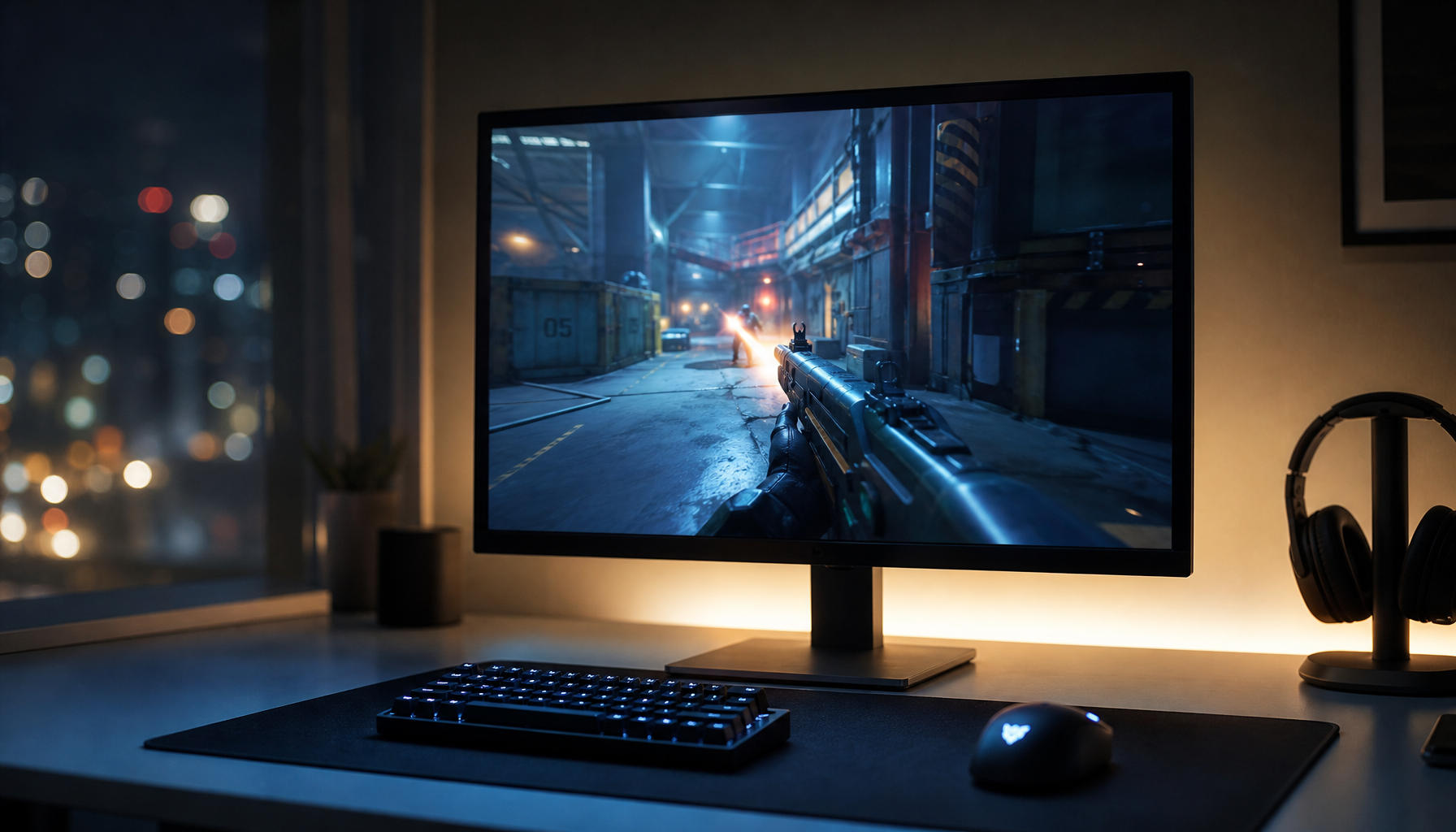
For those whose work blends design and motion content, the H27P3 offers practical flexibility. Purely text-based workflows may not need the 120 Hz mode, while hybrid users gain a monitor that adapts without swapping hardware.
Professional Color and Brightness Without the Studio Price Tag
Color accuracy remains critical for designers and photographers who need screen output to match print or client deliverables. A Delta E value below 2—commonly cited in professional monitor evaluations—means color differences are generally imperceptible to the human eye under standard viewing conditions. The linked guide What Delta E Values Actually Mean for Your Creative Work explains how these metrics translate to real editing reliability.
Ten-bit color support, whether through native 10-bit or 8-bit + FRC (Frame Rate Control), helps deliver smoother gradients and fewer banding artifacts in shadows or skies. The article What Does Bit Depth Mean, and How Does 8-bit Differ From 10-bit Display? breaks down the practical differences for creative applications. At 500 nits, a 5K panel like the H27P3 provides comfortable headroom for well-lit offices without the extreme brightness needed for HDR video mastering.
These specifications make such monitors viable for professional color work when paired with proper calibration. Results can still vary slightly between units, so using a colorimeter for final profiling is recommended for critical projects.
Choosing Your Workspace: When to Go 5K vs. High-Refresh 4K
Your choice should start with the dominant content type. Writers, coders, and layout designers who spend most of the day reading small text or aligning fine details usually benefit most from 5K's native sharpness and the resulting reduction in scaling overhead. The improved clarity can reduce eye strain over eight- or ten-hour sessions.
Hybrid creators who split time between static design and video timelines or occasional gaming may prefer the added versatility of Dual Mode on the H27P3 or a high-refresh 4K option such as the KTC 27" 4K 160Hz/320Hz 90W Gaming Monitor | H27P6. The latter maintains strong color performance while offering smoother motion when needed. If your workflow is almost entirely text-based, the 5K route is typically the clearer winner; mixed-motion users should weigh the refresh-rate advantage of 4K Mini-LED models like the M27P6 against the pixel-density edge of 5K.
Additional practical considerations include desk space, available ports on your Mac, and whether you plan to use a monitor arm for height adjustment—the H27P3 includes a basic tilt stand, so many users add VESA arms for ergonomic tuning. Testing scaling behavior with your specific applications before committing is the most reliable way to confirm fit.
Frequently Asked Questions
Is 5K resolution necessary for graphic design on a Mac in 2026?
For professionals who work extensively with vector graphics, small typography, or dense UI layouts, 5K at 27 inches continues to provide the most comfortable native scaling and reduced eye fatigue. Many designers find that once they experience true Retina sharpness, returning to fractional-scaled 4K feels noticeably softer. However, if your projects are primarily raster-based at web resolutions or you sit farther from the screen, a well-calibrated 4K panel with strong color accuracy can still deliver excellent results at a lower price point.
How does the KTC H27P3 handle macOS scaling compared to the Apple Studio Display?
Both support 5120×2880 resolution, enabling identical 2x integer scaling on compatible Macs. The primary differences appear in secondary ecosystem features rather than raw pixel mapping. The H27P3 relies on USB-C DisplayPort Alt Mode, which works reliably for video and power delivery but may require occasional cable reseating after sleep on certain Mac configurations. Users report that color and sharpness match expectations for creative work once calibrated.
Can a budget 5K monitor achieve professional color accuracy for print work?
Many current 5K panels, including the H27P3, ship with factory calibration targeting Delta E < 2 and 99% DCI-P3 coverage. When paired with a hardware colorimeter and tools like DisplayCAL, they can reach publication-grade accuracy for most graphic design and photography workflows. The key is verifying post-calibration performance rather than relying solely on box specifications, as panel lottery and ambient lighting still influence final results.
What are the main drawbacks of choosing a third-party 5K monitor over the Apple Studio Display?
The most commonly cited limitations are reduced Thunderbolt functionality (no daisy-chaining multiple high-resolution displays), a plastic or simpler metal stand instead of full aluminum construction, and occasional USB-C wake-from-sleep quirks that may require manual reconnection. Audio quality from built-in speakers is also typically lower. For users who value one-cable simplicity and premium materials above all else, the Studio Display may still be worth the premium; for those focused primarily on on-screen image quality, the trade-offs are often acceptable.
Should I buy a 5K monitor if I also do video editing and light gaming?
A dual-mode 5K display such as the H27P3 can be an effective compromise, letting you switch to 1440p at 120 Hz when motion smoothness matters more than maximum pixel density. If your video work involves fast timelines or you game regularly, a high-refresh 4K Mini-LED model like the M27P6 may ultimately provide a better balance of sharpness, contrast, and fluidity. Evaluate your time split: more than 70% static design work usually favors 5K, while balanced creative and motion work often suits versatile 4K options better.
How important is USB-C power delivery when selecting a 5K alternative?
For MacBook users, 90 W or higher USB-C delivery allows single-cable setups that keep the laptop charged during intensive work. Lower-wattage options may still function but could require a separate charger during heavy GPU loads. Confirm your Mac model's charging requirements and whether you already use a dock before deciding; many professionals find 65–90 W sufficient for typical creative applications.