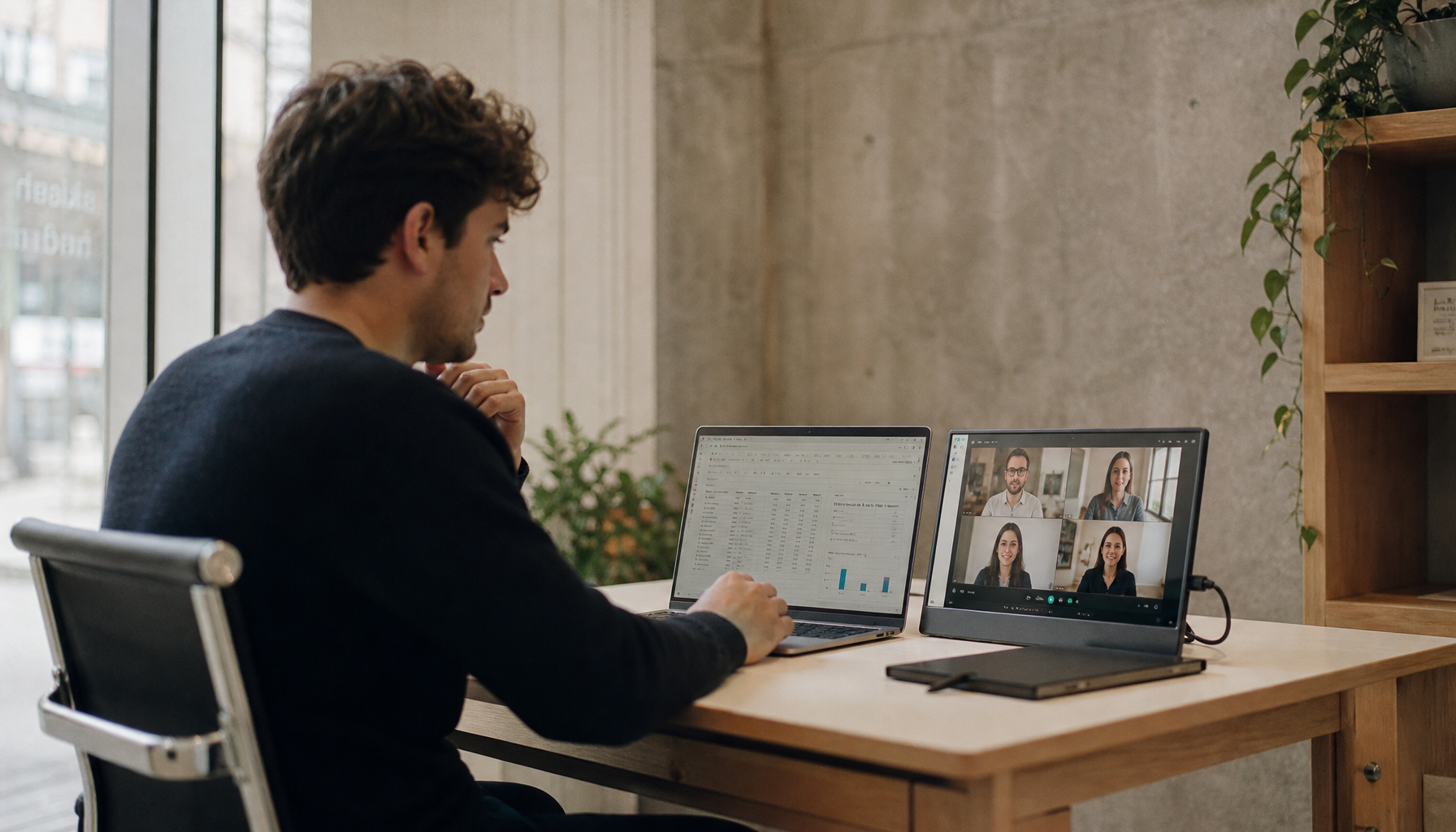
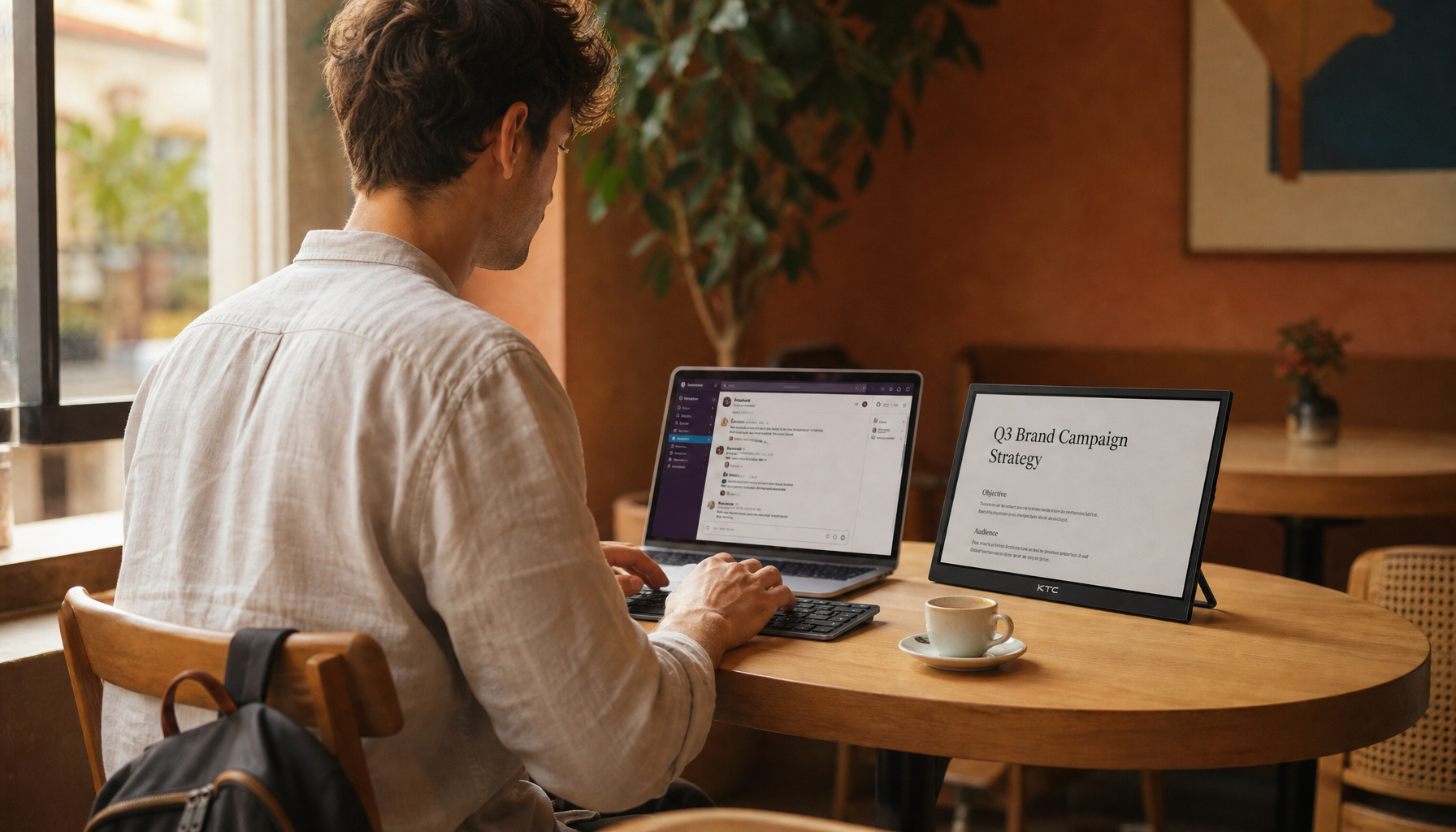
Portable monitor weight affects more than shoulder comfort; it determines whether your second screen becomes a daily productivity tool or a “nice idea” left at home. For frequent travelers, the best long-term carry usually sits around 1.5 to 2.0 lb, unless your workflow clearly justifies more weight.
Does your backpack feel fine at the airport but punishing after three terminals, a rideshare line, and a hotel check-in? A lighter 14- to 15.6-inch monitor can preserve the dual-screen workflow travelers buy these displays for without turning every commute into a load-management problem. The goal is to choose a monitor that still feels reasonable after months of travel, not just during one test pack.
Why Weight Becomes a Long-Term Carry Problem
A portable monitor is a lightweight external display that gives a laptop, tablet, cell phone, or console extra screen space while traveling. That sounds simple, but the real carry cost is not just the display panel. It is the monitor, sleeve, stand or cover, USB-C cable, HDMI fallback cable, charger, power bank, and the extra padding needed to keep the screen safe.
Travel-focused buying guidance often puts the weight breakpoints clearly: under 1.5 lb is best for frequent travelers, 1.5 to 2.5 lb balances portability and durability, and over 2.5 lb is better for stationary or feature-heavy setups. That aligns with the practical reality that a monitor may be technically portable but still too annoying to pack every day.
A frequent traveler should treat weight as a habit predictor. If the monitor adds 1 lb and connects with one USB-C cable, it is easy to justify on a three-day work trip. If the total kit adds 3 lb after the case and accessories, it starts competing with a charger, headphones, a water bottle, or a change of clothes.
The Backpack Math: Screen Weight Versus Carry Weight
A bare monitor spec can be misleading because backpacks carry systems, not product pages. A 1.4 lb display can become close to 2 lb after a protective sleeve, cable, and compact stand. A 2.3 lb touch monitor can approach 3 lb once you add a rigid case and power accessories.

Bare monitor class |
Real backpack effect |
Best fit |
Under 1.5 lb |
Feels genuinely travel-first when paired with a slim sleeve and one cable |
Weekly flyers, train commuters, digital nomads |
1.5 to 2.5 lb |
Noticeable but manageable if the stand is built in and the case is efficient |
Hybrid workers, hotel-desk users, creators |
Over 2.5 lb |
Often becomes desk-first once accessories are included |
Longer stays, gaming setups, dual-screen kits |
The hidden penalty is fatigue accumulation. One extra pound may not matter during a five-minute walk from car to lobby, but it changes posture over a 40-minute transit route. Frequent travelers also handle bags more often, so the weight repeats through airport security, overhead-bin lifts, coworking days, and hotel moves.
The carry-on context matters too. Common carry-on dimensions are about 22 x 14 x 9 inches, and carry-on weight limits can range widely from about 15 to 45 lb depending on airline and route. A monitor kit that seems small can still push a dense tech backpack toward discomfort or airline limits. For flights, portable monitors are generally better in carry-on baggage because checked bags face rougher handling, stacking, humidity, and theft risk, while carry-on baggage lets you control orientation and pressure.
The Best Weight Range for Frequent Travelers
For most frequent travelers, the sweet spot is a 14- to 15.6-inch portable monitor around 1.5 to 2.0 lb. This range usually gives enough screen area for spreadsheets, calls, references, code, slide decks, and travel gaming without making the backpack feel like a workstation crate.
A 15.6-inch 1080p USB-C portable monitor is often recommended as the budget-friendly workhorse because it matches common laptop sizing, keeps text readable, and avoids the bulk of larger screens. The practical benefit of a single USB-C cable is huge on the road because one compatible cable can carry both power and video, reducing setup time and accessory weight.

Lighter is not always better. Under 1.5 lb can be excellent for constant travel, but some ultra-light models rely on weaker stands, cheaper shells, lower brightness, or less rigid construction. If your travel includes packed trains, soft backpacks, or frequent overhead-bin handling, a slightly heavier model with a stable kickstand and stronger casing may be the more reliable long-term choice.
When Heavier Monitors Are Worth Carrying
A heavier portable monitor earns its place only when it materially changes your output. For creators, higher resolution, stronger brightness, better contrast, and wider color coverage can justify extra weight. For gamers, a larger 17-inch panel, 144Hz or higher refresh rate, adaptive sync, and low response time may create a more responsive and immersive setup than a basic 60Hz travel display.
Portable monitor buying criteria often include brightness, refresh rate, stand quality, connectivity, touch input, wireless use, and battery power. That matters because a lightweight design is only one part of usability; a flimsy cover stand can make a lighter monitor more frustrating than a slightly heavier one with a proper integrated kickstand.
The trade-off is clear. A heavier gaming or creative monitor can deliver smoother motion, sharper previews, better color, or more vertical workspace. The downside is more shoulder load, more power demand, more heat in a packed bag, and a higher chance you leave it behind on shorter trips.
Weight Also Changes Protection Strategy
A portable monitor that rides in a backpack needs rigidity more than bulk. Screen damage usually comes from flexing, corner impact, point pressure, scratches, vibration, and compression. The heavier the monitor, the more important it becomes to stop movement inside the bag because mass increases the force of every bump and drop.
A good travel setup puts the monitor vertically in a padded laptop compartment, parallel to the laptop, with the screen facing inward. Hard accessories should live elsewhere. Chargers, power banks, mice, books, bottles, and HDMI adapters can create pressure points that press directly into the panel during transit.

Practical screen protection guidance is straightforward: a screen protector can reduce scratches and minor impacts, but it does not solve pressure damage. A sleeve or hard shell case with shock-absorbing padding, soft lining, secure closure, and separate accessory pockets does more for daily backpack travel than a protector alone, especially when portable monitors are carried beside hard objects.
The Ergonomic Cost: Your Back, Shoulders, and Setup Behavior

The biggest long-term effect of weight is behavioral. If the monitor makes the backpack feel overloaded, you will start optimizing around not carrying it. That defeats the productivity purpose.
Hybrid-work research on portable multi-screen setups argues that the benefit is not just display quality but reduced window switching and better simultaneous visibility. Yet the same logic points to a hard limit: if mobility cost, setup friction, cables, and power burden are too high, the display stops functioning as daily productivity infrastructure and becomes occasional gear. The productivity logic only holds when the screen actually travels with you.
Use a simple personal test. Pack your laptop, charger, water, headphones, normal travel items, and the full monitor kit. Carry it for 20 minutes, then set it up on a small table in under two minutes. If either step feels annoying, the kit is too heavy, too complicated, or both.
Choosing the Right Weight by Traveler Type
A weekly flyer who works mostly in email, documents, dashboards, and calls should prioritize a 14- or 15.6-inch 1080p monitor under 2 lb with USB-C video and power. A hybrid worker who spends full days in hotel rooms can tolerate closer to 2.5 lb if the screen is brighter, the stand is better, and the display area improves real work.
A mobile gamer should decide whether performance is worth the carry cost. High refresh rates such as 120Hz, 144Hz, or higher can improve responsiveness, but they matter most when the laptop, console, or handheld can actually drive that frame rate. A creator should be more willing to carry extra weight for color accuracy, 2K or 4K resolution, and brightness, but only if the work requires precise visual judgment away from the desk.
For travel-first buyers, KTC’s use-case guidance is the right lens: start with weight, slim design, easy packing, simple setup, and adequate brightness before chasing refresh rate. A 15.6-inch travel monitor around 1.4 lb and about 0.5 inches thick shows why travel buyers should evaluate the whole kit, not just the screen spec.
Practical Buying Rules for Long-Term Backpack Carry
Choose the lightest monitor that still meets your real workflow, not the lightest monitor on the shelf. For general productivity, 15.6-inch 1080p remains the efficient standard because it balances readability, price, power use, and bag fit. For frequent flights, a 14-inch model can be the better move because every ounce counts and tray-table space is limited.
Check dimensions, not just diagonal size. A monitor’s bezels, stand design, case, and cable placement determine whether it fits cleanly beside a laptop. Also confirm USB-C video support on your laptop, because a USB-C-shaped port does not guarantee video output. HDMI fallback is useful when you move between older laptops, consoles, streaming devices, and docks.
Brightness is worth weight when you work in bright rooms. Around 300 nits is a practical indoor baseline; lower brightness can make you lean forward, raise display brightness, drain more power, and still struggle near windows. For long sessions, that visual strain may feel worse than carrying a few extra ounces.
FAQ
Is a 2.5 lb portable monitor too heavy for travel?
It is not too heavy for occasional travel or hotel-desk use, but it is near the upper edge for daily backpack carry. Once you add a case, cables, and possibly a charger, the full kit can feel closer to a desk-first setup.
Should I choose a smaller screen just to save weight?
Only if the smaller screen still improves your workflow. A 14-inch monitor can be excellent for frequent flyers, while a 15.6-inch screen often gives a better balance of readability and portability for most remote workers.
Does a built-in battery help or hurt backpack carry?
It can reduce cable clutter, but it usually adds weight. For frequent travelers, battery value depends on whether you often work away from outlets; otherwise, USB-C power from a laptop or charger may be lighter and simpler.
Is a heavier monitor more durable?
Not automatically. Weight can come from a stronger chassis, a better stand, a battery, touch hardware, or simply inefficient design. Look for rigid construction, a stable stand, protected corners, and a case strategy rather than assuming weight equals toughness.
Final Carry Judgment
Portable monitor weight affects long-term backpack carry by shaping comfort, packing risk, setup friction, and whether you actually use the screen every trip. For most frequent travelers, a 1.5 to 2.0 lb monitor with a rigid sleeve, simple USB-C setup, and enough brightness is the performance-driven sweet spot: light enough to carry, capable enough to earn the space.