A smaller monitor can help competitive players react more comfortably by keeping more of the action within view. The real gains come from pairing the right screen size with strong refresh rate, motion clarity, and frame rate.
A smaller monitor can improve competitive gaming performance for many players, but not because smaller screens are inherently faster. The real advantage is that a 24-inch to 25-inch screen keeps more of the action inside your natural field of view, which can make tracking, snapping, and scanning feel cleaner in fast shooters.
If you lose a duel and feel like the enemy was there but your eyes got there a fraction too late, that fraction matters. In competitive play, the biggest gains usually come from keeping the whole fight easy to read while pairing your screen with genuinely high refresh performance. That makes it easier to choose between 24-inch, 27-inch, and larger displays without guessing.
Why smaller screens often feel faster in esports
For competitive FPS games, the strongest pattern across buying guides is that 24-inch to 27-inch monitors for gaming genres are the preferred range because they keep more of the match visible at once. In practice, that means less eye travel from your crosshair to the minimap, from a doorway to your health bar, or from one edge of a peek angle to the other. The difference players usually notice first is not raw speed from screen size itself, but less visual effort to stay locked in.
That matters most in games like CS2, Valorant, Fortnite, and Apex Legends, where you are constantly reading peripheral information while keeping your aim centered. A 32-inch display can look spectacular, but if you sit close, the edges demand more eye movement and sometimes head movement. On a 24-inch or 25-inch monitor, the same information is compressed into an easier scan, which helps many players maintain a faster visual rhythm in repeated fights.
There is a limit, though. A screen can also be too small. If target detail becomes harder to read, especially in battle royale or mixed-distance shooters, you may give back some of the advantage. That is why 24-inch to 27-inch remains the practical zone rather than turning smaller is always better into a rule.
Size does not work alone; refresh rate and frame rate do the heavy lifting
Many players blame monitor size when the real bottleneck is refresh rate, motion clarity, and system performance. One useful comparison is that 144Hz updates every 6.94 ms, while 240Hz updates every 4.17 ms. That roughly 2.77 ms gap is small on paper, but in fast shooters it can translate into cleaner tracking and less perceived latency when the rest of the system is equally fast.
This is where many desk setups go wrong. A player moves from a 27-inch 1440p monitor to a 24-inch screen and reports better performance, but the improvement may actually come from switching to a 240Hz panel, getting lower motion blur, or moving to easier-to-drive 1080p. Size helps comfort and scanning, but the real competitive edge comes from the whole display stack working together.
The most reliable tournament-style configuration is still a modest screen size with aggressive motion specs. If your PC can hold close to 240 fps, a 24-inch or 25-inch 1080p 240Hz display or better makes technical sense. If your system stays closer to 144 fps, a high-quality 144Hz to 180Hz monitor often gives better value and more consistent results than chasing a 240Hz label you cannot fully use.
The real decision: 24-inch, 27-inch, or larger?
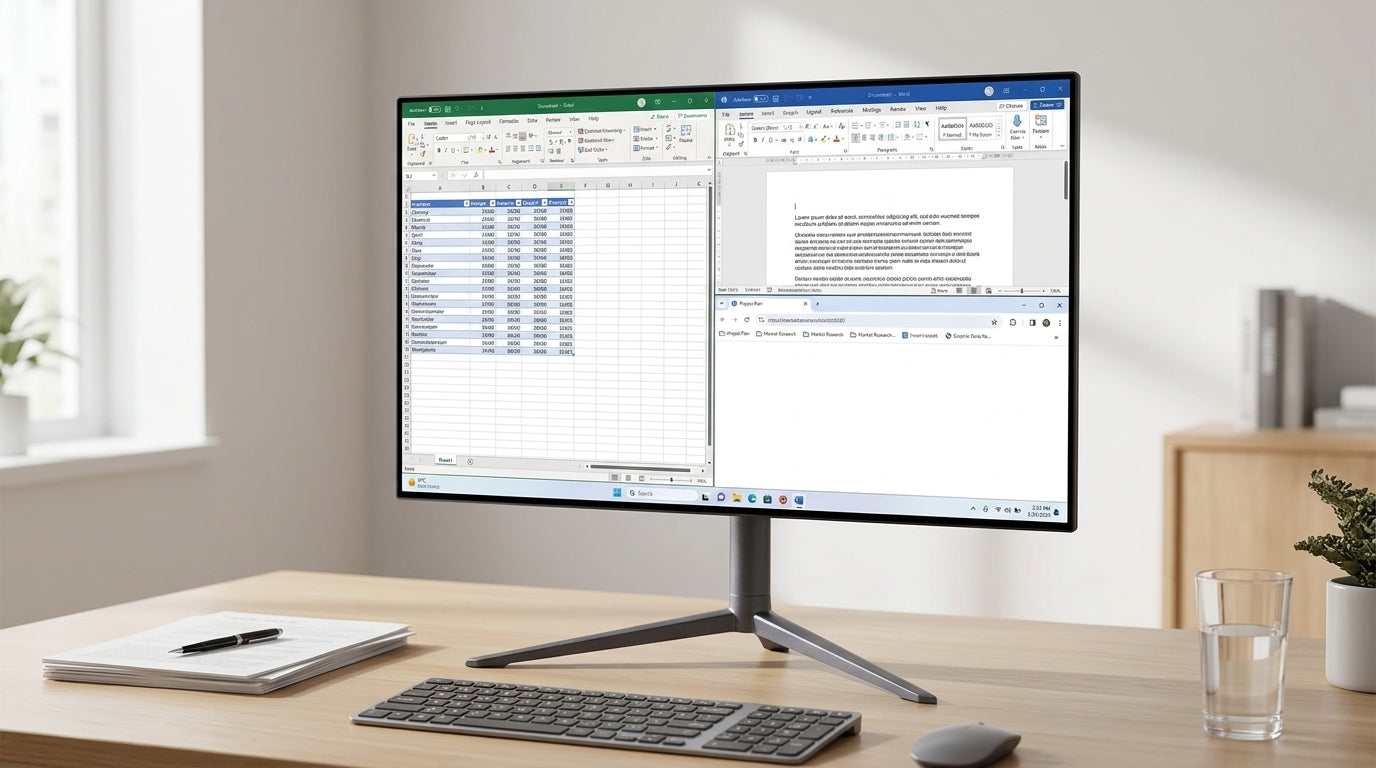
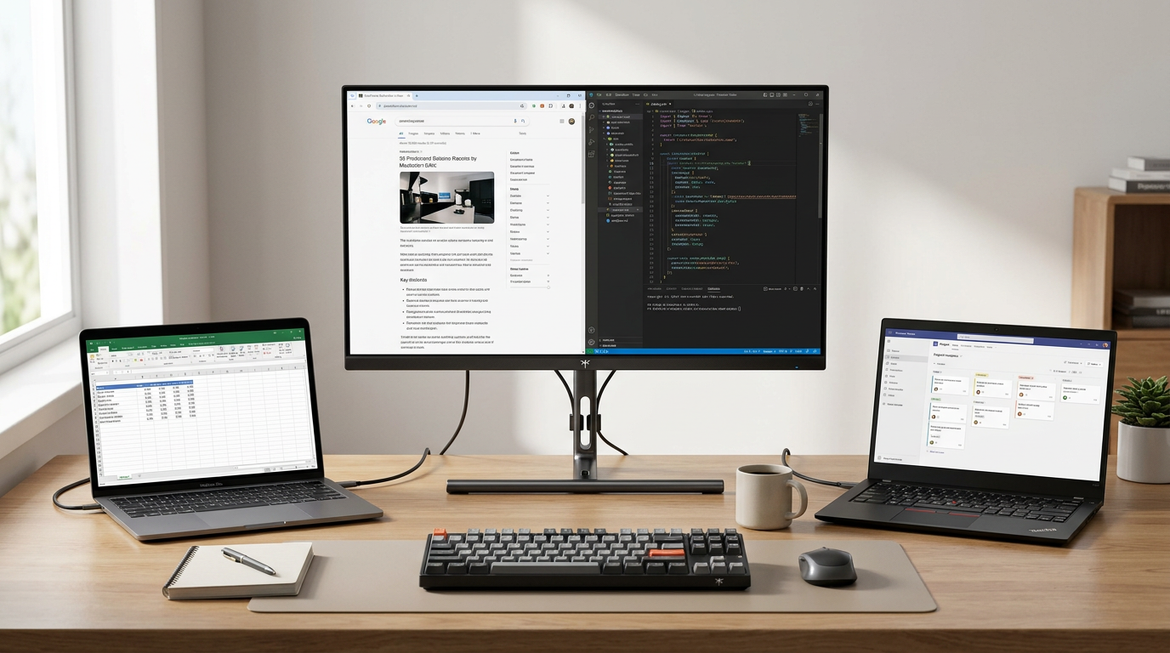
The best answer depends on what you play, how far you sit from the screen, and whether your desk gives the monitor enough space. Competitive players often sit fairly close, which favors a tighter display. Mixed-use players usually want more image area for work, streaming tools, chat windows, browser tabs, or story-driven games. That is why one size can feel ideal in ranked play and awkward everywhere else.

Screen size |
Best fit |
Competitive upside |
Main tradeoff |
24 to 25 inches |
Ranked FPS, fighting games, close seating |
Easy full-screen scanning, strong focus, less visual travel |
Lower immersion, less workspace |
27 inches |
Mixed gaming, esports plus productivity |
Still fast enough for most players, more detail at 1440p |
Slightly more eye travel in tight shooters |
32 inches and up |
RPGs, sims, racing, multitasking |
Big image, more immersion, easier side-by-side windows |
Usually worse for close-range competitive focus |
For gaming monitors by game type, KTC reaches a similar conclusion: shooters benefit from 240Hz or higher, low response times, adaptive sync, and often 1080p, while larger and higher-resolution displays make more sense for RPGs, strategy, and sims. That matches real-world use. A player who grinds ranked six nights a week should not shop the same way as someone splitting time between Warzone, spreadsheets, and single-player RPGs.
When a 27-inch monitor is actually the better competitive choice
It is easy to overcorrect and assume the smallest display is automatically optimal. In reality, 27 inches can be the smarter pick if you want sharper 1440p visuals, better mixed-use value, and enough speed for serious play. Many current gaming displays now combine 27-inch panels with extremely high refresh rates, including 360Hz, 480Hz, and 500Hz-class esports monitors.
That matters because modern 27-inch monitors are no longer slow, oversized screens. They can be extremely fast. Recent coverage has highlighted 27-inch QHD models at 280Hz, 360Hz, and 500Hz, and a 27-inch 500Hz OLED esports monitor has been named a top current pick. If you want one display for competitive play and everything else on your desk, 27 inches is often the sweet spot because it gives you room without the sprawl of a 32-inch panel.

The caveat is discipline. A 27-inch screen works best for competitive gaming when you place it at a sensible distance and avoid under-speccing it. A 27-inch 1080p panel can look soft at close range, while a 27-inch 1440p panel tends to feel much cleaner. If you go with 27 inches, it should usually be because you want the extra resolution, not just the extra diagonal size.
Definitions that actually matter when choosing
Refresh rate is how many times the monitor updates the image each second. Higher refresh rates usually improve smoothness and reduce the blur you perceive during fast movement. Response time is how quickly pixels change color; lower response times reduce trailing and smearing. Adaptive sync aligns the monitor with the GPU’s frame output to reduce tearing and stutter, which is especially useful when frame rate fluctuates.
Panel type also shapes the experience. One explanation of IPS and OLED gaming monitor performance notes that IPS is a strong competitive choice because it balances fast response with good color and viewing angles, while OLED pushes response times and contrast even further for premium buyers. In plain terms, if you are choosing for pure ranked performance, size should come after refresh rate, response behavior, and whether your hardware can maintain the target frame rate.
A simple way to choose without overthinking it
If your only goal is competitive advantage in shooters, a smaller monitor usually helps when it keeps the whole image easy to scan and lets you buy higher refresh at a realistic price. That is why 24-inch to 25-inch displays remain so common in esports-style setups. They are efficient, focused, and easy to place on a shallow desk.
If you want one monitor for gaming, work, and everyday use, a 27-inch 1440p panel is often the smarter long-term purchase. You lose a little of that compact tournament feel, but you gain sharper visuals, more usable space, and a better all-around experience. Current gaming monitor recommendations reflect that split clearly: smaller screens still dominate value and speed-first picks, while 27-inch models increasingly own the premium middle ground.
The strongest setup is not the smallest screen. It is the screen size that lets you see everything quickly, sit comfortably, and sustain the frame rate your panel was built to show. For pure competitive focus, that usually means smaller. For most real desks and real workloads, it means staying small enough to remain fast and large enough to stay useful.