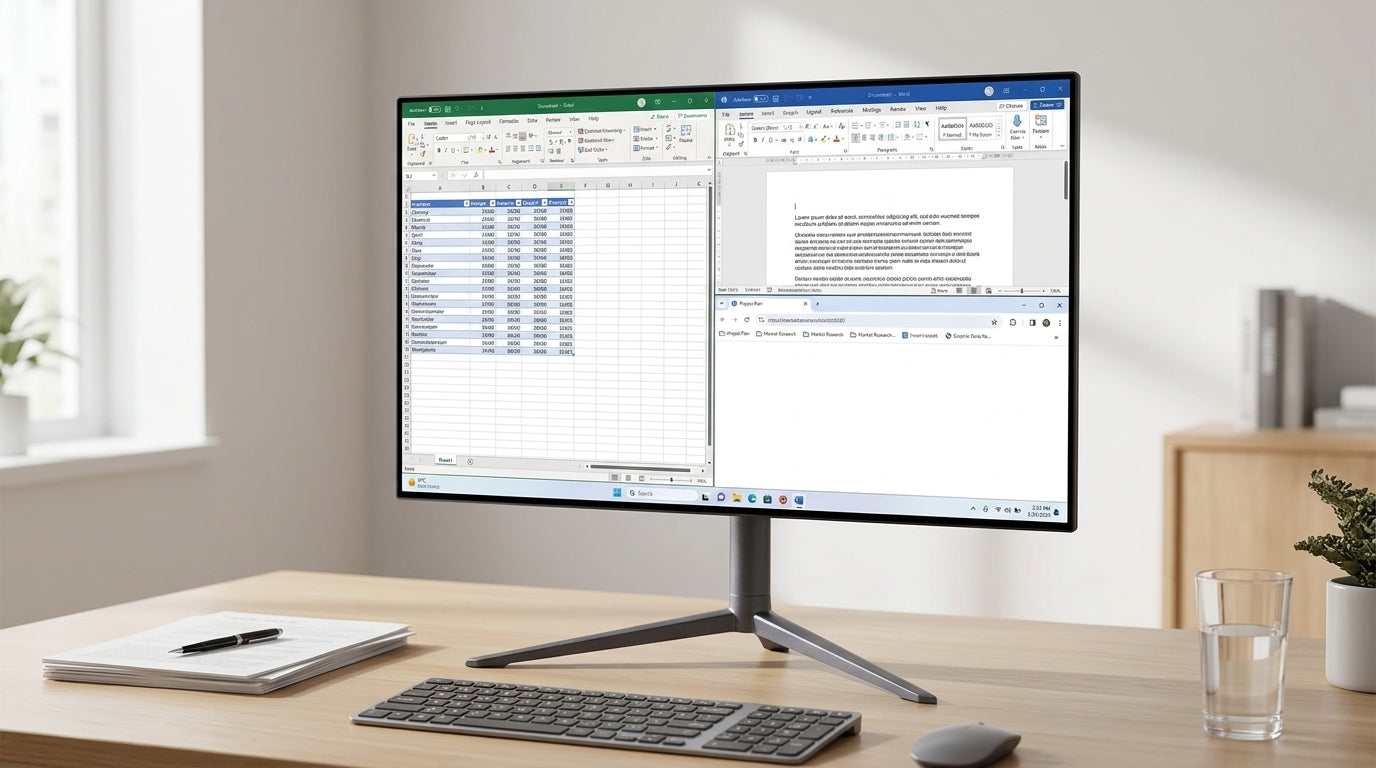
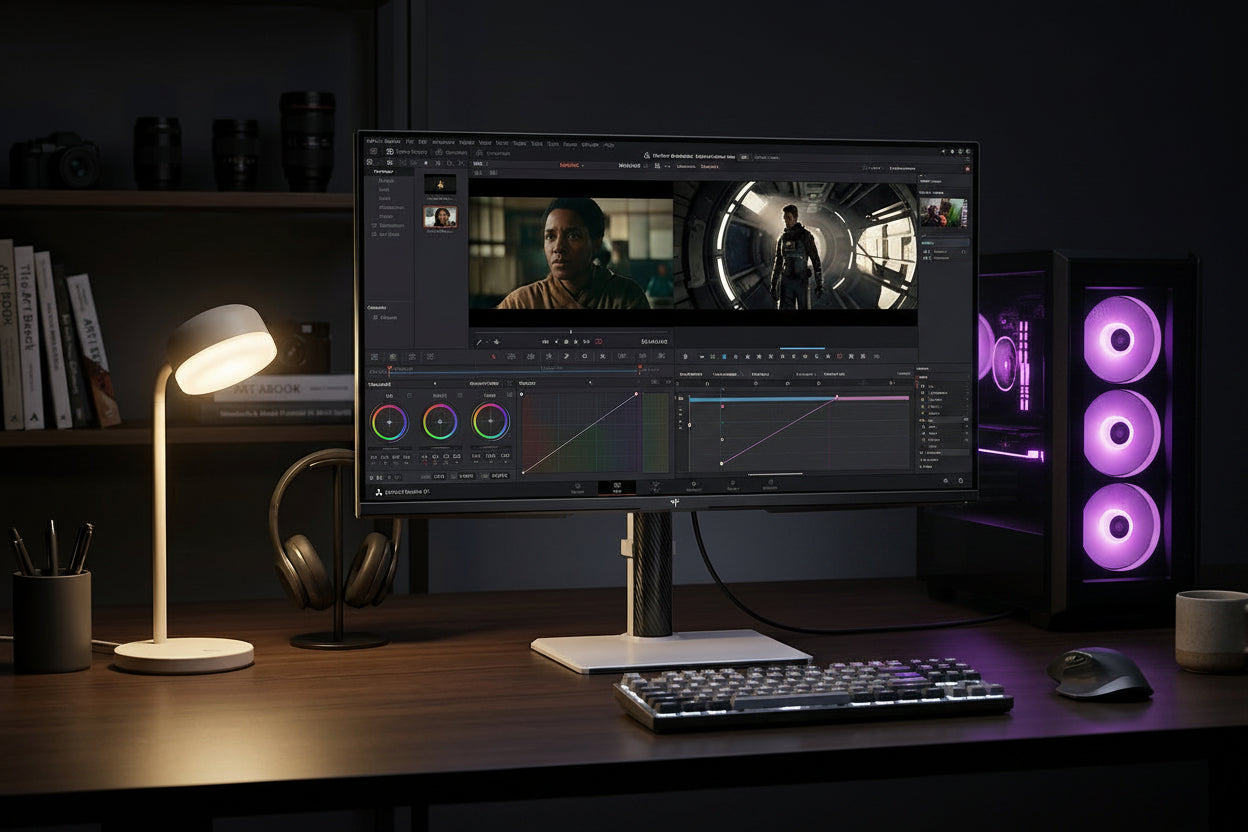
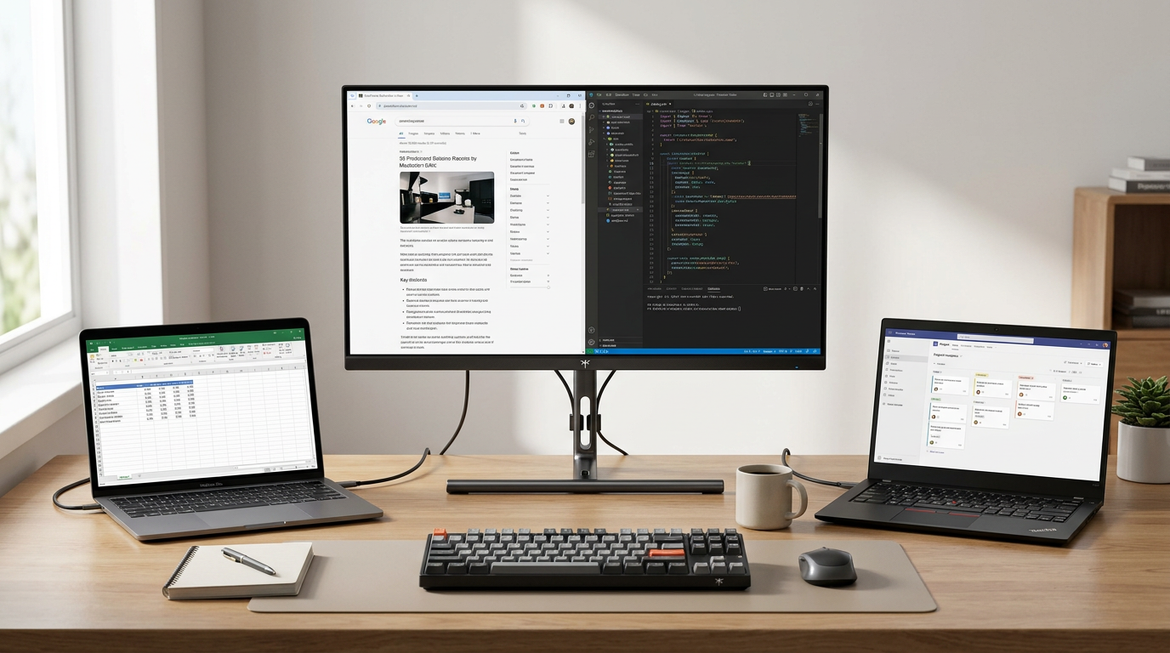
OLED monitor productivity is a trade-off decision, not a universal upgrade. For spreadsheets, email, documents, and browser work, the main questions are text clarity, long-day comfort, and how much static UI sits on screen. If your desk is mostly fixed office windows, OLED may still be appealing, but it is not the safest default. If you want the lowest-hassle work monitor, IPS or Mini-LED can be the more predictable fit.
What Office Buyers Need From OLED
Office buyers should judge OLED by how it handles text, glare, and repeated static panels, not by gaming hype. In a workday built around spreadsheets, email, documents, and chat, the best panel is the one that stays comfortable and legible for hours. OLED can look excellent, but it is still a trade-off against the habits of your desk.
A useful way to think about it is this: if you want richer contrast and you move between mixed content, OLED can be attractive. If you leave the same interface elements up all day, a more conventional office monitor often feels safer. If you want to browse a broader office-first path, the Office Monitor collection is the cleaner starting point than a gaming-first lineup.
Text Clarity for Documents and Spreadsheets
For office work, text clarity depends on pixel density, scaling, and app support more than panel type alone. That means an OLED can look sharp in one setup and less comfortable in another, even when the panel is technically very good. KTC's display scaling and perceived sharpness guidance makes the same basic point: the same monitor can feel clearer or softer depending on how the operating system and apps render it.

The practical check is simple. If you spend most of your day in dense spreadsheets, dashboards, or long documents, look at how the text behaves at your actual scaling setting, not just in a product photo. A high-resolution office IPS like the 27-inch 4K home and office monitor gives you a useful baseline for comparison because 4K on 27 inches generally gives you more text density to work with.
OLED can still be a strong fit when your work is mixed and you value high contrast, especially on dark interfaces. But if your eyes are sensitive to text edge behavior, the right resolution and scaling matter more than the OLED label itself.

A simple decision sentence: if your main job is reading and editing text all day, OLED is worth considering only when the resolution and scaling feel comfortable in your real apps. If the text looks distracting during normal use, the panel type stops mattering and the setup is the problem.
Eye Comfort During Long Workdays
Comfort is usually about brightness, glare, viewing distance, and room lighting more than blue-light language. That is why office buyers should not assume a high refresh rate automatically means easier eye comfort. A smoother scroll can feel nicer, but it does not fix a screen that is too bright for the room or poorly placed near a window.
KTC's eye-strain guidance frames comfort in the same practical way: flicker behavior, brightness, and glare matter more than vague blue-light claims. That matters for OLED productivity because a monitor that looks beautiful in a dim demo can still feel harsh in a bright home office.
What to check before you buy: can the display dim low enough for your room, does the stand let you set a comfortable height, and does your desk face windows or overhead lights? If the room is bright and reflective, the comfort gap between OLED and a conventional office panel can narrow fast. In that case, an office-oriented IPS with a more predictable setup may be the calmer choice.
Refresh rate is a separate question. A higher refresh rate can make cursor movement and scrolling feel smoother, but it is not a substitute for good desk lighting or a sane brightness setting. For most office buyers, that distinction matters more than the number on the spec sheet.
Static UI Risk and Desk Habits
This is the section that usually decides the purchase. If your day is mostly spreadsheets, email panes, browser chrome, taskbars, and chat windows that stay on screen for hours, OLED is a cautious choice rather than an automatic one. The risk signal is the work pattern, not just the panel label.
A useful filter is to separate three desk habits:
- Low static exposure: mixed content, frequent app switching, video, and varied layouts.
- Moderate static exposure: office apps most of the day, but with regular changes in windows and content.
- High static exposure: fixed spreadsheets, dashboards, and the same interface blocks on screen for long stretches.
If you are in the high-static group, the lower-risk path is often a Mini-LED or office IPS setup. KTC's Mini-LED productivity guidance presents Mini-LED as the safer pick for long static UI sessions, and that is the right kind of comparison for office buyers.
A key decision sentence: OLED is a better fit when your screen changes often; it is a weaker fit when the same office layout stays up for most of the day. Warranty and trial periods can reduce regret, but they do not change the basic desk habit question.
Which Office Traits Matter Most
For office productivity, the traits below matter more than gaming specs. Use them as a quick filter before you get distracted by refresh rate or response-time marketing.
| Office trait | Why it matters for productivity | What to look for | When to skip OLED |
|---|---|---|---|
| Resolution and pixel density | This shapes text sharpness in spreadsheets and documents | A resolution and size combo that feels crisp at your normal scaling | If text looks soft or tiring in your real apps |
| Brightness and glare control | This affects comfort in bright rooms and near windows | Enough brightness control for your desk lighting and reflections | If your office is bright and reflective most of the day |
| Static UI exposure | This is the main fit question for OLED in office use | How long the same taskbar, sheet, or dashboard stays visible | If your workflow is mostly fixed-office windows |
| Stand and connectivity | This affects setup comfort and daily convenience | A stable stand, the ports you actually need, and laptop charging if useful | If the monitor forces awkward desk posture or cable workarounds |
| Warranty and returns | This lowers downside, especially for cautious buyers | A return window or trial that gives you time to test real apps | If you are buying blind without a practical way to evaluate the panel |
For a concrete OLED example, the G27P6 lists 27-inch 2560×1440 OLED, 240Hz, 0.03ms GTG, 450 nits peak brightness, 65W USB-C charging, a 3-year warranty, and a 30-day risk-free trial. Those are useful context clues, but they do not by themselves prove it is the right office monitor for you. The office question still comes back to text comfort, desk lighting, and how static your UI really is.
A practical reading of the table: if you want a premium screen and your workday is mixed, OLED can make sense. If you want the easiest all-day office setup, resolution plus glare control plus a low-static workflow usually matter more than panel type.
A Practical Shortlist for Office Buyers
- Check your real workload first. If your day is mostly static spreadsheets and email, OLED monitor productivity is a cautious fit at best.
- Test text in the apps you actually use. If scaling and text edges feel comfortable, OLED stays in the running.
- Look at your room. Bright windows and glare push the decision toward a more conventional office panel.
- Compare the downside protection. A trial or return window helps, but it should not be treated as burn-in immunity.
- If you still want OLED, keep it as a mixed-use premium option. If you want the safer desk choice, an IPS or Mini-LED office monitor is usually easier to live with over time.
FAQs
How Can I Tell If OLED Is Good for My Office Workflow?
Ask one question: how static is your day? If you spend most of it in documents, spreadsheets, and email panes, OLED is a more cautious choice. If you also do a lot of mixed content, creative work, or video, it becomes easier to justify. The best sign is whether the screen feels comfortable in your actual apps, not in a demo photo.
What Should I Check Before Buying an OLED Monitor for Work?
Check resolution, scaling behavior, stand flexibility, brightness control, and return terms. For office use, the monitor has to fit your desk first, then your apps. If the panel is only comfortable at one awkward scaling setting, or if your room creates heavy glare, that is a real warning sign.
Can OLED Be a Bad Choice for All-Day Spreadsheets and Email?
Yes, it can be a poor fit when the same interface stays up all day. That does not mean every OLED monitor is unsuitable, but it does mean the workflow matters more than the spec sheet. Buyers who want a lower-hassle option often do better with an office IPS or Mini-LED model.
Why Do Some Office Documents Look Softer on Certain OLED Monitors?
Because perceived sharpness depends on pixel density, scaling, and app support. Two monitors can both be excellent and still feel different in text-heavy work. If documents look softer than expected, the first thing to check is your OS scaling and the resolution-to-size match.
What Is the Safest Alternative If I Decide OLED Is Not Right for Office Work?
An office-oriented IPS or Mini-LED monitor is usually the safer fallback. Those panels are easier to recommend when your desk is mostly static and you want predictable text behavior. If your goal is simply solid office productivity, that is often the lower-regret path.
Final Takeaway
OLED monitor productivity comes down to fit, not hype. If you split your day between documents, browsing, and mixed content, OLED can be a premium option worth testing. If your workday is mostly static spreadsheets, email, and dashboards, a conventional office IPS or Mini-LED monitor is usually the easier buy. Start with your workflow, then your room lighting, then the panel. If you are still unsure, compare an OLED candidate against a purpose-built office monitor before ordering.