Education and startup buyers should treat the KTC monitor education bulk purchase guide as a procurement decision, not a consumer shopping list. The cheapest monitor is not always the lowest-risk choice when you are standardizing classrooms, labs, or office desks. Start with fit, warranty logistics, panel consistency, and total cost of ownership, then decide whether any KTC model is actually a sensible fleet candidate.

Why Bulk Monitor Buying Needs a Different Lens
For bulk purchases, the real question is not "Which monitor looks good on a spec sheet?" It is "Which monitor creates the least support work after rollout?" That is especially true for schools, higher-ed teams, and startups that have to place, label, receive, and sometimes replace many units at once. The KTC monitor education bulk purchase guide is useful only if it helps you rule options in or out quickly.
A consumer buyer can tolerate a little setup friction. A procurement team usually cannot. If a model needs extra adapters, awkward cabling, or a lot of hand-holding during receiving, the hidden labor can erase a price advantage.
A practical rule: if you would not want to troubleshoot the same issue across 20 or 50 desks, it is probably not a good fleet choice. That is why the first pass should focus on buyer fit, not model names or marketing claims.
Match the Monitor to the Deployment
Use the deployment first, then the spec. That order matters because classroom, lab, and office needs do not line up perfectly, even if the monitors all sit on the same purchasing form. If you want a category starting point, the Office Monitor collection is a better browse path than a single spec sheet, and the 27 inch Monitors collection is a useful size filter when you already know the room layout.

| Deployment | Best Fit Signal | What It Means In Practice | Check Before Buying |
|---|---|---|---|
| Classroom | Simple connectivity, durable receiving workflow, easy swaps | Shared rooms need fewer surprises and fewer cable mismatches | Confirm source device mix, port types, and who handles first failures |
| Lab or library | Consistent image behavior and easier asset control | Uniformity matters because students notice mismatched screens quickly | Sample-test a few units and check panel consistency on arrival |
| Office desk | Text clarity, desk depth, and long-session comfort | Admin and staff work is usually more about readability than speed | Check desk space, posture needs, and whether 27 or 32 inches fits better |
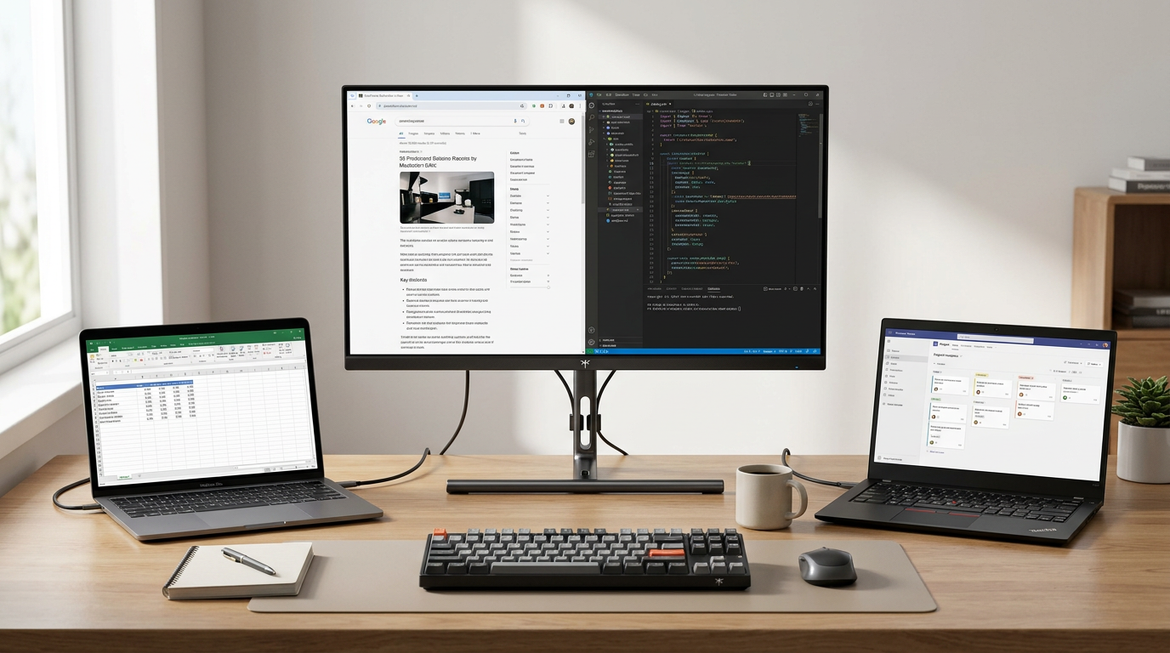
| Shared startup station | Mixed tasks, moderate multitasking, low admin overhead | One model can work, but only if it fits most desks and endpoints | Verify cables, adapters, and whether the same model suits all teams |
For classrooms and shared labs, the safest choice is usually the model that is easiest to support, not the one with the most aggressive spec. That is where a stable office monitor line often makes more sense than a gaming-first product.
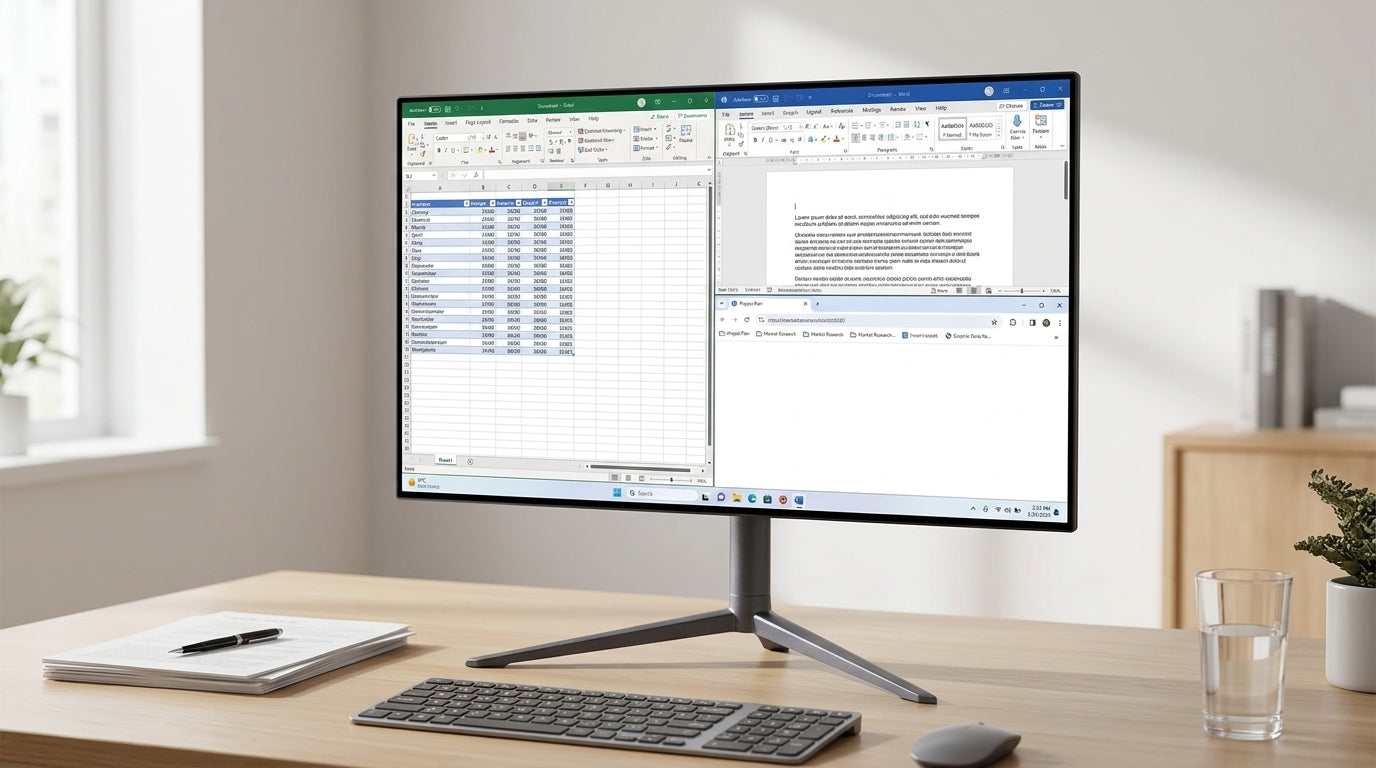
For office and admin workloads, a 27-inch 4K display can be a strong text-first option, while a 32-inch 2K display can feel more spacious for spreadsheets or side-by-side windows. The choice flips when the desk is shallow, because a larger screen can become awkward if users sit too close.
If you need a quick comparison for how procurement fit changes by scenario, the matrix below is best read as a decision aid, not a performance ranking.
| Scenario | Better Starting Point | Why It Usually Fits | What to Confirm |
|---|---|---|---|
| Classroom | Office-oriented 27-inch model | Easier to support and less likely to overcomplicate daily use | Ports, cabling, and swap workflow |
| Lab or library | Office-oriented 27-inch or 32-inch model | Uniformity and readability matter more than speed | Panel consistency on arrival |
| Office desk | 27-inch 4K office model | Strong text clarity for fixed desks | Desk depth and user comfort |
| Shared startup station | 32-inch 2K larger-workspace model | More room for multitasking and side-by-side windows | Endpoint mix and physical footprint |
Compare Ownership Costs Before You Commit
Sticker price is only one line in the budget. For bulk monitor orders, power settings, refresh-cycle timing, shipping, returns, and replacement handling can all affect the real cost. The EPA notes that schools can save meaningfully when monitors are configured to sleep after short periods of inactivity, which is why power management belongs in the TCO conversation, not the afterthought pile. EPA school energy guidance
Intel's TCO framework also makes the broader point: older hardware can look cheaper at purchase time but become more expensive once help-desk calls and break-fix work rise. In practice, that means bulk buyers should think in refresh cycles, not just unit price. Intel's TCO white paper
| Buyer Factor | What It Affects | Why It Matters In Bulk | What To Verify |
|---|---|---|---|
| Purchase price | Up-front budget | A low unit price can be offset by more support work later | Compare the model against the whole rollout budget, not just list price |
| Power management | Long-run utility cost | Sleep settings can matter across many units and many hours | Confirm default power behavior and whether IT can standardize it |
| Shipping timing | Installation schedule | Delays can push a room refresh past the date you promised | Check shipping windows, receiving hours, and damage handling |
| Return window | Early defect recovery | A short window can raise risk if receiving is staggered | Confirm the return clock starts at ship date or delivery date |
| Warranty handling | Replacement workflow | A long warranty is only useful if the claim path fits your process | Verify who takes first contact and what proof is required |
| Replacement friction | Downtime and labor | A "simple" swap can still consume staff time at scale | Ask how defective or dead-on-arrival units are reported and replaced |
| Installation labor | Internal rollout cost | Unpacking, labeling, and desk setup can cost real staff hours | Estimate time per unit, especially if stands or cables are inconsistent |
A useful decision sentence: if the rollout is small and the desk setup is simple, a lower-priced monitor can be fine; if the rollout is large or the receiving process is messy, the cheaper choice can become the more expensive one. That is why the KTC monitor education bulk purchase guide should always include ownership cost, not just hardware specs.
Where KTC Fits in a Bulk Purchase Plan
KTC fits best when you already know the deployment and want a model that matches it without overbuying. For office and admin desks, the KTC 27-inch 4K office model is a natural first example because the supplied facts support a 27-inch 4K IPS layout, 60Hz refresh, 3-year warranty protection, and 30-day returns. That makes it a reasonable check-before-buying option for text-heavy workstations, faculty offices, and other fixed desks where sharpness matters more than motion speed.
The same product is less compelling if your buyers expect flexible height adjustment or a fast-refresh workflow across shared desks. In that case, the spec fit depends more on the room and the endpoints than on the brand name.
For larger workspaces, the KTC 32-inch 2K option gives you a different trade-off: a 32-inch WQHD IPS panel, 100Hz native refresh with 120Hz overclock support, 3-year warranty protection, and 30-day returns. That can suit shared desks or office users who want more on-screen space without jumping to 4K. The overclock mode is worth verifying, but it should not be the deciding factor unless your team actually benefits from it.
A clear boundary helps here: warranty length and return policy do not prove institutional-grade support. They are still useful details, but they should be treated as verification points, not as a guarantee that fleet replacements will be painless. If you need a deeper arrival-day QC step, keep the KTC monitor panel inspection checklist nearby and use it on the first sample units.
If the room leans toward competitive gaming or fast-motion use, that is a different procurement question. The esports monitor specs guide is better suited to those thresholds than a general office rollout plan.
Verify Warranty, Returns, and Support
Before you place a volume order, confirm the process, not just the promise. Education and startup buyers should know who receives the first defect report, how damaged-in-transit units are handled, and whether the claim path changes when the order size changes. The U.S. Department of Education's acquisition guidance is a useful reminder that procurement should explicitly address security, privacy, and operational requirements where relevant. U.S. Dept. of Education acquisition standard
Use this checklist before approval:
- Confirm the return window and whether it starts at shipment or delivery.
- Ask who handles DOA and damaged-in-transit cases.
- Verify whether packaging must be retained for returns or warranty claims.
- Record serial numbers before the units go to desks.
- Separate any protection plan from the base warranty so they are not confused.
- Test at least one sample unit before the full rollout.
If a monitor looks like a bargain but the claim process is unclear, that is a reason to pause. For bulk buyers, support logistics are part of the product.
Roll Out the Fleet Without Surprises
A clean rollout is mostly about discipline. Unbox a pilot batch, check the panels, verify ports and cables, label the assets, and confirm that the room layout works before the full install. If the sample units pass, you can move with more confidence; if they do not, you save yourself a larger receiving headache.
A practical sequence is simple:
- Lock the final model mix.
- Verify source-device compatibility.
- Inspect sample units on arrival.
- Record serial numbers and asset tags.
- Test the most common desk setup first.
- Expand only after the pilot is stable.
If you are deciding whether to buy from KTC at all, this is the right moment to compare office-oriented models and any discounted options that still match your deployment. The goal is not to find the fanciest screen. It is to avoid a rollout that creates extra work on day two. For arrival-day QC, the panel inspection checklist is a practical follow-up, and discounted options can be worth a last-pass review if they still fit the room.
Final Takeaway
For schools and startups, the KTC monitor education bulk purchase guide should lead with fit, not hype. The H27P27 is the cleaner office-style example, while the H32D6 is the more spacious option when desks and workflows need it. Verify support, returns, and panel quality before you commit, then pilot a small batch before full rollout. If the first units fit your room and your process, scale from there.